Gila County Deed in Lieu of Foreclosure Form
Last validated October 13, 2026 by our Forms Development TeamFormatted for recording in Gila County, for property anywhere in the county: rural and unincorporated areas as well as Claypool, Globe, Hayden, Miami, Payson, Peridot, Pine, Roosevelt and 4 more.
- 3 documents included
- Immediate PDF download
- Formatting guarantee
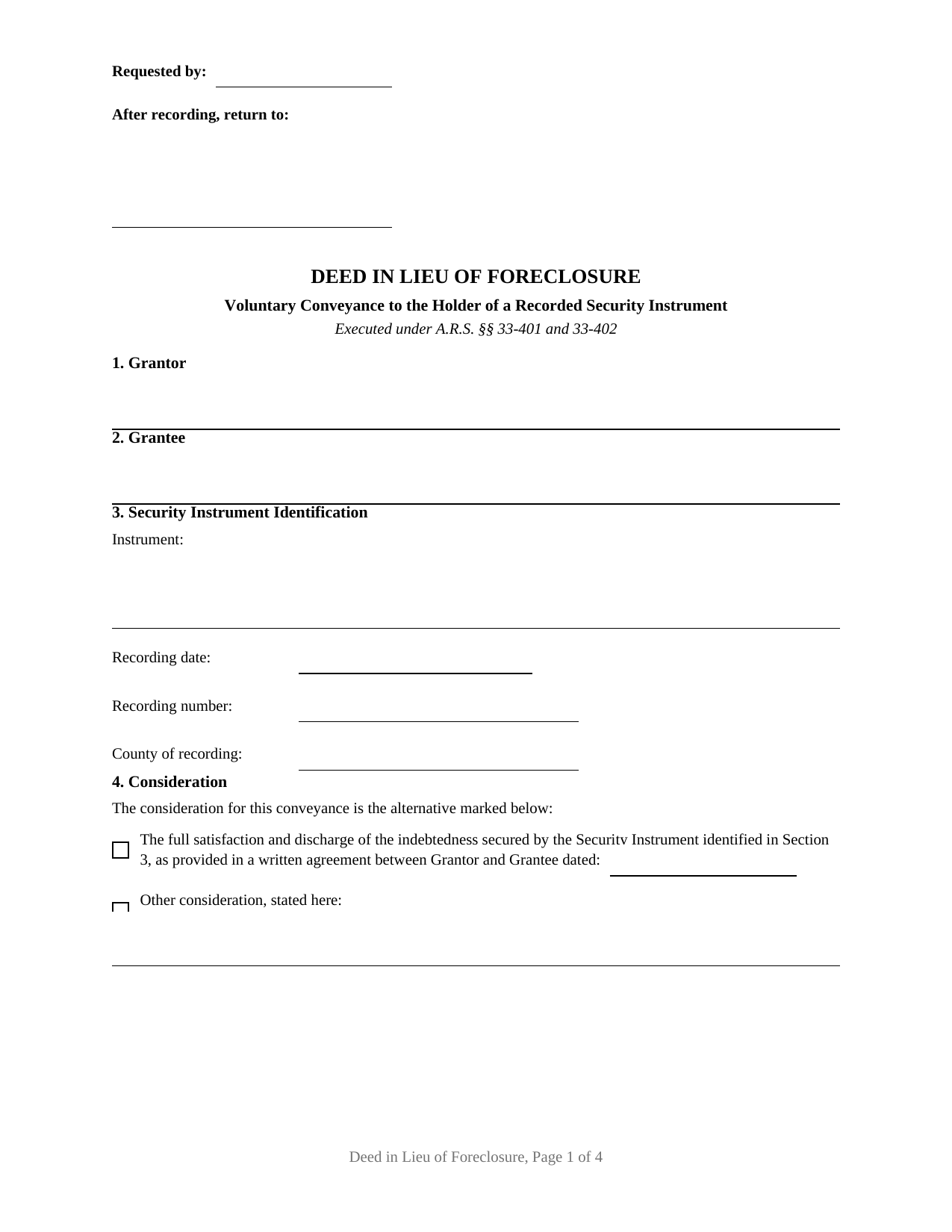
Gila County Deed in Lieu of Foreclosure Form
Fill in the blank Deed in Lieu of Foreclosure form formatted to comply with all Arizona recording and content requirements.
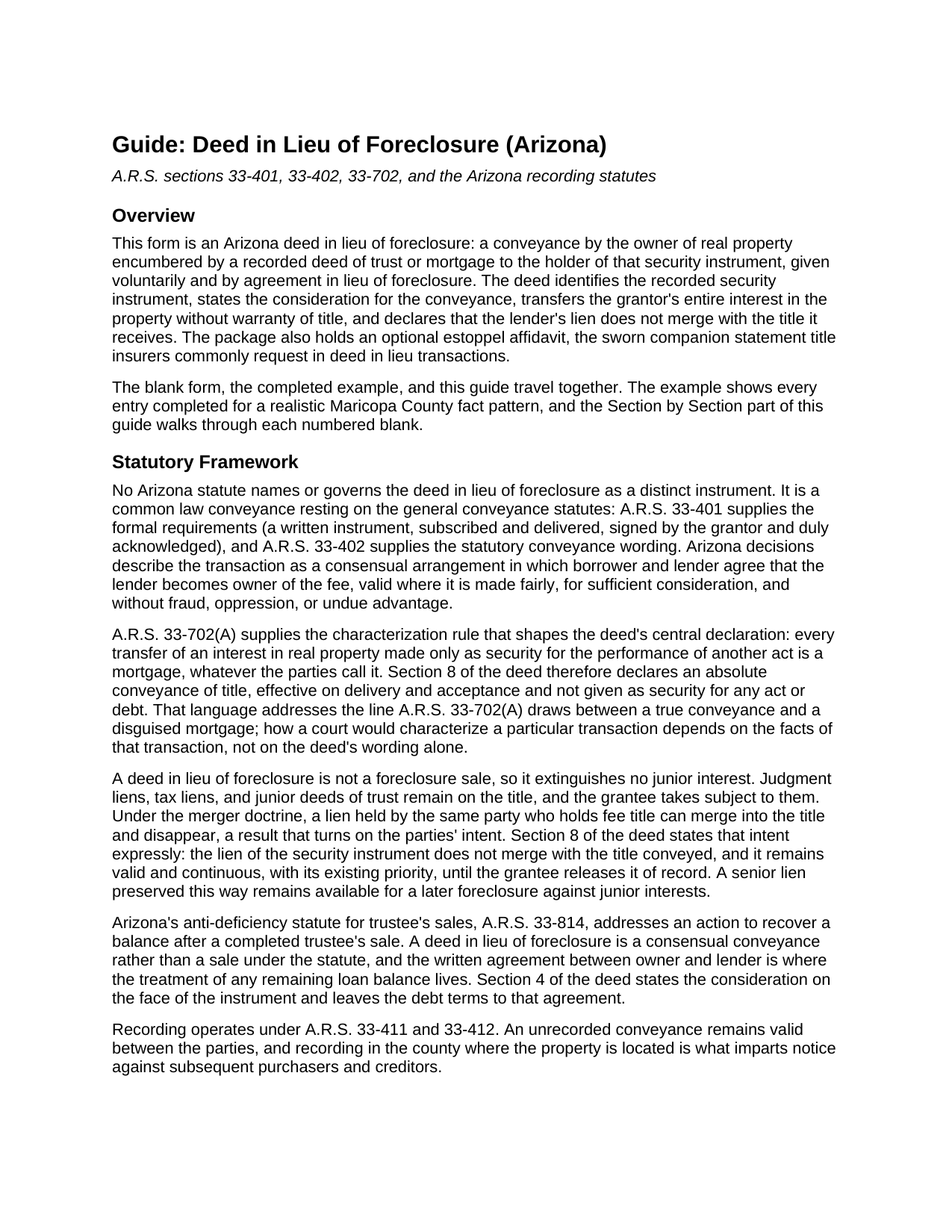
Gila County Deed in Lieu of Foreclosure Guide
Line by line guide explaining every blank on the Deed in Lieu of Foreclosure form.
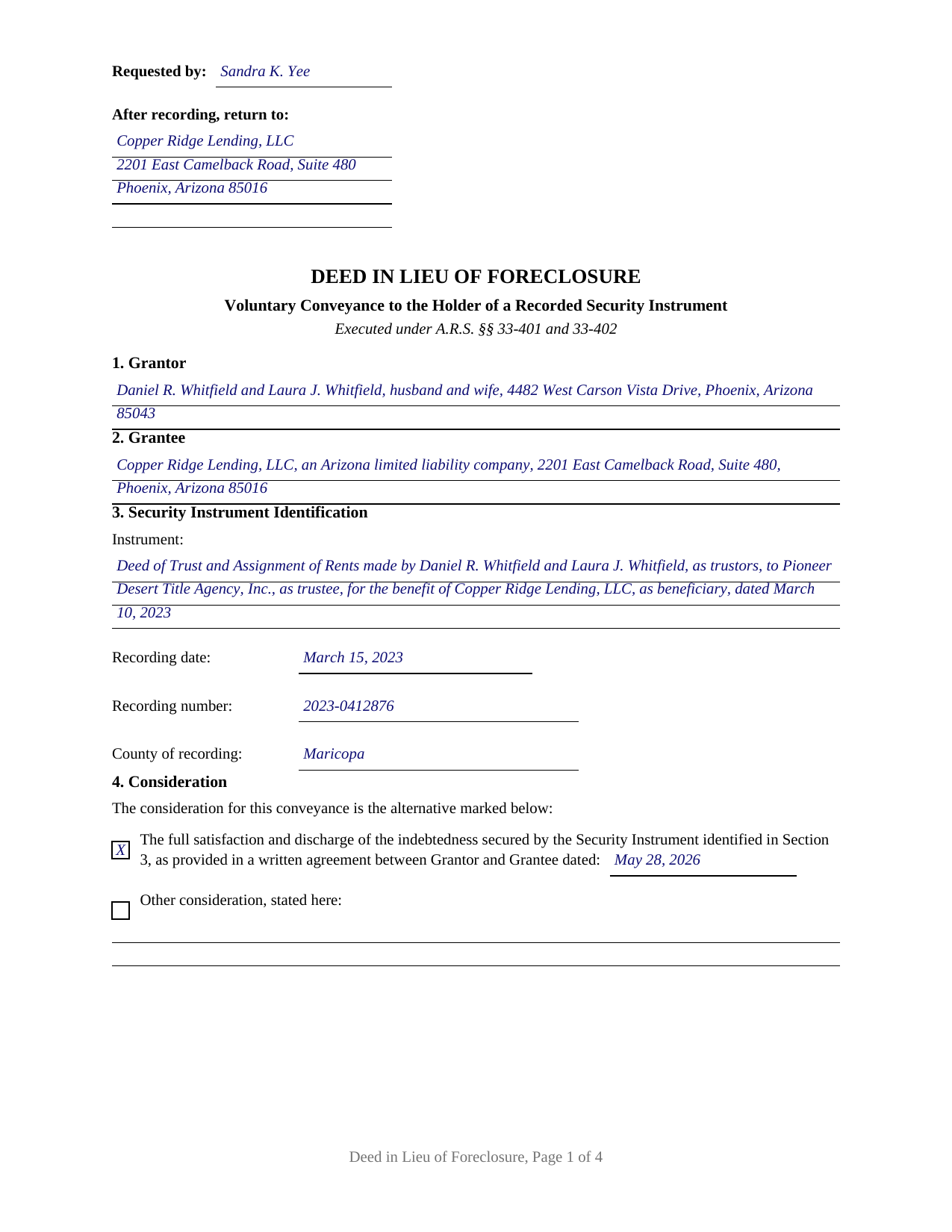
Gila County Completed Example of the Deed in Lieu of Foreclosure Document
Example of a properly completed Arizona Deed in Lieu of Foreclosure document for reference.
All 3 documents above included • One-time purchase • No recurring fees
Immediate Download • Secure Checkout
Additional Arizona and Gila County documents included at no extra charge:
Where to Record Your Documents
Recorder: Main Office
Globe, Arizona 85501
Hours: 8:00 - 5:00 Monday through Friday
Phone: 928-402-8740
Satellite Office
Payson, Arizona 85541
Hours: 8:00 - 12:00 & 1:00 - 5:00 Monday through Friday
Phone: 928-474-7198
Recording Tips for Gila County:
- Bring your driver's license or state-issued photo ID
- Ensure all signatures are in blue or black ink
- Check that your notary's commission hasn't expired
- Documents must be on 8.5 x 11 inch white paper
- Double-check legal descriptions match your existing deed
Cities and Jurisdictions in Gila County
Properties in any of these areas use Gila County forms:
- Claypool
- Globe
- Hayden
- Miami
- Payson
- Peridot
- Pine
- Roosevelt
- San Carlos
- Tonto Basin
- Winkelman
- Young
Hours, fees, requirements, and more for Gila County
How do I get my forms?
Forms are available for immediate download after payment. The Gila County forms will be in your account ready to download to your computer. An account is created for you during checkout if you don't have one. Forms are NOT emailed.
Are these forms guaranteed to be recordable in Gila County?
Yes. Our form blanks are guaranteed to meet or exceed the applicable formatting requirements used for recording in Gila County, including margin requirements, font requirements, and other layout standards. This guarantee applies to formatting, not to the legal sufficiency of information entered by the user or the suitability of a form for a particular transaction.
Can I reuse these forms?
Yes. You can reuse the forms for your personal use. For example, if you have multiple properties in Gila County you only need to order once.
What do I need to use these forms?
The forms are PDFs that you fill out on your computer. The free Adobe Acrobat Reader is recommended, and most PDF apps also work. You do NOT enter your property information online - you download the blank forms and complete them privately on your own computer.
Are there any recurring fees?
No. This is a one-time purchase. Nothing to cancel, no memberships, no recurring fees.
How much does it cost to record in Gila County?
Recording fees in Gila County vary. Contact the recorder's office at 928-402-8740 for current fees.
Questions answered? Let's get started!
An Arizona deed in lieu of foreclosure ends a defaulted loan the negotiated way: the owner conveys the property to the holder of the deed of trust or mortgage by agreement, and the trustee's sale never happens. This form prepares that conveyance for Arizona real property, with the recitals Arizona practice builds into the instrument: a voluntary, absolute conveyance, an express absence of warranty, and a non-merger clause that keeps the lender's lien alive against junior interests.
A conveyance that stands in for the foreclosure sale
Arizona has no statute creating the deed in lieu of foreclosure. Sometimes called a lieu deed or simply a voluntary conveyance to the lender, it is a common law instrument resting on the general conveyance statutes, A.R.S. 33-401 and 33-402, and on decisions describing the transaction: a consensual arrangement in which borrower and lender agree that the lender becomes owner of the fee, valid where it is made fairly, for sufficient consideration, and without fraud, oppression, or undue advantage. The form identifies the recorded security instrument by its description, recording date, recording number, and county, states the consideration for the conveyance, and transfers the grantor's entire interest in the property.
One recital does especially heavy lifting. Under A.R.S. 33-702(A), a transfer of real property made only as security for another act is a mortgage, whatever the parties call it. The deed therefore declares itself an absolute conveyance, effective on delivery and acceptance and not given as security, the statement that separates a true deed in lieu from a disguised mortgage.
Why the lien survives its own deed
A deed in lieu of foreclosure is not a foreclosure sale, so it extinguishes nothing junior: judgment liens, tax liens, and second deeds of trust ride through, and the grantee takes title subject to them. That is where the merger doctrine turns dangerous. If the lender's lien merged into the title it just received, the lender would lose the senior position that a later foreclosure needs in order to clear those junior interests. Merger turns on intent, so the deed states the intent plainly: the lien of the security instrument does not merge with the title conveyed, and it remains valid and continuous, with its existing priority, until the grantee releases it of record.
The consideration and the debt
The consideration section states the debt position on the face of the deed: fixed text reciting the full satisfaction and discharge of the secured debt as provided in the parties' written agreement, with a checkbox alternative for other consideration, and the completed example shows the full satisfaction alternative marked. Arizona's anti-deficiency statute for trustee's sales, A.R.S. 33-814, attaches to a completed sale rather than to a consensual conveyance, so the written agreement between owner and lender is where the treatment of any remaining balance lives; the deed records the consideration and leaves the debt terms to that agreement. The conveyance itself carries no warranty of title, stated expressly on the face of the deed. Married owners conveying Arizona community property both sign under A.R.S. 25-214(C)(1), and the form carries two grantor signature blocks with separate acknowledgment certificates for exactly that pattern; a sole owner signs alone and leaves the second block blank.
The sworn companion: an estoppel affidavit
The final pages of the fillable deed hold an optional estoppel affidavit, the sworn statement title insurers commonly request before insuring title taken by deed in lieu. The grantor, as affiant, swears that the deed was a free and voluntary act made without duress or misrepresentation, that it was intended as an absolute conveyance rather than security, that the consideration was fair and adequate, that no agreements exist beyond the deed and the written agreement it identifies, and that the conveyance was not made to hinder, delay, or defraud any creditor. Each affiant signs before a notary, who completes a jurat on the A.R.S. 41-265 verification on oath form. The affidavit carries its own reserved recording space and its own page numbering, so it is recorded with the deed, recorded separately, or retained in the transaction file, and its pages are simply removed where the transaction does not call for it.
Recording in Arizona
The deed is recorded with the county recorder of the county where the property is located, formatted to A.R.S. 11-480: a caption, letter size pages, 10 point print, and a two inch top margin on page one reserved for recording information. The statewide fee under A.R.S. 11-475 is $30 for an ordinary instrument, which already includes Arizona's $2 real estate transfer fee; Arizona imposes no separate deed tax. Arizona also ties recording to the Affidavit of Property Value: the recorder refuses a deed without a completed affidavit unless the deed bears an exemption notation under A.R.S. 11-1134. The exemption for a transfer made solely to provide or release security for a debt or obligation is the one that county exemption code explanations illustrate with the deed in lieu pattern, and the form carries a dedicated notation line beneath the legal description, where Department of Revenue instructions place it. An assessor's parcel number line sits with the legal description as well; A.R.S. 11-480 does not require one, but county intake staff commonly look for it, and the same number appears on the Affidavit of Property Value where one is filed. Deeds notarized on or after September 12, 2026 also pick up Arizona's new notary journal thumbprint rule, described in the guide.
The download prepares one complete package: the Arizona deed in lieu of foreclosure as a fillable PDF, a completed example showing every entry for a realistic Maricopa County fact pattern, and a plain language guide that walks through each numbered section, the signing and notarization formalities, and the recording steps. The materials are informational and are not legal advice; an Arizona attorney can address how a deed in lieu of foreclosure operates on a specific loan and title.
Important: Your property must be located in Gila County to use these forms. Documents should be recorded at the county recording office listed above.
This Deed in Lieu of Foreclosure meets all recording requirements specific to Gila County.
Our Promise
The documents you receive here are guaranteed to meet or exceed the applicable Gila County recording format requirements. If there is a rejection caused by our formatting, we will correct the issue or refund your payment. This guarantee applies to document formatting only and does not extend to information entered by the user, the selection of the form, or the legal effect of the completed document.
Save Time and Money
Get your Gila County Deed in Lieu of Foreclosure form done right the first time with Deeds.com Uniform Conveyancing Blanks. At Deeds.com, we understand that your time and money are valuable resources, and we don't want you to face a penalty fee or rejection imposed by a county recorder for submitting nonstandard documents. We constantly review and update our forms to meet rapidly changing state and county recording requirements for roughly 3,500 counties and local jurisdictions.
4.8 out of 5 - ( 4,832 Reviews )
ieva r. 5 out of 5 stars
Excellent! I was worried because I saw some negative reviews online but I really needed an e-recording company and they completed everything perfectly. I will most definitely recommend them and use them again in the future. All the staff was super nice and very helpful.
We appreciate your business and value your feedback. Thank you. Have a wonderful day!
Mercedes B. 5 out of 5 stars
Great site. It lets your fingers do the walking. It took me half a day to get deed info a couple of years ago. Thanks Deeds.com
Thank you for your feedback. We really appreciate it. Have a great day!
Gladys B. 5 out of 5 stars
Good and fast service. Thank you.
Thank you for your feedback. We really appreciate it. Have a great day!
Susan M. 5 out of 5 stars
It was easy to use and clear directions.
Thank you!
Norbert C. 5 out of 5 stars
Great resource and everything went smoothly except email was performed through autofill prompted by the system but the autofill added a letter that gave wrong email. I can still sign in with wrong email since the system recognizes it as mine even though it is wrong. May be my fault and not the system since I did not catch the discrepancy in time. I would suggest a field that allows a correction to any misinformation prior to signing out from the initial sign on. Still think it is a great resource if all documents are processed and accepted by the pwers to be. Thanks.
Thank you!
Terry W. 5 out of 5 stars
Loved it no recurring fees easy to use your app
Thank you!
Anita C. 5 out of 5 stars
I found this site when looking for help filing a quitclaim deed to change my property deed to my married name. I received the correct forms, an example filled out, and a guide specific to my state. I have already submitted it for review to my county assessor's office (they were extremely helpful also) and it looks as if it should sail through. Thank you Deeds.com!
Thank you for your feedback. We really appreciate it. Have a great day!
Bill M. 4 out of 5 stars
PROS: Quick communication. Completed the task expediently. CONS: Deciphering what was being referred to on the website when needing the proper classification wasn't clear. Had to delve through your unfamiliar territory. But managed. OVERALL: Got the job done swiftly and the end result was satisfactory. Will use again.
Thank you!
Teri B. 5 out of 5 stars
Glad to have all of the helpful extra information, even though they don't answer all questions for all situations. So, I accessed public records and asked questions at the auditor's office. Also, on my Mac computer, filling out the actual deed form is a challenge because the screen jumps to the last page everytime I try to type a few letters or hit the return key, so I'm rollling back up to the first 2 pages after most keystrokes. A bit annoying. Overall, happy to have these form options are available! There is really no need to wait and pay for an attorney when all the information needed is available via public records. Fill in the blanks!
Thanks so much for the feedback Teri. There are known issues between Adobe and Mac, we try to work around them as much as possible. Have a wonderful day!
karen w. 5 out of 5 stars
outstanding forms and information. stay safe and healthy everyone.
Thank you Karen, you do the same please.
Roderick S. 2 out of 5 stars
It all started out well, then I was abruptly told that I would have to submit the documents directly to the recording office. No explanation was offered and I wasted a lot of time on your website for nothing. Very disappointing, as the concept of e-recording is what is needed in 2026.
We reviewed your order and our support messages. The document uploaded for recording was a very low-quality scan that did not meet the county’s eRecording image requirements. Our staff asked that a clearer scan be uploaded, but the same image was submitted again.
Because the document could not be processed electronically, we advised recording it directly with the county recorder’s office.
E-recording systems require clear, legible document images that meet county standards. When those requirements cannot be met, recording directly with the recorder is often the fastest option.
Kay G. 5 out of 5 stars
Found just the form I was looking for. It was an easy download process. Now just have to complete the forms!
Thank you for your feedback Kay, we really appreciate it.
Elizabeth S. 5 out of 5 stars
Easy to download. I like the fact that it gives me an example of how to fill it out and also the instructions. Thank you so much.
Thank you for your feedback. We really appreciate it. Have a great day!
ian a. 3 out of 5 stars
Your website advertising was somewhat deceptive regarding doing a quitclaim on a name change. "If you are transferring the property to yourself under your new name, all you have to do is update the deed from your former name to your current one." This made this sound easy. But when I downloaded the material for my state, expecting to find an example, there was no example of how to do a name change quitclaim deed! I therefore had to figure this out myself. You might have provided a warning about certain uses that were not covered in the material so that people know ahead of time that the use they needed to know about wasn't covered in the material.
Thank you for your feedback. We really appreciate it. Have a great day!
Ronald W. 5 out of 5 stars
User friendly, but couldn't find the information needed.
Thank you for your feedback. We really appreciate it. Have a great day!