Yuma County Easement Deed Form
Last validated September 28, 2026 by our Forms Development TeamFormatted for recording in Yuma County, for property anywhere in the county: rural and unincorporated areas as well as Dateland, Gadsden, Roll, San Luis, Somerton, Tacna, Wellton, Yuma.
- 4 documents included
- Immediate PDF download
- Formatting guarantee
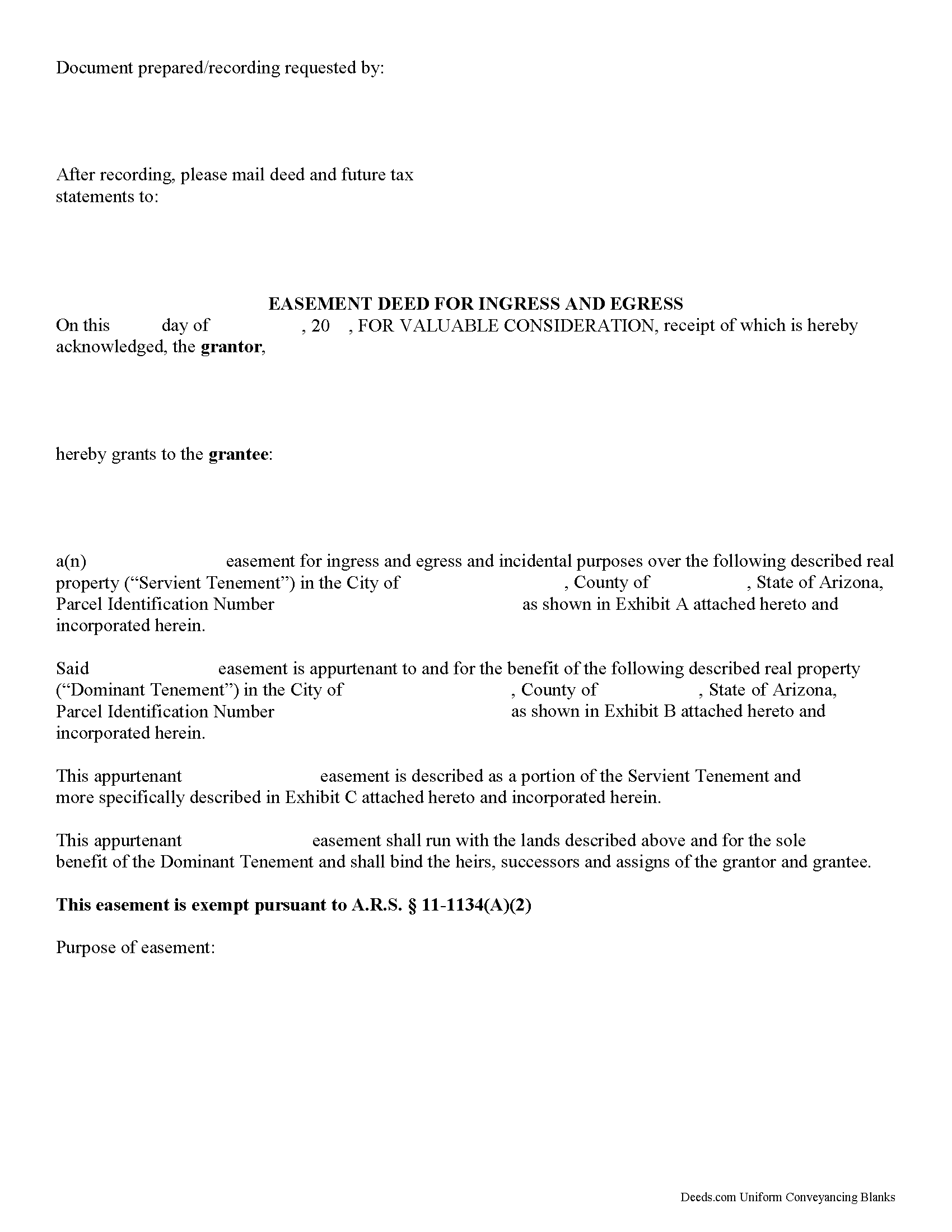
Yuma County Easement Deed Form
Fill in the blank form formatted to comply with all recording and content requirements.
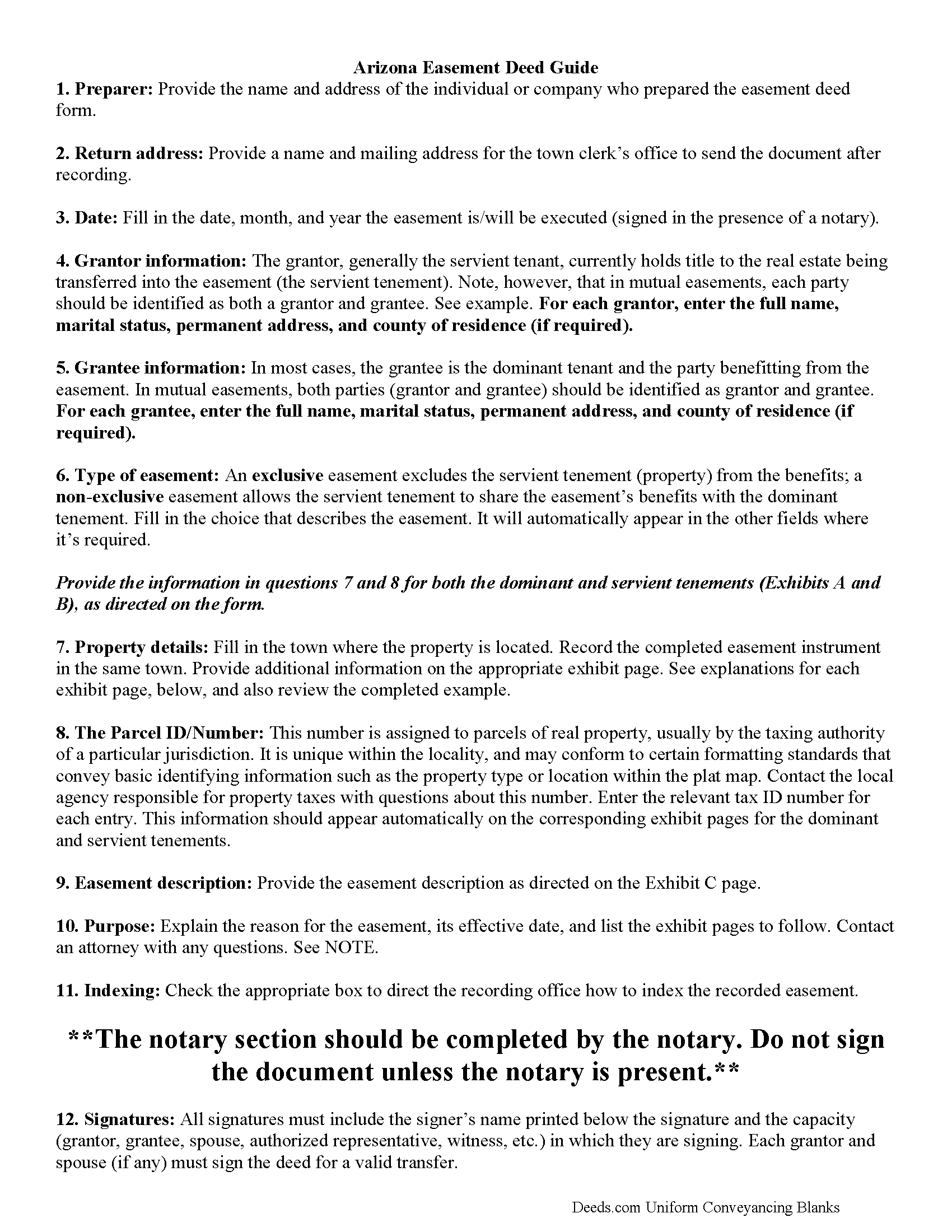
Yuma County Easement Deed Guide
Line by line guide explaining every blank on the form.
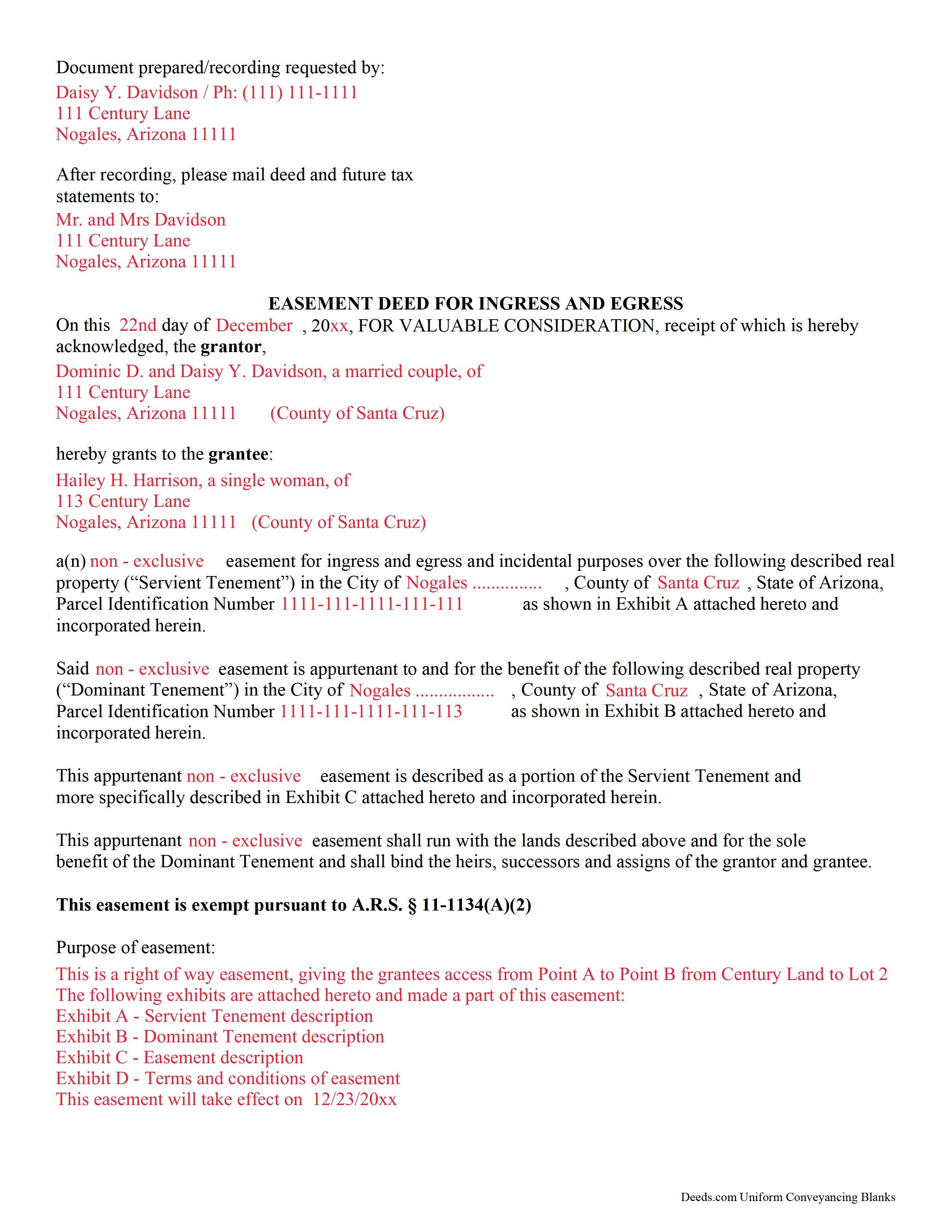
Yuma County Completed Example of the Easement Deed Document
Example of a properly completed form for reference.
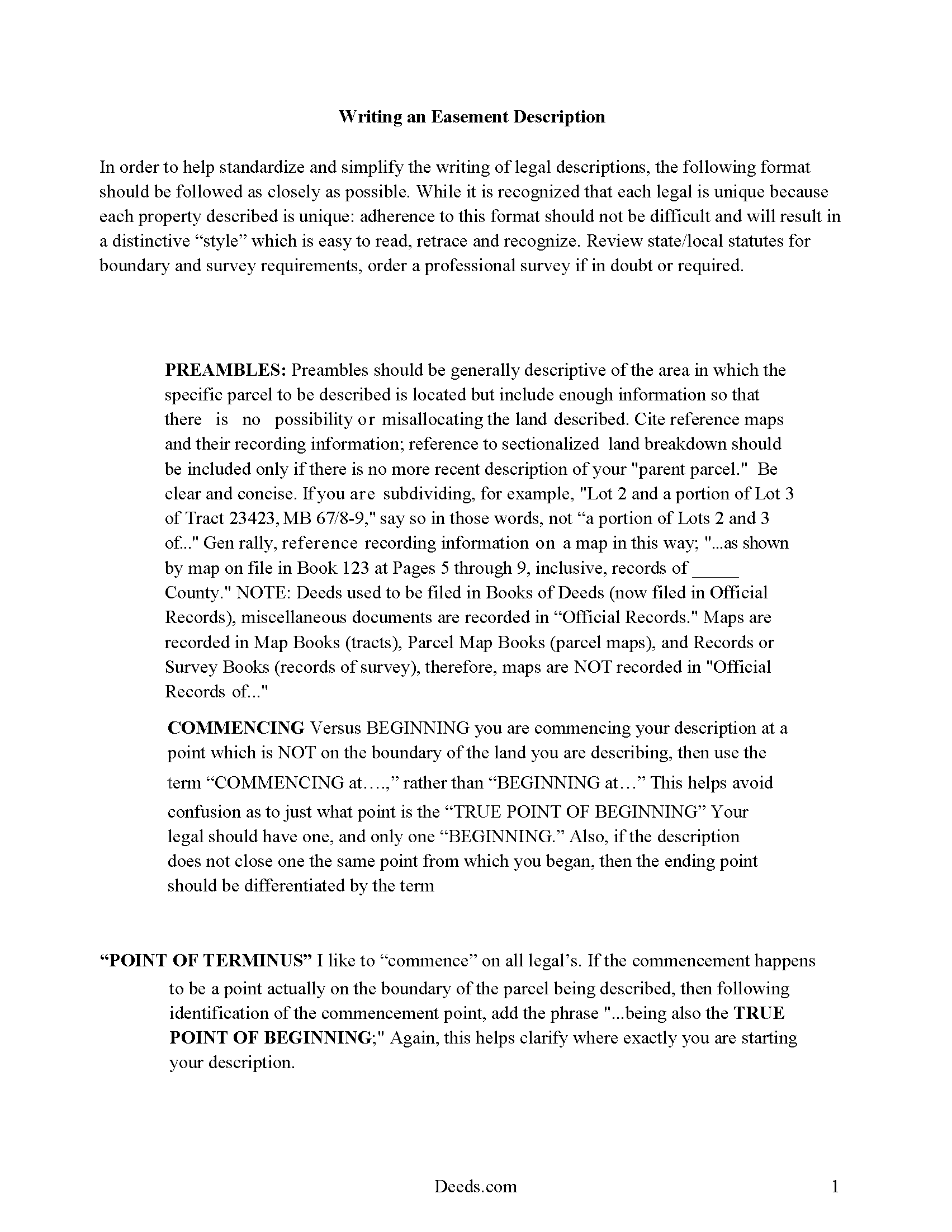
Yuma County Guide to Writing an Easement Description
A Description of the Easement will be required, apply this guide to write an acceptable description of an easement/right of way, which gives access, to and from - point A to point B.
All 4 documents above included • One-time purchase • No recurring fees
Immediate Download • Secure Checkout
Additional Arizona and Yuma County documents included at no extra charge:
Where to Record Your Documents
Recorder's Office
Yuma, Arizona 85364-2311
Hours: 8:00am - 5:00pm M-F
Phone: 928-373-6020
Recording Tips for Yuma County:
- Bring your driver's license or state-issued photo ID
- Ensure all signatures are in blue or black ink
- Both spouses typically need to sign if property is jointly owned
- Bring extra funds - fees can vary by document type and page count
- Check margin requirements - usually 1-2 inches at top
Cities and Jurisdictions in Yuma County
Properties in any of these areas use Yuma County forms:
- Dateland
- Gadsden
- Roll
- San Luis
- Somerton
- Tacna
- Wellton
- Yuma
Hours, fees, requirements, and more for Yuma County
How do I get my forms?
Forms are available for immediate download after payment. The Yuma County forms will be in your account ready to download to your computer. An account is created for you during checkout if you don't have one. Forms are NOT emailed.
Are these forms guaranteed to be recordable in Yuma County?
Yes. Our form blanks are guaranteed to meet or exceed the applicable formatting requirements used for recording in Yuma County, including margin requirements, font requirements, and other layout standards. This guarantee applies to formatting, not to the legal sufficiency of information entered by the user or the suitability of a form for a particular transaction.
Can I reuse these forms?
Yes. You can reuse the forms for your personal use. For example, if you have multiple properties in Yuma County you only need to order once.
What do I need to use these forms?
The forms are PDFs that you fill out on your computer. The free Adobe Acrobat Reader is recommended, and most PDF apps also work. You do NOT enter your property information online - you download the blank forms and complete them privately on your own computer.
Are there any recurring fees?
No. This is a one-time purchase. Nothing to cancel, no memberships, no recurring fees.
How much does it cost to record in Yuma County?
Recording fees in Yuma County vary. Contact the recorder's office at 928-373-6020 for current fees.
Questions answered? Let's get started!
The Arizona Easement Deed creates a non-possessory interest in real property using the same conveyance formalities Arizona applies to full transfers of title. Because an easement is a property interest, not a contract, it has to be in writing, signed by the owner of the burdened land, acknowledged, and recorded in the county where the property sits — otherwise later purchasers without notice can take free of it. Arizona is also one of the states that has codified the Uniform Conservation Easement Act at ARS 33-271 et seq., which gives the state a distinct statutory framework for perpetual conservation, historical, and archaeological easements on top of the usual rules for access, utility, and right-of-way easements.
When the Arizona Easement Deed Is Used
Easements come in several forms, and Arizona law recognizes each. Right-of-way easements give one party the right to cross another's land, typically for ingress and egress to a landlocked or interior parcel. Utility easements permit the installation and maintenance of power, water, gas, telecommunications, or sewer infrastructure across a property. Affirmative easements authorize the holder to do something on the burdened land — run a road, pipe water, graze livestock. Conservation easements under ARS 33-271 go the other direction: they impose limitations or affirmative obligations on the landowner to preserve natural, historical, architectural, archaeological, or cultural features of the property. Whichever type is being created, the deed is the instrument that does it, and the type of easement must be identified in the first paragraph of the document so the nature of the interest is apparent from the face of the deed.
Conservation Easements Under ARS 33-271
Arizona's Conservation Easement Act imposes a specific framework that does not apply to ordinary easements. A conservation easement is a non-possessory interest held by a qualifying holder — typically a governmental body or a charitable corporation or trust whose purposes include conservation or historic preservation — that restricts what the landowner may do with the property in order to protect open space, agricultural use, wildlife habitat, historical or archaeological resources, or similar values. The statute governs who may hold the easement, how it may be created and released, and how it interacts with other property interests. Conservation easements are typically granted in perpetuity, which has meaningful consequences for both the grantor (who is permanently restricting the use of the land) and for the grantor's tax position (a qualifying grant may support a federal income tax deduction). Any conservation easement should be drafted with the specific restrictions, reserved rights, and termination provisions clearly spelled out; the standard easement form used for a right-of-way is not the right starting point.
Appurtenant Versus In Gross; Identifying Dominant and Servient Estates
Arizona recognizes both easements appurtenant and easements in gross. An appurtenant easement benefits a particular parcel of land — the "dominant estate" — and burdens another parcel — the "servient estate." Appurtenant easements run with the land and pass automatically to subsequent owners of the dominant estate, without needing to be re-granted. A private access easement between neighboring parcels is the classic example. An easement in gross benefits a person or entity rather than a parcel; utility easements are typically in gross, held by the utility company itself rather than attached to a specific piece of land. The distinction matters because it dictates how the easement passes on a later sale, who can enforce it, and whether it can be transferred independently of any particular property. The deed should state clearly whether the easement is appurtenant or in gross, and if appurtenant, it should identify the dominant estate as well as the servient estate.
Legal Description Requirements
An easement deed requires two legal descriptions, not one. The first describes the servient estate — the parcel being burdened — with the same specificity required for any other conveyance of an Arizona parcel: a recorded subdivision lot and block reference, a metes-and-bounds description, or a reference to a recorded survey. The second describes the easement area itself — the specific portion of the servient estate where the easement runs. A utility easement typically describes a strip of defined width along a property line; an access easement typically describes a specific driveway corridor by width and centerline or by metes and bounds. An easement deed that describes only the servient parcel without delineating the easement area is the most common drafting failure and is frequently challenged on the ground that the burdened area is not reasonably certain. Complex easement areas are often shown on an exhibit survey attached to and referenced in the deed.
The deed should also state the purpose of the easement, any restrictions on its use, and any maintenance obligations as between the dominant and servient owners. Absent express provisions, Arizona courts will imply reasonable-use and shared-maintenance rules, but express language is materially more enforceable and avoids litigation over unstated assumptions.
Community Property and Spousal Joinder
Arizona is a community property state, and granting an easement is a conveyance of a real property interest under ARS 25-211. When the servient estate is community property, both spouses must sign the easement deed; a grant by one spouse alone is voidable by the other. When title is held by one spouse as separate property, the separate owner can grant the easement alone, but the marital status of the grantor still belongs in the conveyancing clause so the record establishes the basis for the solo signature.
Execution and Acknowledgment
Under ARS 33-401, a conveyance of real property — which includes the grant of an easement — must be in writing, subscribed by the grantor, and acknowledged before a notary public or other officer authorized to take acknowledgments. Arizona does not require subscribing witnesses. Acknowledgments taken outside Arizona must comply with ARS 33-501. The grantee typically does not sign an easement deed, because the deed is a one-way conveyance of an interest from the landowner; when the easement imposes affirmative obligations on the grantee (maintenance, restoration, shared access rules), the deed may be structured with a grantee acknowledgment or a separate agreement to bind the grantee to those terms.
Affidavit of Property Value and Exemption
Arizona requires an Affidavit of Property Value to accompany most instruments transferring an interest in real property (ARS 11-1133), and by its terms the requirement reaches easement conveyances. The practical answer in most transactions is that the easement qualifies for an exemption under ARS 11-1134 — easements granted without consideration, easements between related parties, easements to utilities, and several other categories — and the exemption must be claimed on the face of the deed with a statement and citation to the specific subsection below the legal description. Easement deeds that omit the exemption recital are frequently rejected at the recorder's window, even when the easement unquestionably qualifies. When an easement is granted for meaningful consideration in an arm's-length transaction, the affidavit itself is required.
Formatting, Recording, and Priority
ARS 11-480 sets the formatting requirements that apply to every recordable instrument: ten-point or larger legible type, white paper no larger than 8.5 by 14 inches, a caption identifying the document (for example, "Easement Deed" or "Grant of Conservation Easement"), a top margin of at least two inches on the first page reserved for the recorder's stamp, and half-inch minimums elsewhere. Counties reject non-conforming documents, and several enforce the first-page margin rule strictly.
Record the easement deed in the county where the servient property is located. Recording provides constructive notice to subsequent purchasers and encumbrance holders for value without notice (ARS 33-411), and Arizona's race-notice rule at ARS 33-412 makes an unrecorded easement void as against a later purchaser for value who records first without notice. This is a particularly important point for easements: an unrecorded easement between neighbors can be cut off entirely when the servient parcel sells to a new owner who had no actual knowledge of it, leaving the holder with no way to reach the land they thought they had rights in. Record promptly.
What's Included in the Download Package
The Arizona Easement Deed package includes the deed form drafted to satisfy ARS 33-401 conveyance requirements and to accommodate appurtenant, in gross, access, utility, and conservation easement structures, detailed guidelines covering the Arizona-specific drafting and recording requirements, and a completed example showing how the form should look for a typical easement grant. All files are available for instant download after purchase.
Important: Your property must be located in Yuma County to use these forms. Documents should be recorded at the county recording office listed above.
This Easement Deed meets all recording requirements specific to Yuma County.
Our Promise
The documents you receive here are guaranteed to meet or exceed the applicable Yuma County recording format requirements. If there is a rejection caused by our formatting, we will correct the issue or refund your payment. This guarantee applies to document formatting only and does not extend to information entered by the user, the selection of the form, or the legal effect of the completed document.
Save Time and Money
Get your Yuma County Easement Deed form done right the first time with Deeds.com Uniform Conveyancing Blanks. At Deeds.com, we understand that your time and money are valuable resources, and we don't want you to face a penalty fee or rejection imposed by a county recorder for submitting nonstandard documents. We constantly review and update our forms to meet rapidly changing state and county recording requirements for roughly 3,500 counties and local jurisdictions.
4.8 out of 5 - ( 4,815 Reviews )
Clarence O. 5 out of 5 stars
Very easy process to record a Quit Claim Deed. Would definitely recommend!
Thank you!
Dennis B. 5 out of 5 stars
It was easy to download the necessary "Death of Joint Tenant" forms. These easy to use interactive forms are made to comply with the laws specific to your state.
Thank you!
Kevin C. 3 out of 5 stars
Nice site but $30 to download a blank form is a bit much.
Thank you for your feedback. We really appreciate it. Have a great day!
Lisa A. 5 out of 5 stars
I am so thankful for the time saved by using Deeds.com. Not having to run downtown and stand in line is awesome!
We are delighted to have been of service. Thank you for the positive review!
John H. 1 out of 5 stars
Re: Idaho Affidavit of Successor: Decedent's residence may be a state other than Idaho. Death certificate documnet# field is too small.
Thank you for your feedback. We have emailed you an amended document to address your specific needs outlined in your feedback, hope this helps. Have a wonderful day.
Robert M. 1 out of 5 stars
Ultimately, it directed me to the wrong form. Not very helpful. I had to turn to a title company to get my issue addressed.
Our website makes documents available to you. It does not direct you as to which one to use. We are glad that you sought the assistance it sounds like you needed. Have a wonderful day
COURTNEY K. 5 out of 5 stars
I could not be happier with this service! It was so easy and fast!
Thank you!
Sheila P. 5 out of 5 stars
What a great service to provide with excellent directions! At first I thought I would need an attorney, but I walked through the steps and now I have it finished! Saved a ton of money. Thanks Deed.com.
Thank you for your feedback. We really appreciate it. Have a great day!
Christine W. 5 out of 5 stars
excellent
Thank you!
Rebecca Q. 5 out of 5 stars
Very helpful! Unfortunately, they didn't have what I needed, but they got back to me quickly and didn't charge me anything. Easy to work with.
Thank you for your feedback. We really appreciate it. Have a great day!
Thomas B. 5 out of 5 stars
My deeds were filed with Pinellas County Florida with a simple process and with no problems. 5 star for sure.
We appreciate your business and value your feedback. Thank you. Have a wonderful day!
Rhonda L. 5 out of 5 stars
This was one of the most simple but efficient process. Walked me thru every step. Total process was less than 2 weeks.
Thank you!
George S. 4 out of 5 stars
Very good, very expensive. I hope that this is what my lawyer needed for us to finish our wills. George
Thank you!
Ricardo C. 5 out of 5 stars
I was pleased with the process. Easy and secure. Great customer service. I will use again for sure
Thank you!
Fritz C. 5 out of 5 stars
Quick and complete info
Thank you!