Yuma County Lis Pendens Form
Last validated October 14, 2026 by our Forms Development TeamFormatted for recording in Yuma County, for property anywhere in the county: rural and unincorporated areas as well as Dateland, Gadsden, Roll, San Luis, Somerton, Tacna, Wellton, Yuma.
- 3 documents included
- Immediate PDF download
- Formatting guarantee
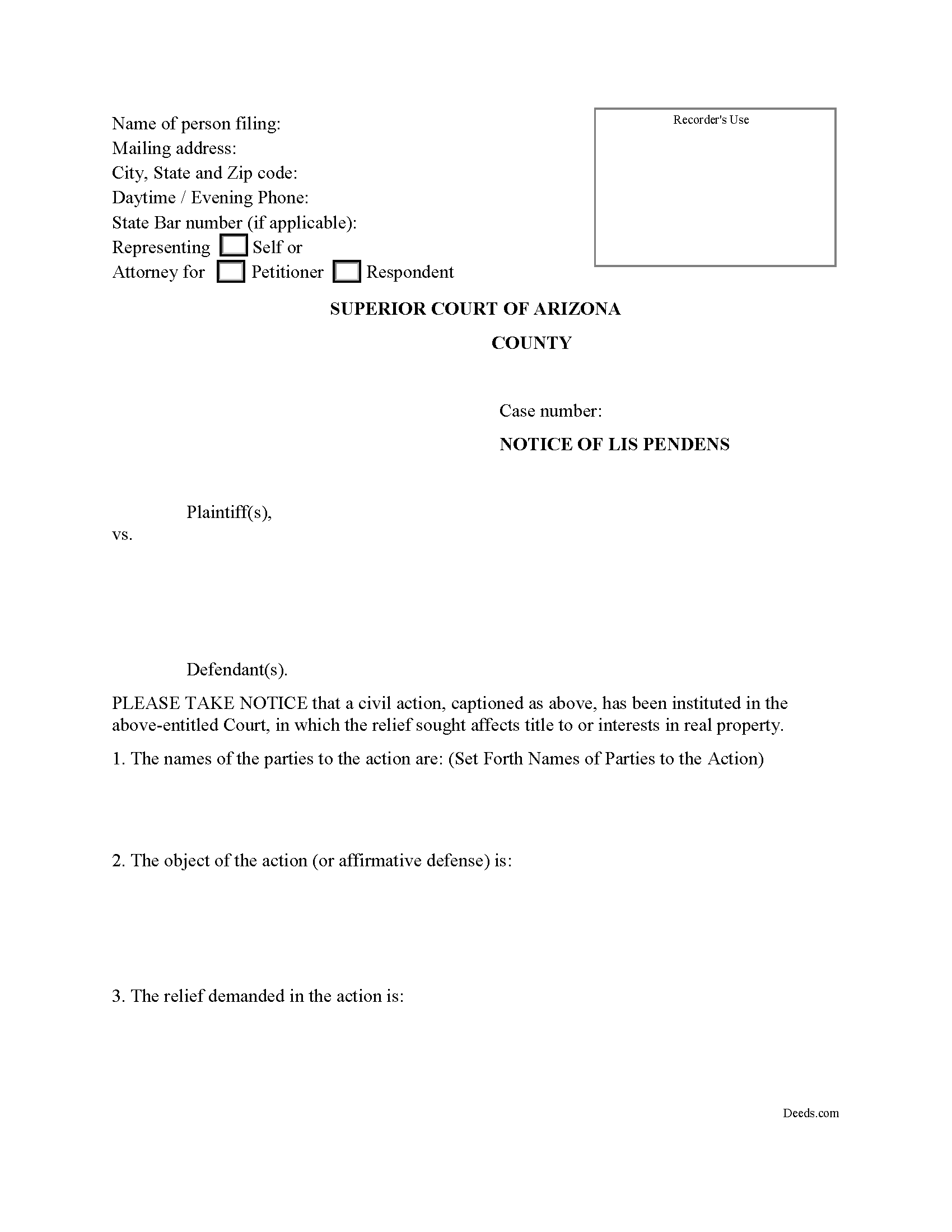
Yuma County Lis Pendens Form
Fill in the blank form formatted to comply with all recording and content requirements.
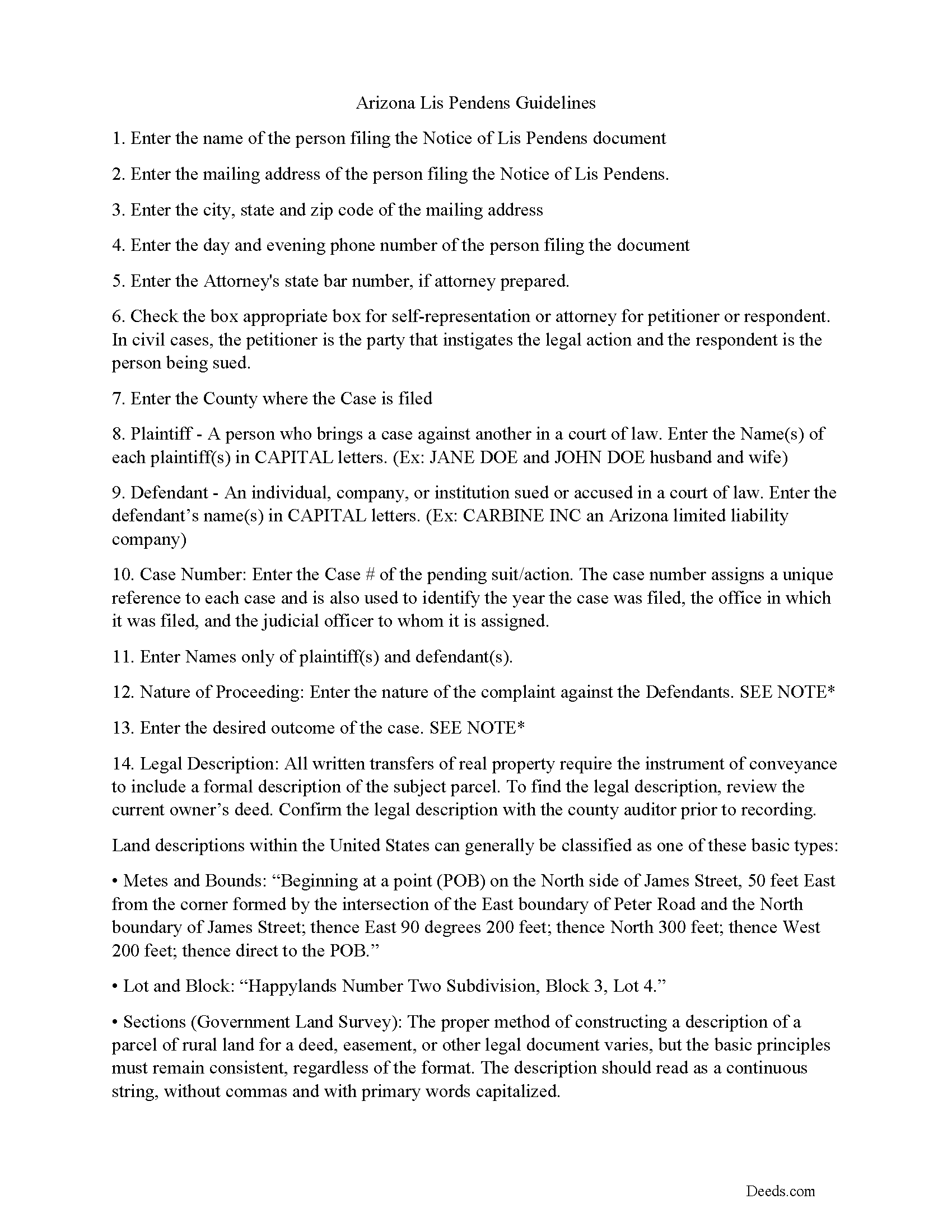
Yuma County Lis Pendens Guide
Line by line guide explaining every blank on the form.
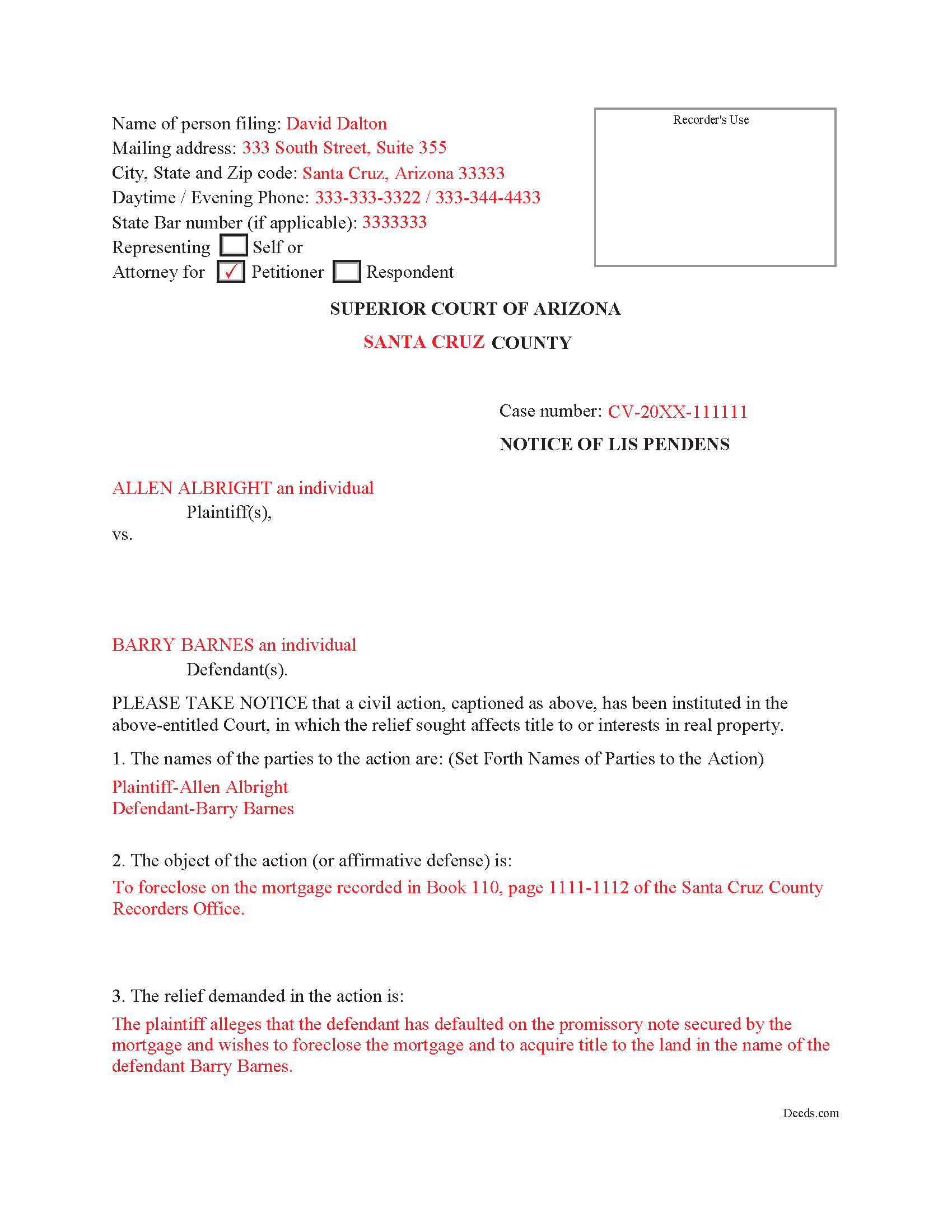
Yuma County Completed Example of the Lis Pendens Document
Example of a properly completed form for reference.
All 3 documents above included • One-time purchase • No recurring fees
Immediate Download • Secure Checkout
Additional Arizona and Yuma County documents included at no extra charge:
Where to Record Your Documents
Recorder's Office
Yuma, Arizona 85364-2311
Hours: 8:00am - 5:00pm M-F
Phone: 928-373-6020
Recording Tips for Yuma County:
- Bring your driver's license or state-issued photo ID
- Ensure all signatures are in blue or black ink
- Verify all names are spelled correctly before recording
- White-out or correction fluid may cause rejection
- Ask about their eRecording option for future transactions
Cities and Jurisdictions in Yuma County
Properties in any of these areas use Yuma County forms:
- Dateland
- Gadsden
- Roll
- San Luis
- Somerton
- Tacna
- Wellton
- Yuma
Hours, fees, requirements, and more for Yuma County
How do I get my forms?
Forms are available for immediate download after payment. The Yuma County forms will be in your account ready to download to your computer. An account is created for you during checkout if you don't have one. Forms are NOT emailed.
Are these forms guaranteed to be recordable in Yuma County?
Yes. Our form blanks are guaranteed to meet or exceed the applicable formatting requirements used for recording in Yuma County, including margin requirements, font requirements, and other layout standards. This guarantee applies to formatting, not to the legal sufficiency of information entered by the user or the suitability of a form for a particular transaction.
Can I reuse these forms?
Yes. You can reuse the forms for your personal use. For example, if you have multiple properties in Yuma County you only need to order once.
What do I need to use these forms?
The forms are PDFs that you fill out on your computer. The free Adobe Acrobat Reader is recommended, and most PDF apps also work. You do NOT enter your property information online - you download the blank forms and complete them privately on your own computer.
Are there any recurring fees?
No. This is a one-time purchase. Nothing to cancel, no memberships, no recurring fees.
How much does it cost to record in Yuma County?
Recording fees in Yuma County vary. Contact the recorder's office at 928-373-6020 for current fees.
Questions answered? Let's get started!
The Arizona Lis Pendens is the recorded notice that alerts the public to a pending lawsuit affecting title to real property. The term translates from Latin as "suit pending," and the instrument's legal function is exactly that — giving constructive notice to any potential buyer, lender, or other party that the described property is the subject of active litigation and any interest they acquire will be bound by whatever the court eventually decides. Arizona's statute at ARS 12-1191 authorizes the notice, and the state's race-notice recording framework at ARS 33-412 gives it teeth: a buyer who takes property with a recorded lis pendens on it cannot claim bona fide purchaser status against the outcome of the underlying lawsuit. That power is also the source of the instrument's danger — a wrongfully filed lis pendens clouds title, prevents sales, and exposes the filer to significant liability under ARS 33-420 when the filing is groundless.
When the Arizona Lis Pendens Is Used
A lis pendens is appropriate only when a pending lawsuit actually seeks relief affecting title to real property. Proper uses include quiet title actions under ARS 12-1101 et seq. (where the plaintiff is asking the court to adjudicate ownership of a parcel), partition actions among co-owners seeking division or sale of jointly-held property, specific performance actions to enforce a real estate purchase contract, actions to reform or rescind a deed, foreclosure actions (whether judicial foreclosure of a mortgage or actions related to a deed of trust dispute), actions to impose or enforce a constructive trust on real property, claims of easement or prescriptive easement rights, boundary dispute actions to establish or relocate property lines, and divorce proceedings where one spouse claims a community property interest in real estate titled solely in the other spouse's name. In each of these cases, the outcome of the lawsuit will directly affect who owns what interest in the described property, and the notice to the world preserves the claimant's ability to obtain meaningful relief.
When a Lis Pendens Is Not Appropriate
The critical negative rule is that a lis pendens is not appropriate for any lawsuit that does not directly affect title to the described property, even when the lawsuit relates to the property in some broader sense. A personal injury claim arising from an accident on someone's property does not affect title. A breach of contract claim seeking money damages, even when the contract involved the property in some way, does not affect title. A nuisance claim seeking injunctive relief against the use of adjacent property does not affect title. Mechanic's liens — which are recorded separately under ARS 33-981 et seq. rather than through a lis pendens — do not themselves support a lis pendens filing; only after the lienholder brings a foreclosure action on the lien does a lis pendens for that action become appropriate. Eviction proceedings under landlord-tenant law do not affect title and do not support a lis pendens.
This limitation matters because recording a lis pendens on a property when the underlying lawsuit does not actually affect title is itself actionable. ARS 33-420 creates a cause of action against persons who record groundless documents asserting claims against real property, with statutory damages of five thousand dollars or three times actual damages (whichever is greater), plus attorneys' fees. A lis pendens filed on a claim that does not involve title — even when the filer thought the filing was justified — can trigger this liability. Filers should confirm with counsel that the underlying action genuinely seeks relief affecting title before recording the notice.
Effect of the Recorded Notice
Once recorded, the lis pendens puts the world on constructive notice of the pending litigation. Anyone acquiring an interest in the property after the recording — a buyer, a lender, a tenant, a judgment creditor — takes subject to the outcome of the lawsuit. If the plaintiff prevails and obtains a judgment affecting title, that judgment binds the intervening transferee, even though the transferee was not a party to the lawsuit. If the plaintiff loses, the lis pendens is released and the property title is unaffected. The effect is to freeze the property's title status from the perspective of potential purchasers while the lawsuit runs its course.
The practical consequence for the property owner is that the property becomes very difficult to sell or refinance while the lis pendens is on the record. Title insurers will refuse to issue policies without exceptions for the recorded notice, which makes the property unmarketable in the ordinary sense. Lenders will not fund loans secured by the property until the notice is cleared. Potential buyers who learn of the litigation typically walk away rather than inherit the risk. This paralysis is the intended effect — it protects the plaintiff's ability to obtain meaningful relief by preventing the defendant from conveying the property to a third party who might then claim bona fide purchaser status — but it also means the recording has serious real-world consequences for the property owner.
Divorce and Community Property Claims
One particularly common Arizona application is in divorce proceedings where one spouse has a community property claim to real estate titled solely in the other spouse's name. Arizona is a community property state, and property acquired during marriage is presumptively community regardless of how title is held (ARS 25-211). A spouse who fears the titled spouse may sell the marital home or other community real estate before the divorce is finalized can record a lis pendens on the divorce action to prevent such a sale. The lis pendens puts potential buyers on notice that the title is subject to the dissolution proceeding, and the community property claim can be pursued against the property itself through the divorce court's division of assets. This is a legitimate use of the instrument, and it appears frequently in contested dissolutions.
The divorce use does require care: the underlying divorce must actually involve a claim affecting title to the specific property. A general divorce proceeding that does not specifically put the property at issue may not support a lis pendens; an amended petition or separate claim specifically addressing the property may be needed. Family law counsel handling a contested dissolution should evaluate whether the pleadings support recording a lis pendens before doing so.
Contents of the Notice
A lis pendens should contain specific information linking the notice to the underlying lawsuit and the specific property affected. Content typically includes the court in which the action is pending (superior court of the county where the property is located, or another court if appropriate), the case number and caption of the pending action, the names of the plaintiffs and defendants, a description of the nature of the action and the relief sought (particularly the specific claim affecting title), the legal description of the property affected by the action, and the date the action was filed or is being prosecuted. The filer signs the notice, which is then recorded with the county recorder.
The legal description should match the description on the current vested deed, and the connection between the lawsuit's claims and the described property should be clear on the face of the notice. A lis pendens that describes property in a way that does not match the property actually at issue in the lawsuit can create its own problems — both by failing to give proper notice and by clouding title to property the lawsuit does not really concern.
Who Signs and Files
The lis pendens is typically signed and filed by the plaintiff in the underlying lawsuit or by the plaintiff's attorney. Some Arizona practice allows the attorney's signature alone; other filings include the plaintiff's verified statement about the pending action. The filer must have a good-faith basis for the underlying claim affecting title — this is not a matter of strict pleading standards but of avoiding the ARS 33-420 groundless-document liability. When the plaintiff is a business entity, a trust, or a governmental body, the filing is made through appropriate representatives with proper authority. The defendant in the lawsuit does not typically file the lis pendens; the defendant's remedy against a groundless filing is to seek its removal and to pursue damages under the statute.
Release and Removal
A lis pendens remains on the record until it is affirmatively released or removed. Release can occur voluntarily when the underlying lawsuit settles or when the plaintiff otherwise determines that the notice is no longer necessary — the plaintiff signs and records a release of lis pendens. Release also occurs by court order when the defendant successfully challenges the notice (by motion to quash, motion to expunge, or similar procedural vehicle), and the court orders the release as part of the ruling. Under ARS 12-1191, a defendant whose property is subject to a wrongfully recorded lis pendens can move the court to cancel or expunge the notice, and when the defendant prevails, the court orders the release. Release also occurs at the final conclusion of the underlying litigation — a final judgment either establishes the property rights the plaintiff was asserting (in which case the judgment itself gets recorded and the lis pendens is no longer needed) or establishes that the plaintiff had no claim (in which case the lis pendens should be released by the plaintiff or ordered released by the court).
Failure to release a lis pendens after the underlying action has concluded is itself a problem. The notice continues to cloud title even though the lawsuit has ended, and the former plaintiff who does not release promptly may face demand from the former defendant and ultimately a court order compelling release. Best practice is to coordinate the recording of the release with the final resolution of the action, so that the property's title clears at the same time as the underlying dispute.
ARS 33-420 — The Liability for Groundless Filings
ARS 33-420 is the statute that gives the lis pendens framework its teeth on the defensive side. A person who records a lis pendens knowing it is groundless, containing material misstatements or false claims, or asserting a claim against real property without a good-faith basis faces statutory damages of the greater of $5,000 or three times actual damages, plus reasonable attorneys' fees and costs. This liability can run not only against the person who recorded the notice but also, in egregious cases, against the attorney who assisted. The statute exists because lis pendens filings have such significant extra-judicial effects on property owners that the legal system needs a meaningful deterrent against abuse.
The practical implications are that prospective filers should take the decision to record a lis pendens seriously, confirm with counsel that the underlying claim genuinely affects title, and be prepared to defend the filing if challenged. Filers who are simply trying to pressure an adversary through the clouding of title without an actual title-affecting claim can find themselves on the wrong side of ARS 33-420 liability that exceeds the value they hoped to extract.
Execution and Recording
Under ARS 33-401, the notice must be in writing and — when it is executed as a recordable instrument — acknowledged before a notary public or other officer authorized to take acknowledgments. Some Arizona practice treats the lis pendens as needing only the signature of the filer or the filer's attorney without formal acknowledgment, while other practice (and many county recorders) expect a notarized signature. The safer approach is to have the notice notarized, which eliminates any argument about formalities and streamlines recording. Acknowledgments taken outside Arizona must comply with ARS 33-501.
Formatting and Recording
ARS 11-480 sets the formatting requirements for every recordable instrument: legible type of at least ten points, white paper no larger than 8.5 by 14 inches, a caption identifying the document (for example, "Notice of Lis Pendens" or "Lis Pendens"), a top margin of at least two inches on the first page reserved for the recorder's stamp, and minimum half-inch margins elsewhere. Record the lis pendens with the county recorder in the county where the property is located. When the property spans multiple counties, record in each. Confirm current recording fees and accepted forms of payment with the county recorder's office in advance.
What's Included in the Download Package
The Arizona Lis Pendens package includes the notice form drafted with ample space for multiple plaintiffs and defendants, structured to identify the underlying lawsuit, the court, the case number, the nature of the claim affecting title, and the legal description of the property, detailed guidelines covering the Arizona-specific drafting and recording requirements and the interaction with the ARS 33-420 groundless-document liability framework, and a completed example showing how the form should look for a typical filing. All files are available for instant download after purchase.
Important: Your property must be located in Yuma County to use these forms. Documents should be recorded at the county recording office listed above.
This Lis Pendens meets all recording requirements specific to Yuma County.
Our Promise
The documents you receive here are guaranteed to meet or exceed the applicable Yuma County recording format requirements. If there is a rejection caused by our formatting, we will correct the issue or refund your payment. This guarantee applies to document formatting only and does not extend to information entered by the user, the selection of the form, or the legal effect of the completed document.
Save Time and Money
Get your Yuma County Lis Pendens form done right the first time with Deeds.com Uniform Conveyancing Blanks. At Deeds.com, we understand that your time and money are valuable resources, and we don't want you to face a penalty fee or rejection imposed by a county recorder for submitting nonstandard documents. We constantly review and update our forms to meet rapidly changing state and county recording requirements for roughly 3,500 counties and local jurisdictions.
4.8 out of 5 - ( 4,828 Reviews )
Norman K. 5 out of 5 stars
Easy to use, would like to convert to a Word doc though
Thank you!
Brandon O. 5 out of 5 stars
Simple and quick recording.
We appreciate your review and your business. Thank you.
Jeffrey M. 5 out of 5 stars
Great service. It had all the forms I needed.
Thank you!
Paul A. 4 out of 5 stars
The website worked fast but the information was limited and the actual deed of trust was what i was looking for from the county --- the info was limited the website is fast and seemed accurate just limited the information I needed
Thank you!
Sheila P. 5 out of 5 stars
My first time using Deeds.com. Loved the process. It was quick, easy and Deeds.com provided timely responses. Definitely appreciate not having to make a trip to the recorder of deeds.
Thank you for your feedback. We really appreciate it. Have a great day!
RICK M. 5 out of 5 stars
great
Thank you!
CLAUDE G. 5 out of 5 stars
just what I needed Thank You
Thank you!
Kenneth J. 5 out of 5 stars
Great product; Got the Job done.
Thank you!
Rajesh S. 5 out of 5 stars
It was a wonderful and less time-consuming experience. Got my job done in a timely manner.
Thank you, Rajesh. We appreciate you taking the time to share your experience. Glad everything came together quickly and got the job done.
Gerlinde H. 5 out of 5 stars
This was fantastic. I downloaded the document, filled it out, printed it, had it notarized and drove to the recorders office and had it recorded within less than 15 minutes. Instructions are precise and easy to understand. You saved me hundreds of dollars a lawyer would have charged for the same work.
We appreciate your business and value your feedback. Thank you. Have a wonderful day!
Melvin F. 5 out of 5 stars
Was a little frustrated first using your site, but due to my mental state, I expected that! Got what I needed, thank you very much.
Thank you for your feedback. We really appreciate it. Have a great day!
Nicholas B. 5 out of 5 stars
A lot of information to read over but downloading process was great and ill definitely use the service again. Showed me my country and city that my forms would be valid in and the information is step by step with examples and that is great
Thank you for your feedback. We really appreciate it. Have a great day!
karen w. 5 out of 5 stars
outstanding forms and information. stay safe and healthy everyone.
Thank you Karen, you do the same please.
Leo H. 5 out of 5 stars
The deed was very easy to use and the material provided were helpful in completing the form. We haven't filed it yet, but I assume that all will go well.
We appreciate your business and value your feedback. Thank you. Have a wonderful day!
Patricia W. 2 out of 5 stars
The "Trustee's Deed" should have been labeled a Deed of Trust because that's what it really is. So now I just wasted $19.97 getting something I can't use.
Thank you for your feedback. Sorry to hear of your confusion. We have canceled your order and payment for the trustee's deed document.