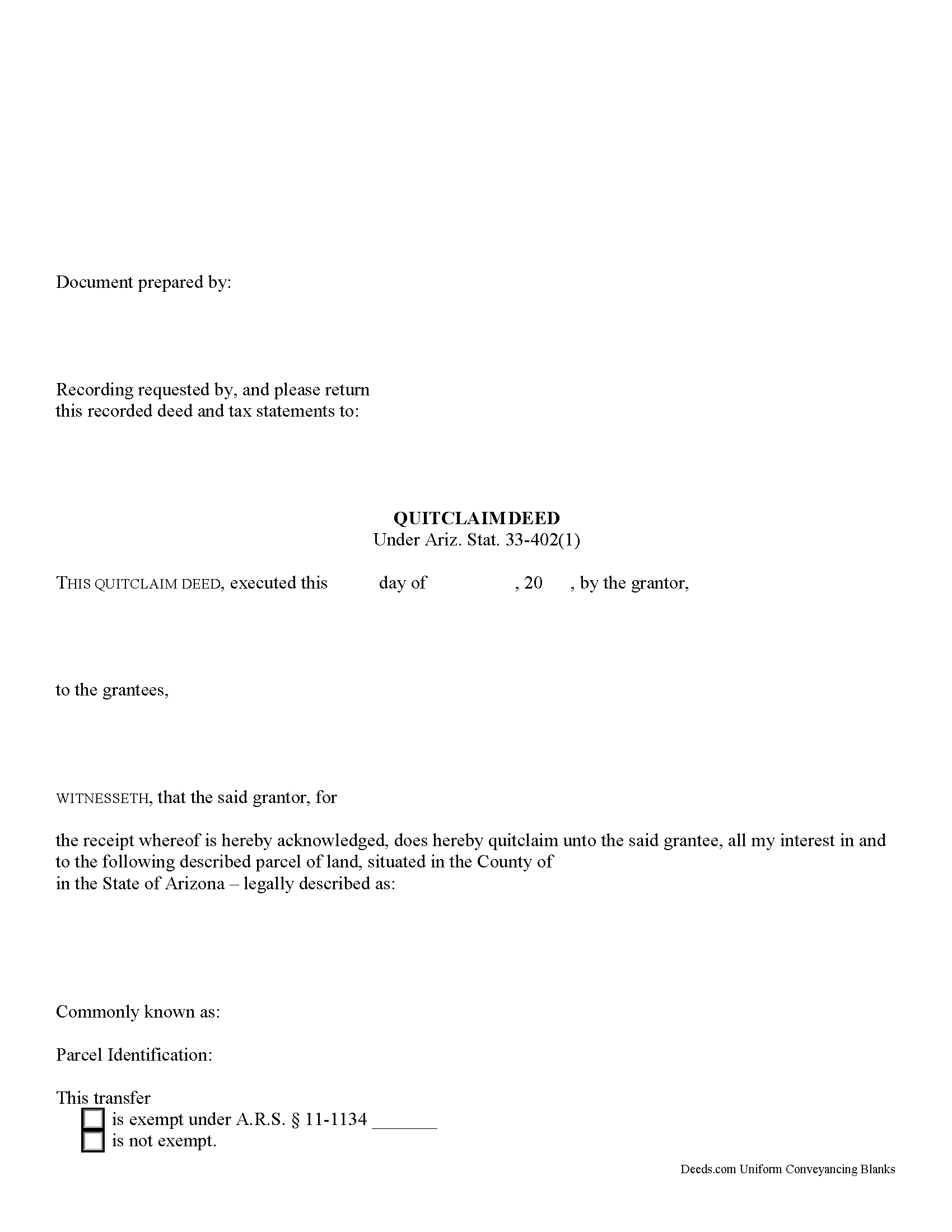
Arizona Quitclaim Deed

County Specific Legal Forms Validated as recently as March 30, 2026 by our Forms Development Team

About the Arizona Quitclaim Deed

Arizona Quitclaim Deed
Select County from List

How to Use This Form

  1. Select your county from the list on the left
  2. Download the county-specific form
  3. Fill in the required information
  4. Have the document notarized if required
  5. Record with your county recorder's office

What Others Like You Are Saying

— James B.

"All required forms readily available at fair price. Easy to create account. Immediately acquired doc…"

— Beverly L J.

"The process for receiving the quitclaim document worked well. I couldn't use the document. If I had …"

— Jim J.

"The forms were easy to use and the fields are tabbed so that you can enter your information and then…"

— Virginia P.

"Not user friendly despite additional guide. There are other products out there that are superior. A …"

— Terry W.

"Loved it no recurring fees easy to use your app"

An Arizona Quitclaim Deed is often used when the goal is to transfer whatever ownership interest the grantor has without giving title warranties, but Arizona has a few recording details that make its version different from a generic quitclaim form. Arizona law supplies a statutory quitclaim form, requires the deed to be acknowledged before it can be lawfully recorded, and commonly ties recording to an Affidavit of Property Value or a statutory exemption notation on the face of the deed (A.R.S. §§ 33-402, 33-401, 33-411, 11-1133, 11-1134).

What the Arizona Quitclaim Deed does

An Arizona quitclaim deed transfers whatever interest, if any, the grantor holds in the real property at the time of the transfer, with no covenant that the title is good, clear, or free of claims. In practice, it is commonly used for transfers between family members, transfers connected to divorce or estate planning, title clean-up work, adding or removing a co-owner, or moving property into or out of certain trust arrangements where the parties are transferring an existing interest rather than promising marketable title (A.R.S. § 33-402).

Arizona statutory requirements

Arizona recognizes a short statutory quitclaim form, but the deed still has to be completed with the information needed for a real recording. The deed must be in writing, signed by the grantor, and delivered. To be lawfully recorded, it must also be acknowledged before an officer authorized to take acknowledgments (A.R.S. §§ 33-401, 33-402, 33-411).

  • A caption identifying the document as a quitclaim deed should appear on the first page (A.R.S. § 11-480).
  • The deed should clearly identify the grantor and grantee and state the consideration, even if the transfer is nominal or made without a traditional sale price (A.R.S. § 33-402).
  • The property must be described with a full legal description, not just a street address.
  • If the deed modifies a previously recorded instrument, it must state the earlier recording date and the docket and page or other recording reference (A.R.S. § 11-480(D)).

Execution requirements in Arizona

Arizona does not generally require subscribing witnesses for a quitclaim deed. The key execution rule is that the deed must be signed by the grantor and duly acknowledged before a notary or other authorized officer. That acknowledgment matters not only for authentication, but also because an instrument affecting real property is not deemed lawfully recorded unless it has been acknowledged in the manner prescribed by law (A.R.S. §§ 33-401(B), 33-411(B)).

If the property being conveyed is community property, Arizona has an additional rule that causes problems when people assume one spouse can sign alone. A conveyance or encumbrance of community property is not valid unless both spouses execute and acknowledge it, subject to limited exceptions not relevant to most residential transfers (A.R.S. § 33-452).

Arizona-specific recording traps

One of the biggest Arizona traps is the recording package itself. A deed that transfers title generally must be recorded with an Affidavit of Property Value unless the transfer falls within one of the statutory exemptions. If the transfer is exempt, Arizona practice is to place the applicable exemption citation and code on the face of the deed instead of attaching the affidavit. County recorders may reject the deed if neither the affidavit nor a proper exemption notation is provided (A.R.S. §§ 11-1133, 11-1134).

Another Arizona-specific trap appears when title is taken or held through a trustee relationship. If the grantee is described as trustee, or if the grantor holds title as trustee, Arizona generally requires disclosure of the names and addresses of the beneficiaries and identification of the trust or a reference to the recorded instrument where that information appears. A deed that misses this disclosure can become voidable by the other party to the conveyance (A.R.S. § 33-404).

Vesting language is also important in Arizona because the state does not treat all multi-owner deeds the same way. A grant to two or more persons generally creates a tenancy in common unless the deed uses express words creating a survivorship estate or another recognized form of co-ownership. That means survivorship should not be assumed just because two names appear on the deed (A.R.S. § 33-431).

For certain unsubdivided land in an unincorporated area, Arizona may also require an Affidavit of Disclosure from the seller, and the statute directs that it be recorded at the same time as the deed. That requirement is not part of every quitclaim transfer, but it is a state-specific issue that can matter in rural land transactions (A.R.S. § 33-422).

Formatting can cause avoidable problems as well. Arizona statutes require an original, legible instrument, original signatures, a caption stating the nature of the instrument, compliant page size, at least ten-point type, and a reserved top margin on the first page for recorder information (A.R.S. § 11-480).

Vesting options and survivorship in Arizona

How the grantee takes title should be stated clearly in the deed because Arizona recognizes different ownership forms with different consequences. If the deed is silent, co-owners usually take as tenants in common. If the deed uses express survivorship language, Arizona allows title to vest as joint tenants with right of survivorship. For married couples, Arizona also allows title to vest as community property with right of survivorship, which is a distinct Arizona vesting option and should be stated expressly if that is how title is intended to be held (A.R.S. § 33-431).

Arizona also has a statute providing that divorce or annulment severs former spouses' interests held as joint tenants with right of survivorship or as community property with right of survivorship and transforms those interests into tenancies in common, unless controlling documents or court orders provide otherwise. That is a state-specific reason the vesting language and the surrounding facts should match the current ownership situation (A.R.S. § 14-2804).

Where to record and why timing matters

An Arizona quitclaim deed is recorded in the office of the county recorder in the county where the real property is located. Recording matters because Arizona is a notice state: an instrument affecting real property does not give notice to later purchasers or encumbrancers for value without notice unless it is recorded as provided by law. Arizona also places the burden on the transferor to record the document within sixty days of the transfer or else indemnify the transferee in later litigation over the property interest (A.R.S. §§ 33-411, 33-411.01).

Prompt recording also helps keep the public chain of title current, ties the deed to the assessor and tax records through the property-value affidavit process where required, and reduces the risk that a later recorded instrument will create title confusion.

What is included in the download package

The Arizona Quitclaim Deed package from Deeds.com includes the state-specific quitclaim deed form, step-by-step recording guidance, and a completed example to help you see how the finished document is typically set out before recording. The package is designed for Arizona county recording practice, including the deed format itself and the supporting guidance needed to prepare the document for submission.

How to Use This Form

  1. Select your county from the list above
  2. Download the county-specific form
  3. Fill in the required information
  4. Have the document notarized if required
  5. Record with your county recorder's office

What Others Like You Are Saying

— James B.

"All required forms readily available at fair price. Easy to create account. Immediately acquired doc…"

— Beverly L J.

"The process for receiving the quitclaim document worked well. I couldn't use the document. If I had …"

— Jim J.

"The forms were easy to use and the fields are tabbed so that you can enter your information and then…"

— Virginia P.

"Not user friendly despite additional guide. There are other products out there that are superior. A …"

— Terry W.

"Loved it no recurring fees easy to use your app"

Common Uses for Quitclaim Deed

  • Transfer property between business entities
  • Transfer property to avoid probate
  • Transfer a vacation or second home to family
  • Add a spouse to a property title after marriage
  • Restructure ownership for tax or liability purposes
  • Remove an ex-spouse from a property title
  • Change the vesting or ownership structure of a property

Important: County-Specific Forms

Our quitclaim deed forms are specifically formatted for each county in Arizona.

After selecting your county, you'll receive forms that meet all local recording requirements, ensuring your documents will be accepted without delays or rejection fees.