Graham County Quitclaim Deed Form
Last validated September 23, 2026 by our Forms Development TeamFormatted for recording in Graham County, for property anywhere in the county: rural and unincorporated areas as well as Bylas, Central, Eden, Fort Thomas, Pima, Safford, Solomon, Thatcher.
- 3 documents included
- Immediate PDF download
- Formatting guarantee
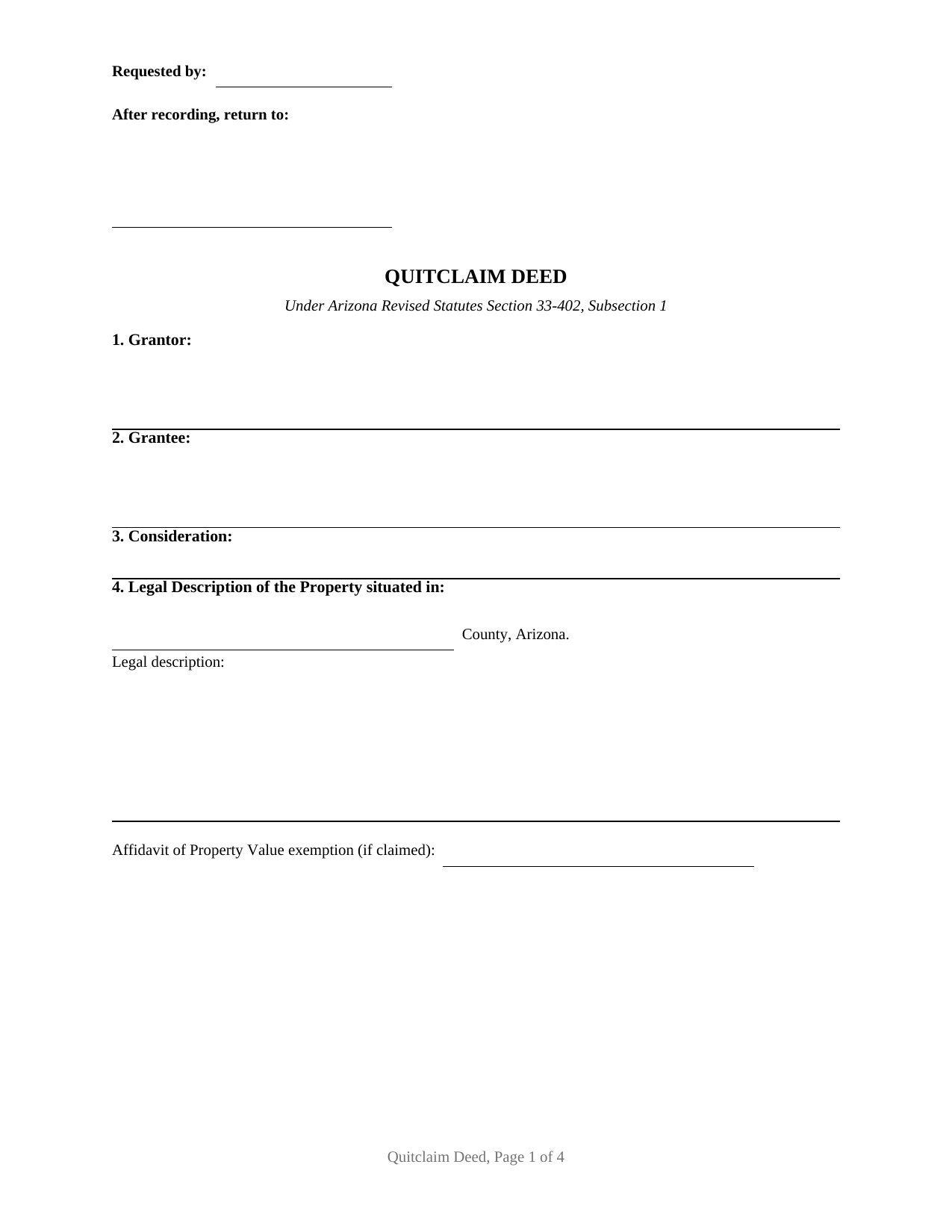
Graham County Quitclaim Deed Form
Fill in the blank Quitclaim Deed form formatted to comply with all Arizona recording and content requirements.
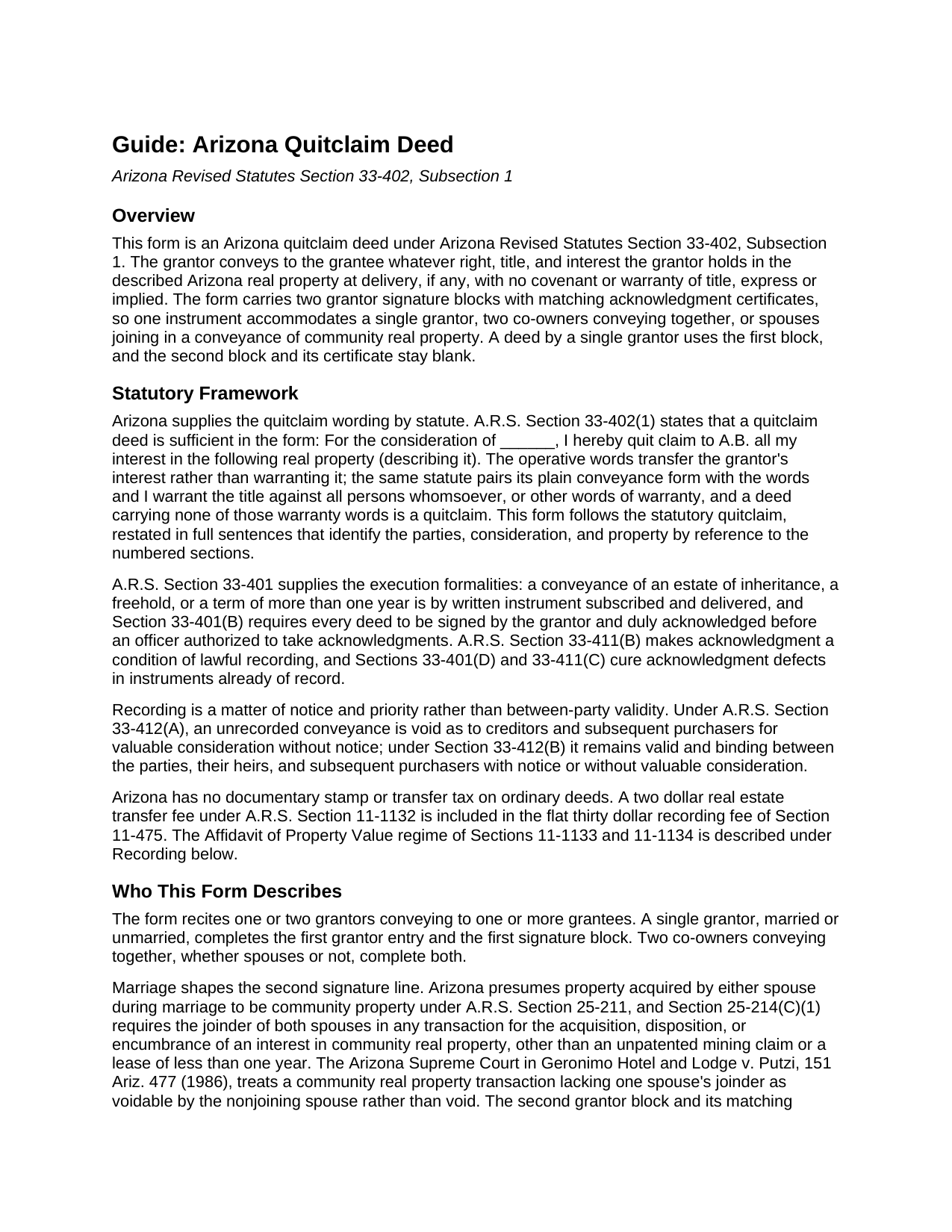
Graham County Quitclaim Deed Guide
Line by line guide explaining every blank on the Quitclaim Deed form.
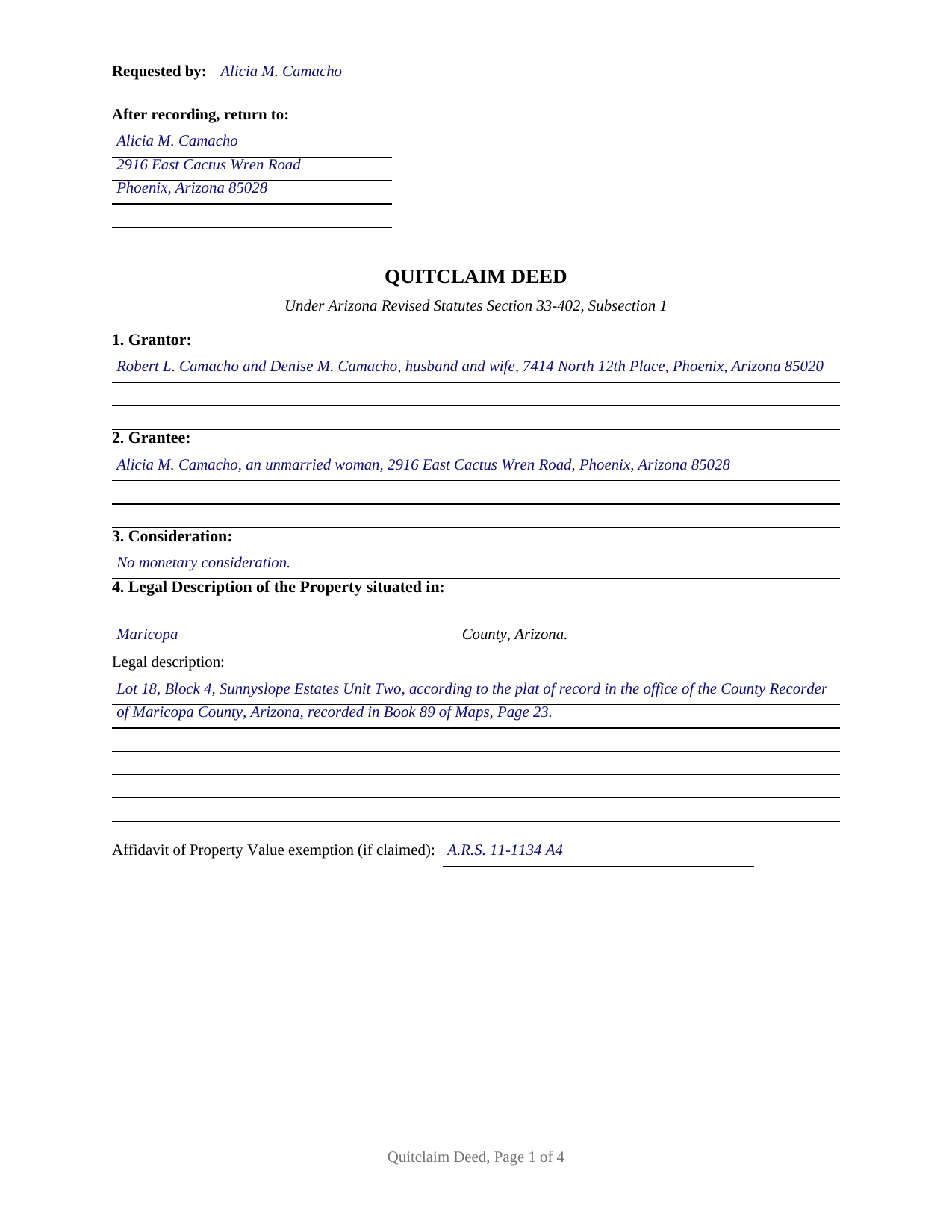
Graham County Completed Example of the Quitclaim Deed Document
Example of a properly completed Arizona Quitclaim Deed document for reference.
All 3 documents above included • One-time purchase • No recurring fees
Immediate Download • Secure Checkout
Additional Arizona and Graham County documents included at no extra charge:
Where to Record Your Documents
County Recorder
Safford, Arizona 85546 / 85548
Hours: 7:00 a.m. to 6:00 p.m. Monday through Thursday / e-Recording until 5 on Friday
Phone: 928-428-3560
Recording Tips for Graham County:
- Bring your driver's license or state-issued photo ID
- Ensure all signatures are in blue or black ink
- Both spouses typically need to sign if property is jointly owned
- Bring extra funds - fees can vary by document type and page count
- Check margin requirements - usually 1-2 inches at top
Cities and Jurisdictions in Graham County
Properties in any of these areas use Graham County forms:
- Bylas
- Central
- Eden
- Fort Thomas
- Pima
- Safford
- Solomon
- Thatcher
Hours, fees, requirements, and more for Graham County
How do I get my forms?
Forms are available for immediate download after payment. The Graham County forms will be in your account ready to download to your computer. An account is created for you during checkout if you don't have one. Forms are NOT emailed.
Are these forms guaranteed to be recordable in Graham County?
Yes. Our form blanks are guaranteed to meet or exceed the applicable formatting requirements used for recording in Graham County, including margin requirements, font requirements, and other layout standards. This guarantee applies to formatting, not to the legal sufficiency of information entered by the user or the suitability of a form for a particular transaction.
Can I reuse these forms?
Yes. You can reuse the forms for your personal use. For example, if you have multiple properties in Graham County you only need to order once.
What do I need to use these forms?
The forms are PDFs that you fill out on your computer. The free Adobe Acrobat Reader is recommended, and most PDF apps also work. You do NOT enter your property information online - you download the blank forms and complete them privately on your own computer.
Are there any recurring fees?
No. This is a one-time purchase. Nothing to cancel, no memberships, no recurring fees.
How much does it cost to record in Graham County?
Recording fees in Graham County vary. Contact the recorder's office at 928-428-3560 for current fees.
Questions answered? Let's get started!
Arizona wrote the quitclaim deed into statute as a single sentence. Under Arizona Revised Statutes Section 33-402, a deed reciting that the grantor, for a stated consideration, quit claims to the grantee all of the grantor's interest in described real property is sufficient to convey that interest. This form prepares that instrument: a conveyance of whatever interest the grantor holds at delivery, carrying no covenant or warranty of title.
Interest, not promises
A quitclaim deed passes the grantor's present interest, if any, and promises nothing about what that interest is. The grantee receives no covenant that the grantor owns the property or that the title is clear. That bare mechanism is what gives the deed its everyday work in Arizona practice: it moves an interest between parties who already know the condition of the title, and it takes a claimed or possible interest off the record so a cloud disappears. Where a transaction calls for title covenants, the statute supplies different words: Section 33-402 pairs its conveyance form with the warranty against all persons whomsoever, and permits other, limited words of warranty reaching only claims arising by, through, or under the grantor. The quitclaim carries none of them.
The affidavit, the exemption code, and a two dollar fee
Arizona has no documentary stamp or transfer tax. A two dollar real estate transfer fee under Section 11-1132 is folded into the flat thirty dollar recording fee of Section 11-475, uniform in every county. What the recorder does police is the Affidavit of Property Value: under Section 11-1133, a deed transferring title is refused unless a completed affidavit is appended or the face of the deed carries an exemption notation under Section 11-1134. A quitclaim deed executed for no monetary consideration is itself an exempt instrument under Section 11-1134(A)(4), noted in the Department of Revenue's style, A.R.S. 11-1134 A4, beneath the legal description. The form carries a dedicated line for that notation, and the completed example shows it in place.
Community property and the second signature
Arizona presumes property acquired during marriage is community property, and Section 25-214(C) requires both spouses to join in a disposition or encumbrance of community real property. The Arizona Supreme Court treats a transfer lacking one spouse's joinder as voidable by the nonjoining spouse. The form carries a second grantor signature block and a matching acknowledgment certificate for exactly this situation.
Recording and the 2026 anti-fraud changes
The deed is recorded with the county recorder of the county where the property is located. An unrecorded deed binds the parties, but Section 33-412 makes it void as to creditors and subsequent purchasers for value without notice. The form is drafted to the Section 11-480 format standards, with the caption, type size, and reserved first page top margin the recording statutes describe, and its first page carries the requesting party and return address in the left portion of that reserved area, the placement Section 11-480(C) allows. Deeds notarized on or after September 12, 2026 also feel Senate Bill 1479: the notary journal gains a thumbprint requirement for deed signers, in-person recording requires photo identification, and recording a groundless document becomes a class 5 felony.
The download includes the blank deed as a fillable PDF, a completed example for a Maricopa County parcel, and a plain language guide that walks through every section of the form, the signing formalities, and recording. The materials are informational; they are not legal advice.
Important: Your property must be located in Graham County to use these forms. Documents should be recorded at the county recording office listed above.
This Quitclaim Deed meets all recording requirements specific to Graham County.
Our Promise
The documents you receive here are guaranteed to meet or exceed the applicable Graham County recording format requirements. If there is a rejection caused by our formatting, we will correct the issue or refund your payment. This guarantee applies to document formatting only and does not extend to information entered by the user, the selection of the form, or the legal effect of the completed document.
Save Time and Money
Get your Graham County Quitclaim Deed form done right the first time with Deeds.com Uniform Conveyancing Blanks. At Deeds.com, we understand that your time and money are valuable resources, and we don't want you to face a penalty fee or rejection imposed by a county recorder for submitting nonstandard documents. We constantly review and update our forms to meet rapidly changing state and county recording requirements for roughly 3,500 counties and local jurisdictions.
4.8 out of 5 - ( 4,833 Reviews )
Geneen C. 5 out of 5 stars
Love this site. The form directions are easy and I finished in less than an hour! Totally recommend it.
Thank you for your feedback. We really appreciate it. Have a great day!
Roger M. 3 out of 5 stars
A better or more simplified explanation of what some of the more common titles would be used for would help. You list 6-8 types of Trusts alone. An example of doing a Grant Deed to move a property into, out of, or from a Trust to a Trust would have been helpful.
Thank you for your feedback. We really appreciate it. Have a great day!
Joel N. 5 out of 5 stars
Was helpful
Thank you for your feedback. We really appreciate it. Have a great day!
Elizabeth M. 5 out of 5 stars
Thanks for making the Quitclaim Mineral Deed easy to understand, and the process so affordable.
Thank you, Elizabeth. We're glad the Quitclaim Mineral Deed package made the process clear and accessible. Mineral rights conveyances can feel intimidating without the right tools, and we appreciate you taking the time to share your experience.
Richard S. 5 out of 5 stars
Prompt and reliable service!!
Thank you!
Kateri S. 4 out of 5 stars
I had to add a section on the form to accomodate the former Grantor/Grantee informtion before it could be recorded
Your insights are invaluable to us and help us strive for better service. Thank you for taking the time to share your thoughts.
Chelsie F. 5 out of 5 stars
Super customer service and communication! Fast service and more informative than expected! Can't say thanks enough.
Thank you!
brian o. 5 out of 5 stars
I was needing some forms from another state. I am a lawyer but don't have ready access to out of state forms. I was impressed with how thorough the intake process was. Very nice that I could download the form in Word so that I could adjust a few things. Very fine service. I recommend.
Thank you!
J Samuel B. 4 out of 5 stars
Good, but make your PDFs convertible to Word or RTF.
Thank you for your feedback. It helps us continue improving.
Paula S. 5 out of 5 stars
The document form was easily retrieved and the sample provided was extremely helpful and no problems were encountered when presenting the completed document to the county. I am grateful for this website and the help and confidence it gave me to complete this task
We appreciate your comments and your trust in us. Thank you.
Gregory B. 5 out of 5 stars
I believe you need more instruction on the use of the web site. I would type and nothing would appear on the form. When I tried to save a completed form I ended with a blank form with no detail.
Thank you!
JoAnn L. 5 out of 5 stars
The process was easy, and efficient. There was a person available to help if needed. Very pleased, would use this again.
Thank you!
Stephanie S. 5 out of 5 stars
I received my information almost immediately. I read a few more things on the website and then refreshed and it was there! SO much easier than having to go to the office myself - thanks!!
Thank you!
Valerie C. 5 out of 5 stars
Thanks
Thank you!
Gregory h. 5 out of 5 stars
OUtsdtanding. Quick and easy, both of which are a huge plus
We appreciate your business and value your feedback. Thank you. Have a wonderful day!