Arizona Warranty Deed
County Specific Legal Forms Validated as recently as September 17, 2026 by our Forms Development Team
About the Arizona Warranty Deed
How to Use This Form
- Select your county from the list
- Download the county-specific form
- Fill in the required information
- Have the document notarized if required
- Record with your county recorder's office
What Others Like You Are Saying
"Easy steps to create an account, will recommend to anyone."
"Yes I appreciate your services everything so far looking good this shows the facts the reasons most …"
"This site was a breeze using."
"Deeds.com provide a great service!!!"
"GREAT CUSTOMER SERVICE WILL ALWAYS USE YOUR HELP."
4.8/5 from 4,815 reviews. Read all
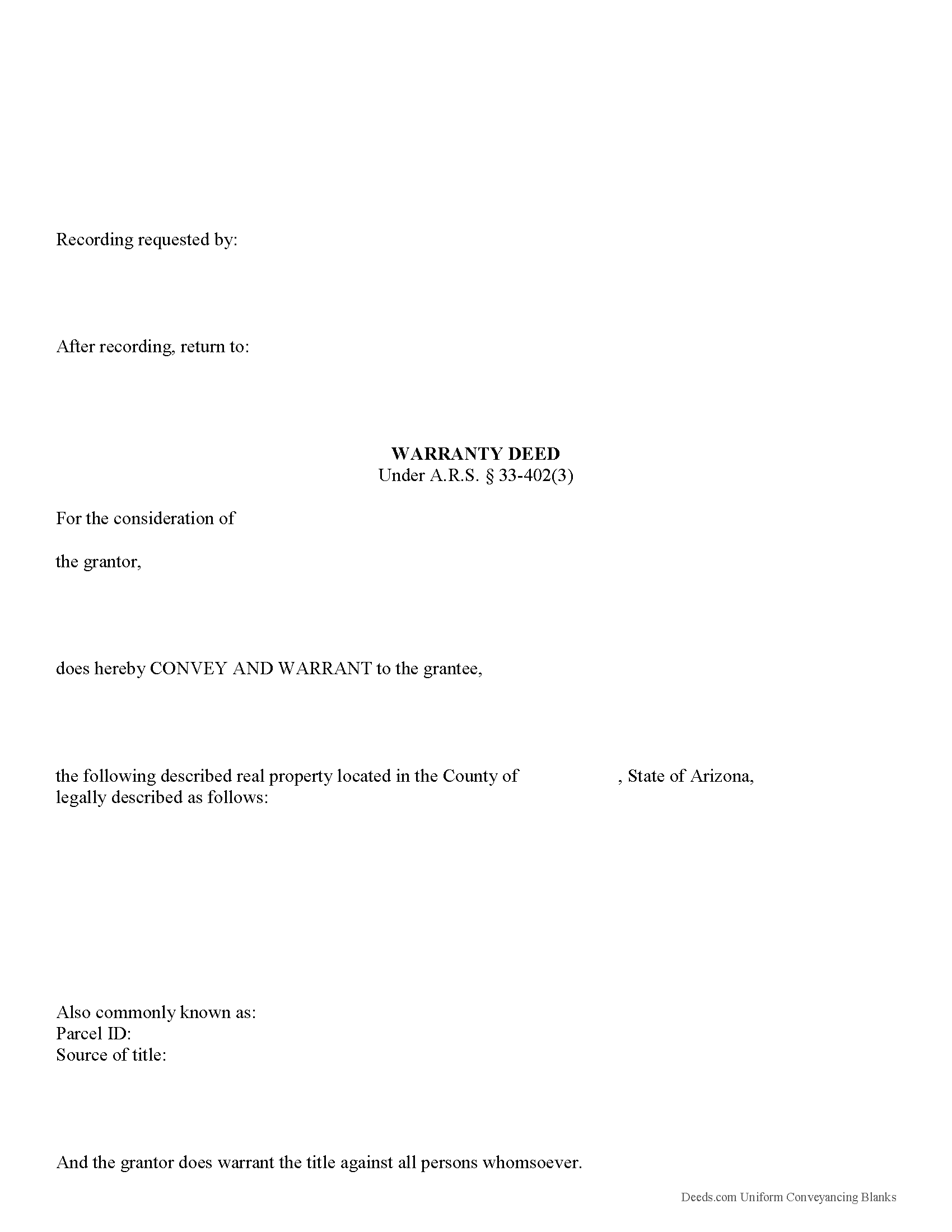
Nothing on the face of this deed decides who the parties are. The Arizona Warranty Deed is the base configuration of the state's statutory warranty deed, built with open party lines rather than preprinted patterns: Section 1 takes one or two grantor names, Section 3 takes one or two grantee names together with any designation of how they hold, and the wording Arizona law treats as decisive comes from the people signing rather than from the printed page.
Open Party Blocks, Two Signature Blocks, Two Certificates
The architecture is fixed even where the wording is not. Each party block runs four lines and holds one or two names of natural persons signing in their own right, with mailing address blocks sized for two entries beside them. Two signature blocks follow the operative section, headed GRANTOR and SECOND GRANTOR, and a separate acknowledgment certificate follows each, so two signers may appear on different dates, before different notaries, in different states. A single seller leaves the second block and the second certificate blank. Four count patterns run through the same instrument: one grantor to one grantee, one to two, two to one, and two to two. The form is not set up for a company signing through a member or manager, for a fiduciary conveying or receiving as trustee, where A.R.S. 33-404 puts a beneficiary disclosure on the deed, for an agent under a power of attorney, or for three or more owners on either side; each carries signer blocks this configuration does not print.
Everything the Warranty Carries
Arizona states its warranty compactly. Section 9 conveys the property and warrants the title against all persons whomsoever, the warranty wording A.R.S. 33-402 prints, and the verb pulls its own weight: under A.R.S. 33-435 the word convey implies, unless the deed restrains it, that the grantor had not already conveyed the same estate or any interest in it to someone other than the grantee, and that the estate is free from encumbrances the grantor made or suffered. Those implied covenants may be sued on as though written out. The express warranty reaches further, because it is not limited to what the grantor caused; it answers for defects that arose before the grantor ever took title. Section 8 is where that exposure gets its boundary: current year taxes, patent reservations, and recorded easements and restrictions entered there fall outside the promise, while a title matter left unentered stays inside it.
The Words That Make Survivorship
Arizona defaults a grant to two or more grantees to an estate in common under A.R.S. 33-431(A), so survivorship exists only where the deed says so. The grantee block leaves room for the express declaration each form needs, and the guide sets out the whole menu: the estate in common default, joint tenancy with right of survivorship for any two co-owners, community property and community property with right of survivorship for spouses, and separate property under A.R.S. 25-213. Marital status matters on the conveying side too. A.R.S. 25-211 presumes property acquired during a marriage to be community property, and A.R.S. 25-214(C)(1) conditions a disposition of community real property on the joinder of both spouses, which is why a community property sale fills both grantor lines even where record title names one person.
What Reaches the Recorder's Counter
The deed records in the county where the land lies for a flat $30 under A.R.S. 11-475, the $2 real estate transfer fee already inside that figure, and A.R.S. 33-411.01 puts the recording duty on the transferor within sixty days of the transfer. A sale for value travels with the Affidavit of Property Value, a Department of Revenue form the parties complete and sign on their own and one that is not part of this package; a transfer qualifying under A.R.S. 11-1134 instead carries its exemption code on the face of the deed, and the form prints that line directly beneath the legal description. Page one keeps its top two inches clear for the recording stamp and places the requester and return address entries in the left band A.R.S. 11-480(C) opens for them.
The download includes the Arizona warranty deed as a fillable PDF, a completed example showing a Mohave County sale filled at two grantors and two grantees from the recording band through both notary certificates, and a plain language guide covering each section, the ways grantees may hold title, and the recording steps. These materials describe Arizona law in general terms and are not legal advice.
Important: County-Specific Forms
Our warranty deed forms are specifically formatted for each of the 15 counties in Arizona.
After selecting your county, you'll receive forms that meet all local recording requirements, ensuring your documents will be accepted without delays or rejection fees.