Cochise County Warranty Deed Form
Last validated October 13, 2026 by our Forms Development TeamFormatted for recording in Cochise County, for property anywhere in the county: rural and unincorporated areas as well as Benson, Bisbee, Bowie, Cochise, Douglas, Dragoon, Elfrida, Fort Huachuca and 12 more.
- 3 documents included
- Immediate PDF download
- Formatting guarantee
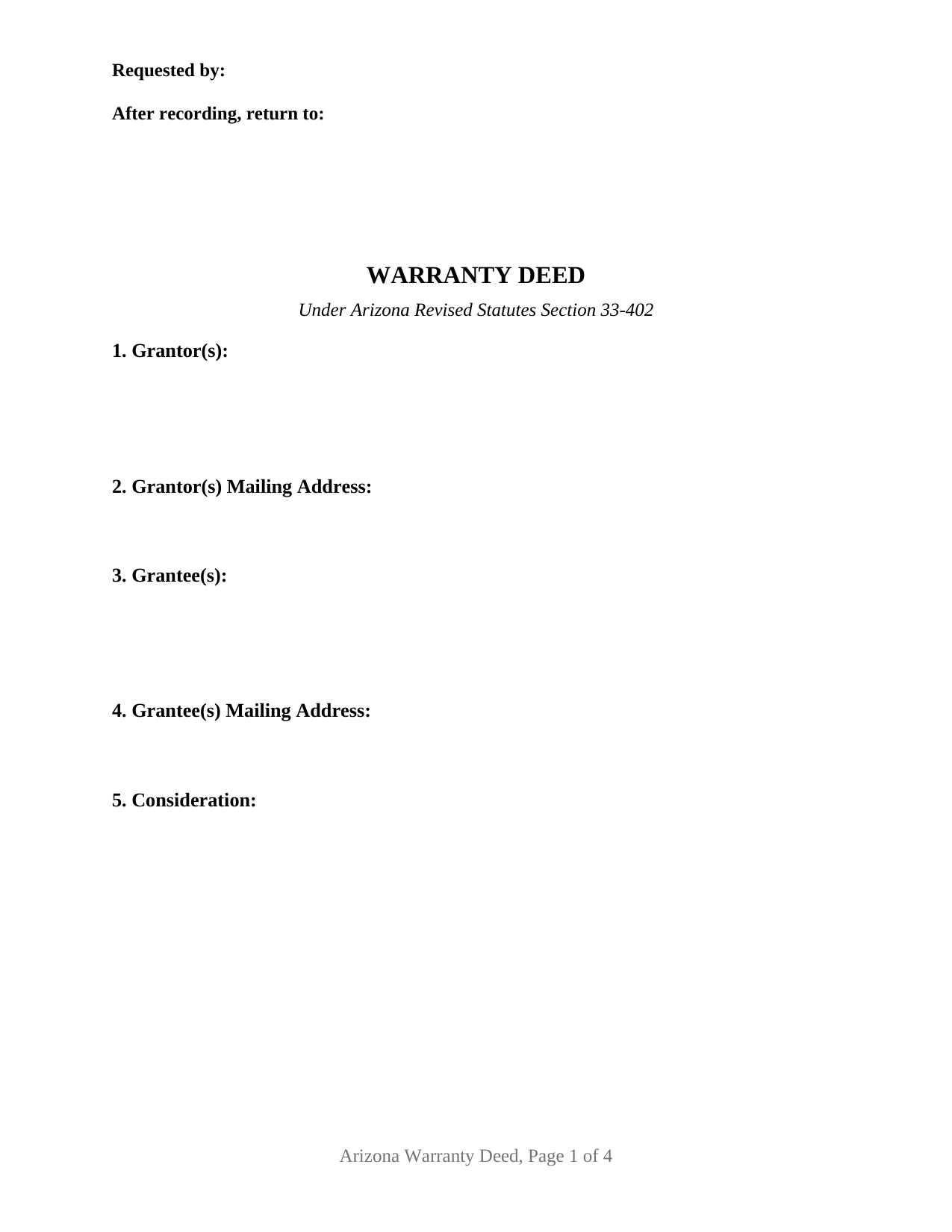
Cochise County Warranty Deed Form
Fill in the blank Warranty Deed form formatted to comply with all Arizona recording and content requirements.
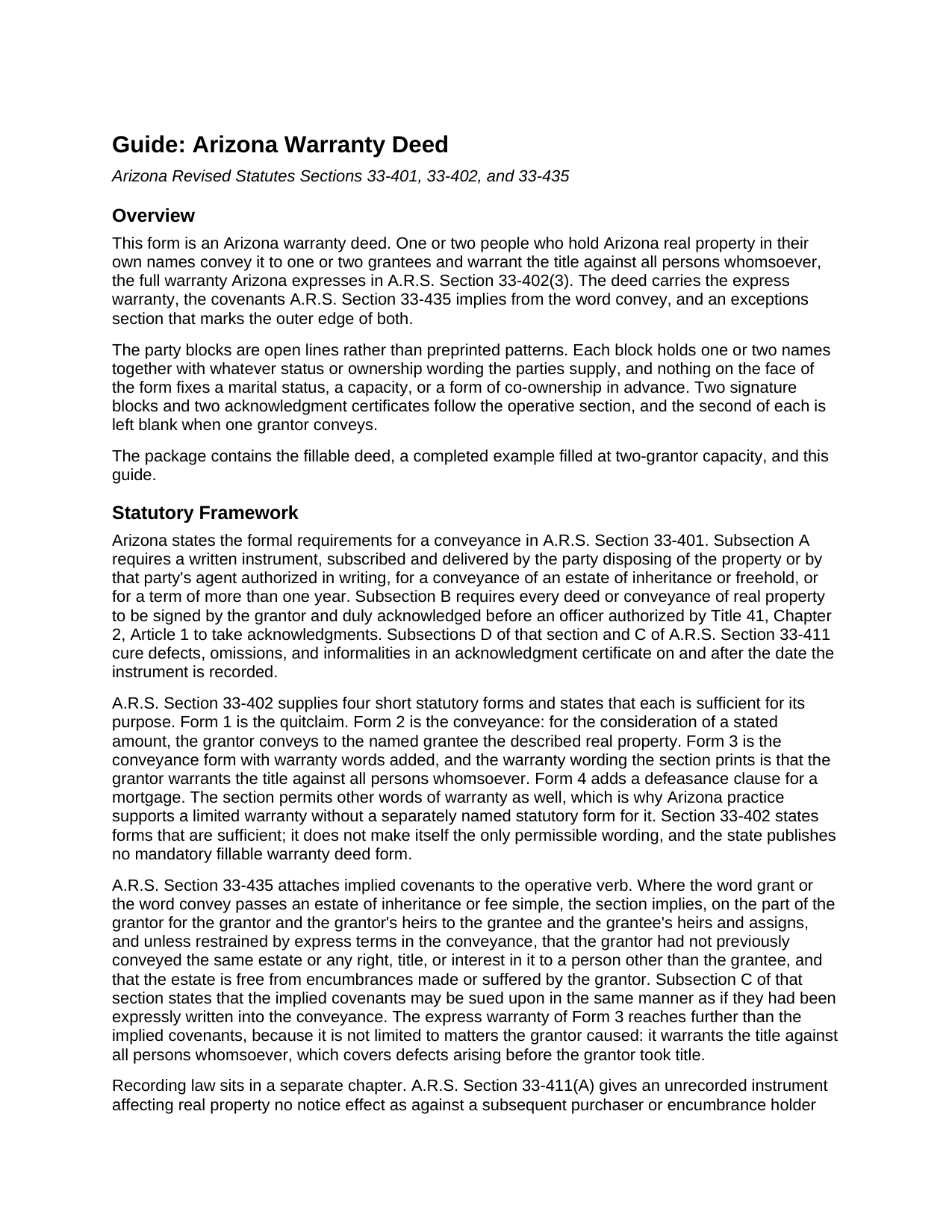
Cochise County Warranty Deed Guide
Line by line guide explaining every blank on the Warranty Deed form.
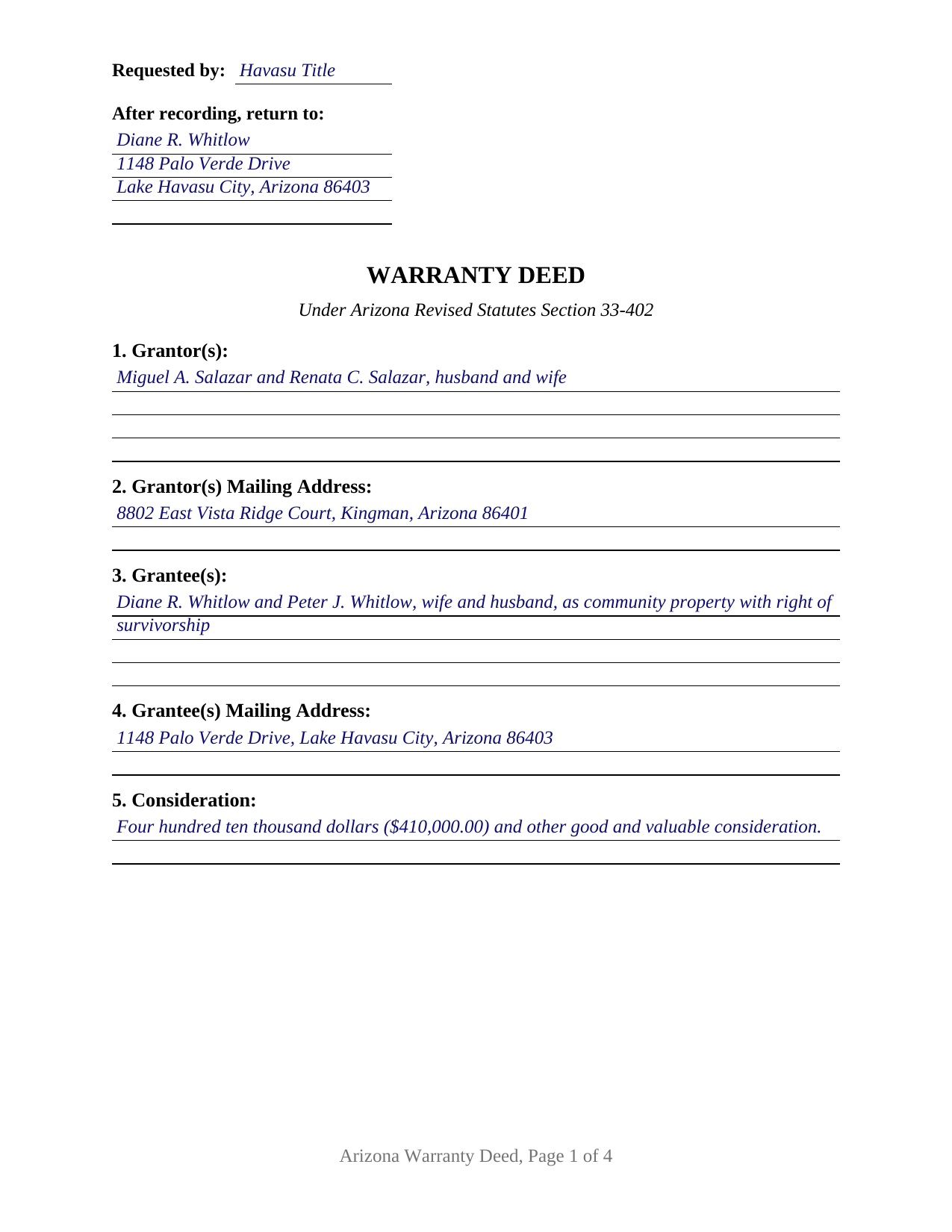
Cochise County Completed Example of the Warranty Deed Document
Example of a properly completed Arizona Warranty Deed document for reference.
All 3 documents above included • One-time purchase • No recurring fees
Immediate Download • Secure Checkout
Additional Arizona and Cochise County documents included at no extra charge:
Where to Record Your Documents
Recorder's Office
Bisbee, Arizona 85603
Hours: 8:00am - 5:00pm Monday - Friday
Phone: 520-432-8350
Recording Tips for Cochise County:
- Bring your driver's license or state-issued photo ID
- Ensure all signatures are in blue or black ink
- Avoid the last business day of the month when possible
- Both spouses typically need to sign if property is jointly owned
- Bring extra funds - fees can vary by document type and page count
Cities and Jurisdictions in Cochise County
Properties in any of these areas use Cochise County forms:
- Benson
- Bisbee
- Bowie
- Cochise
- Douglas
- Dragoon
- Elfrida
- Fort Huachuca
- Hereford
- Huachuca City
- Mc Neal
- Naco
- Pearce
- Pirtleville
- Pomerene
- Saint David
- San Simon
- Sierra Vista
- Tombstone
- Willcox
Hours, fees, requirements, and more for Cochise County
How do I get my forms?
Forms are available for immediate download after payment. The Cochise County forms will be in your account ready to download to your computer. An account is created for you during checkout if you don't have one. Forms are NOT emailed.
Are these forms guaranteed to be recordable in Cochise County?
Yes. Our form blanks are guaranteed to meet or exceed the applicable formatting requirements used for recording in Cochise County, including margin requirements, font requirements, and other layout standards. This guarantee applies to formatting, not to the legal sufficiency of information entered by the user or the suitability of a form for a particular transaction.
Can I reuse these forms?
Yes. You can reuse the forms for your personal use. For example, if you have multiple properties in Cochise County you only need to order once.
What do I need to use these forms?
The forms are PDFs that you fill out on your computer. The free Adobe Acrobat Reader is recommended, and most PDF apps also work. You do NOT enter your property information online - you download the blank forms and complete them privately on your own computer.
Are there any recurring fees?
No. This is a one-time purchase. Nothing to cancel, no memberships, no recurring fees.
How much does it cost to record in Cochise County?
Recording fees in Cochise County vary. Contact the recorder's office at 520-432-8350 for current fees.
Questions answered? Let's get started!
Nothing on the face of this deed decides who the parties are. The Arizona Warranty Deed is the base configuration of the state's statutory warranty deed, built with open party lines rather than preprinted patterns: Section 1 takes one or two grantor names, Section 3 takes one or two grantee names together with any designation of how they hold, and the wording Arizona law treats as decisive comes from the people signing rather than from the printed page.
Open Party Blocks, Two Signature Blocks, Two Certificates
The architecture is fixed even where the wording is not. Each party block runs four lines and holds one or two names of natural persons signing in their own right, with mailing address blocks sized for two entries beside them. Two signature blocks follow the operative section, headed GRANTOR and SECOND GRANTOR, and a separate acknowledgment certificate follows each, so two signers may appear on different dates, before different notaries, in different states. A single seller leaves the second block and the second certificate blank. Four count patterns run through the same instrument: one grantor to one grantee, one to two, two to one, and two to two. The form is not set up for a company signing through a member or manager, for a fiduciary conveying or receiving as trustee, where A.R.S. 33-404 puts a beneficiary disclosure on the deed, for an agent under a power of attorney, or for three or more owners on either side; each carries signer blocks this configuration does not print.
Everything the Warranty Carries
Arizona states its warranty compactly. Section 9 conveys the property and warrants the title against all persons whomsoever, the warranty wording A.R.S. 33-402 prints, and the verb pulls its own weight: under A.R.S. 33-435 the word convey implies, unless the deed restrains it, that the grantor had not already conveyed the same estate or any interest in it to someone other than the grantee, and that the estate is free from encumbrances the grantor made or suffered. Those implied covenants may be sued on as though written out. The express warranty reaches further, because it is not limited to what the grantor caused; it answers for defects that arose before the grantor ever took title. Section 8 is where that exposure gets its boundary: current year taxes, patent reservations, and recorded easements and restrictions entered there fall outside the promise, while a title matter left unentered stays inside it.
The Words That Make Survivorship
Arizona defaults a grant to two or more grantees to an estate in common under A.R.S. 33-431(A), so survivorship exists only where the deed says so. The grantee block leaves room for the express declaration each form needs, and the guide sets out the whole menu: the estate in common default, joint tenancy with right of survivorship for any two co-owners, community property and community property with right of survivorship for spouses, and separate property under A.R.S. 25-213. Marital status matters on the conveying side too. A.R.S. 25-211 presumes property acquired during a marriage to be community property, and A.R.S. 25-214(C)(1) conditions a disposition of community real property on the joinder of both spouses, which is why a community property sale fills both grantor lines even where record title names one person.
What Reaches the Recorder's Counter
The deed records in the county where the land lies for a flat $30 under A.R.S. 11-475, the $2 real estate transfer fee already inside that figure, and A.R.S. 33-411.01 puts the recording duty on the transferor within sixty days of the transfer. A sale for value travels with the Affidavit of Property Value, a Department of Revenue form the parties complete and sign on their own and one that is not part of this package; a transfer qualifying under A.R.S. 11-1134 instead carries its exemption code on the face of the deed, and the form prints that line directly beneath the legal description. Page one keeps its top two inches clear for the recording stamp and places the requester and return address entries in the left band A.R.S. 11-480(C) opens for them.
The download includes the Arizona warranty deed as a fillable PDF, a completed example showing a Mohave County sale filled at two grantors and two grantees from the recording band through both notary certificates, and a plain language guide covering each section, the ways grantees may hold title, and the recording steps. These materials describe Arizona law in general terms and are not legal advice.
Important: Your property must be located in Cochise County to use these forms. Documents should be recorded at the county recording office listed above.
This Warranty Deed meets all recording requirements specific to Cochise County.
Our Promise
The documents you receive here are guaranteed to meet or exceed the applicable Cochise County recording format requirements. If there is a rejection caused by our formatting, we will correct the issue or refund your payment. This guarantee applies to document formatting only and does not extend to information entered by the user, the selection of the form, or the legal effect of the completed document.
Save Time and Money
Get your Cochise County Warranty Deed form done right the first time with Deeds.com Uniform Conveyancing Blanks. At Deeds.com, we understand that your time and money are valuable resources, and we don't want you to face a penalty fee or rejection imposed by a county recorder for submitting nonstandard documents. We constantly review and update our forms to meet rapidly changing state and county recording requirements for roughly 3,500 counties and local jurisdictions.
4.8 out of 5 - ( 4,824 Reviews )
Charles C. 5 out of 5 stars
Easy to use. Good price. I like that it came with instructions and an example.
Thank you for your feedback. We really appreciate it. Have a great day!
Barbara B. 5 out of 5 stars
A great help! Thank you.
Thank you!
Herbert W. 5 out of 5 stars
The service was fast and professional. So much easier than going to the courthouse. I recommend this to anyone who has to record documents at the Clerk's office.
We appreciate your business and value your feedback. Thank you. Have a wonderful day!
CHERYL G. 5 out of 5 stars
After my county rejected a deed from another company, I researched better and purchased my Lady Bird Deed from Deeds.com. Very simple, received everything immediately. Printed out sample and guide sheets and filled out my deed. Very thorough and easy to understand. All the additional forms were awesome. And the best part is, my county recorded my deed this morning! WooHoo! Very happy customer! Thank you!
Glad to hear! Thanks for taking the time to leave your review. We appreciate you. Have a great day.
Christopher B. 5 out of 5 stars
Process went smoothly and will use for my next recording. Only area for improvement would be to provide the ability for the user to delete and replace uploaded documents.
Thank you for your feedback. We really appreciate it. Have a great day!
Ardys A. 5 out of 5 stars
Very pleased with all the info I received and not just a blank form.
We appreciate your business and value your feedback. Thank you. Have a wonderful day!
John M. 5 out of 5 stars
Very satisfied with your service. Considering how complicated real estate titles are, this could not have been simpler. Your website worked perfectly.
Thank you!
Shawn S. 5 out of 5 stars
Seems to be exactly whst j needed. Great job!
Thank you!
Holly K. 5 out of 5 stars
This is the simplest way to record a deed ever. Just uploaded the deed and the professionals at deed.com did the rest. Within 8 hours, I had my recorded deed back. The price is fantastic. It would have cost me more in gas to drive to the county where I had to record the deed.
We appreciate your business and value your feedback. Thank you. Have a wonderful day!
Sidney H. 5 out of 5 stars
Fabulous resource! They provide everything you need at an extremely reasonable price.
Thank you for your feedback. We really appreciate it. Have a great day!
Regina G. 5 out of 5 stars
Very good customer service. Would recommend them highly.
Thank you!
AKILAH S. 4 out of 5 stars
It was a little challenging and I had to call to speak to someone a few time but I got it done and and over with so I'm happy.
It was a pleasure serving you. Thank you for the positive feedback!
Kent B. 2 out of 5 stars
Disappointed on most recent order. Format did not permit changing the "boilerplate" language to change "grantor" to "grantors". In so restricting, could not use pre-printed form to make a joint party conveyance.
Sorry to hear of your disappointment. We've canceled your order and payment for the warranty deed document. Have a wonderful day.
Mary K. 5 out of 5 stars
I love this site already! Even though I have not executed my downloads, the documents are so professionally written, and the extras are great. I am impressed with Deeds. Thank you! I will continue to use Deeds as a source for my business and personal needs.
Thank you for your positive words! We’re thrilled to hear about your experience.
Joseph D. 5 out of 5 stars
Easy to use and a quick turnaround Deed was recorded and retuned within 24 hours
We are grateful for your engagement and feedback, which help us to serve you better. Thank you for being an integral part of our community.