Arkansas Beneficiary Deed
County Specific Legal Forms Validated as recently as November 9, 2026 by our Forms Development Team
About the Arkansas Beneficiary Deed
How to Use This Form
- Select your county from the list
- Download the county-specific form
- Fill in the required information
- Have the document notarized if required
- Record with your county recorder's office
What Others Like You Are Saying
"Thank you for the paperwork. It was so much easier to do at home than go out and have to have people…"
"I called the county clerk office yesterday that i wanted to get a deed e-filed and recorded. I was t…"
"Received the forms I ordered, found them to be easy to complete with the guide and example that was …"
"This company is a super time saver for our firm and our client! Their website was easy to use and th…"
"Love it"
4.8/5 from 4,862 reviews. Read all
Arkansas Beneficiary Deed Package
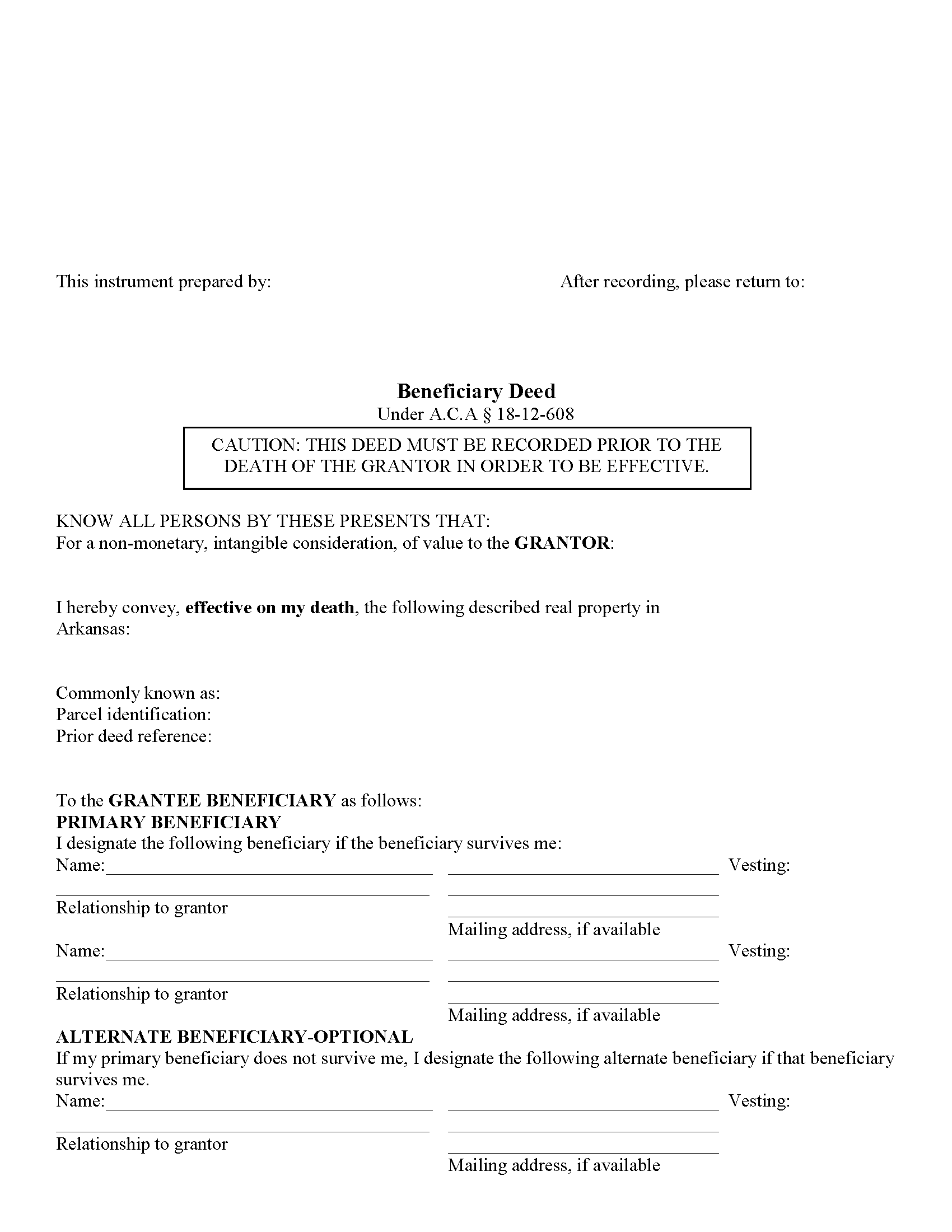
An Arkansas beneficiary deed, authorized by Ark. Code Ann. § 18-12-608, is the deed by which one or two owners of Arkansas real property designate who receives the property at death. The deed transfers nothing during the owner's lifetime: no legal or equitable interest vests in the named grantee beneficiary until the owner's death, and an owner who signed the deed may revoke it while living. A beneficiary deed is valid only if it is recorded, before the death of the owner or of the last surviving owner, in the office of the county recorder for the county where the property is located; the form carries the statutory caution to that effect beneath its title.
This download supplies the deed form together with a guide and a completed example. All three are statewide Arkansas documents for Arkansas real property only; there are no county-specific versions.
What the download contains
- Beneficiary Deed Form – a fillable PDF consisting of a one-page instructions page, which is not part of the recorded instrument, followed by the five-page deed.
- Beneficiary Deed Guide – an eight-page explanation of the deed, the form, signing and notarization, and recording.
- Completed Example – the same instructions page and five-page deed with sample entries added.
What the deed form provides
The form identifies one or two owners, natural persons signing in their own right, in a free-form block; marital status and how the owners hold title are typed in rather than preprinted. The grantee beneficiary block accepts one or more grantees, including the trustee of a trust, with a tenancy designation where more than one grantee is named. A fixed successor grantee beneficiary provision supplies the vesting condition § 18-12-608 requires of a successor designation: a named grantee's interest passes to the successor named in that provision, if one is named, when that grantee does not survive the death on which the deed takes effect. The guide notes that the statute states no rule for a grantee who does not survive when no successor is named, and the guide does not describe that result. Entry space follows for the legal description with county, the street address, and the source of title.
The conveyance paragraph is wholly preprinted. It identifies the instrument as a beneficiary deed under § 18-12-608 and states that the deed takes effect at the owner's death or, where the property is held as a tenancy by the entirety or a joint tenancy with right of survivorship, at the death of the last surviving owner. It restates the statutory terms that no interest vests before that death, that the deed is revocable as the statute provides, and that the grantee beneficiary takes subject to mortgages, liens, and other encumbrances existing at that death. Which effective-date clause operates depends on how record title is held at death, not on any selection made on the form. The form also preprints the first-page preparer statement that Arkansas recording law places on a recordable instrument and the statement that the instrument is exempt from the Arkansas real property transfer tax, the exemption § 26-60-102 provides for a beneficiary deed.
The signature section carries two owner signature blocks, the second marked “if applicable,” and the form supplies a separate acknowledgment certificate for each signer in the individual acknowledgment form of § 16-47-107(b). Because the certificates are separate, two owners can acknowledge on different dates or before different officers; the guide identifies this as a design choice of the form rather than a statutory requirement.
What the guide clarifies
The eight-page guide explains what a beneficiary deed is and its defining features: nothing passes during life, the deed is revocable, it is valid only if recorded before death, and it cannot be revoked or altered by the owner's will. It identifies the four owner patterns the form accommodates (a sole owner, tenants by the entirety, joint tenants with right of survivorship, and tenants in common) and describes the statutory result when only one of two survivorship owners signs. Its section-by-section part follows the form in order and quotes entries from the completed example to show each entry style, including naming a trustee of a trust and designating a named successor or unnamed heirs. Signing and notarization coverage addresses the acknowledgment statutes, out-of-state acknowledgments, Arkansas dower, curtesy, and homestead rules where a spouse does not hold title, and the effect of divorce. The recording part covers the recording rule, the statewide format and fee statutes, the transfer-tax exemption, county submission channels and electronic recording, and the 2025 photo-identification rule under § 14-15-403(f) for deeds presented in person or by mail, including its statutory exceptions. A closing section describes what the deed does not do, such as transfer any interest during life, restrict the owner's ability to sell or mortgage the property, clear liens, override a surviving spouse's rights, or bind a co-owner who did not sign.
What the example demonstrates
The example fills the identical form for a fictional married couple holding title as tenants by the entirety, naming their two children as joint tenants with right of survivorship and designating a named successor grantee beneficiary, with a separately completed acknowledgment certificate for each owner. Because every section and both certificates are completed and the guide quotes those entries, a purchaser can compare each blank on the form against a filled-in version and the guide's description of that entry.
Limits of the supplied form
- The form describes one or two owners who are natural persons signing in their own right. An owner acting through an attorney-in-fact, a trustee holding title for a trust, a corporation or other entity as owner, and three or more owners on one instrument are configurations the form does not describe.
- Signature blocks are for the owner or owners alone; there is no joinder, consent, or relinquishment block for a spouse who does not hold record title. The guide notes that § 18-12-608 says nothing about a non-owner spouse and that the statutes leave certain questions about marital rights open on their text.
- No revocation instrument and no after-death document are included; the guide identifies each as a separate document outside this package.
This description and the included materials provide general information about the Arkansas beneficiary deed and do not constitute legal advice.
Important: County-Specific Forms
Our beneficiary deed forms are specifically formatted for each of the 75 counties in Arkansas.
After selecting your county, you'll receive forms that meet all local recording requirements, ensuring your documents will be accepted without delays or rejection fees.