Arkansas Quitclaim Deed (Corrective)
County Specific Legal Forms Validated as recently as September 29, 2026 by our Forms Development Team
About the Arkansas Quitclaim Deed (Corrective)
How to Use This Form
- Select your county from the list
- Download the county-specific form
- Fill in the required information
- Have the document notarized if required
- Record with your county recorder's office
What Others Like You Are Saying
"Simple and quick recording."
"Deeds.com provide a great service!!!"
"Great service. Very reasonable cost. All necessary detailed information provided."
"These forms were very easy to both download and print, as well as fill out on the site and then prin…"
"Thank you everything was as expected very good service"
4.8/5 from 4,831 reviews. Read all
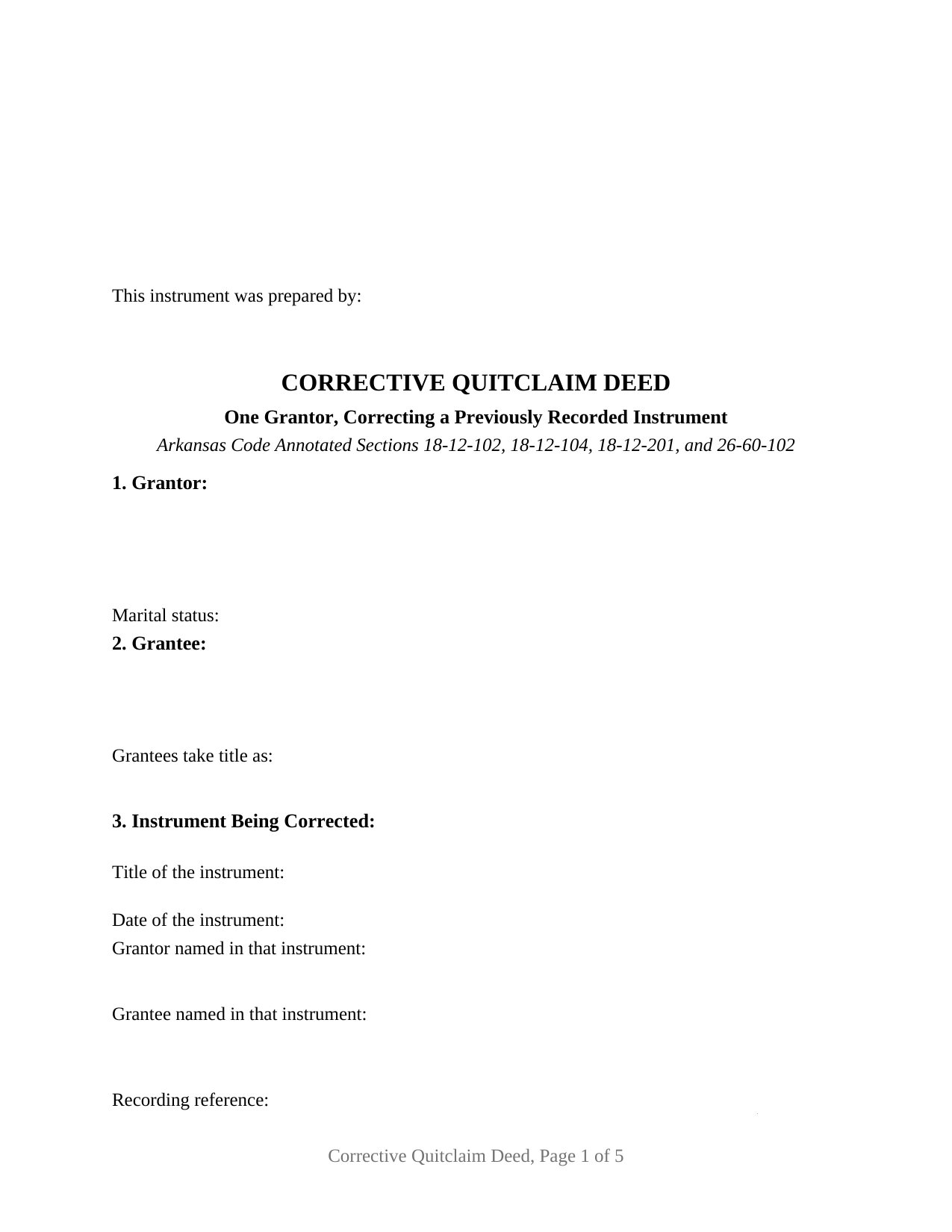
Nothing already filed in an Arkansas circuit clerk's office can be edited; the image on the county's roll is the image the county keeps. Fixing what it says takes a second recorded document, and this one is a deed. It names the earlier instrument by its recording reference, sets the wording as recorded beside the wording that was meant, and releases the interest again. The form is configured for one individual grantor and one previously recorded instrument.
The one place Arkansas statutes name this instrument
No Arkansas statute prescribes a corrective deed or defines one. The code notices it in the transfer tax chapter, where Section 26-60-102 exempts an instrument given to correct or replace a previously recorded instrument on which the full tax was paid. One conveyancing rule then shapes the document: Section 14-15-404 dates constructive notice from the moment of filing, so a correction is read as its own transaction, not folded backward into the first.
An affidavit that reaches only certain facts
Arkansas offers a sworn alternative with a narrow reach. Section 18-12-108 covers the identification, marital status, heirship, relation, death, or time of death of a party, the identification of an entity party, or the legal description of the land. Such an affidavit is titled conspicuously as a Scrivener's Affidavit and recites who prepared the original document, every party to it, its recording data, and each error. Its notice runs from its own recording, except that an obvious error carries notice from the original recording, an exception yielding to a bona fide purchaser. That affidavit is filed on its own and is not included here. A change in who takes, or in the form of ownership, belongs to a conveyance.
Defects Arkansas forgives without a new filing
Section 18-12-208 keeps a family of problems from reaching this stage. A recorded instrument is not defeated because the officer left required words out of the certificate, omitted or misused the seal, or failed to state the date; it still gives constructive notice. A valid jurat may even stand in for a certificate of acknowledgment on instruments recorded since April 8, 2013.
One grantor, one certificate, and a section for the old deed
Section 3 is the part no ordinary conveyance carries: the title of the earlier document, its date, the parties it names, its recording reference and date, and the county holding it. Section 4 sits beneath, with the statement as recorded and the corrected statement. The rest is a conveyance. One individual grantor signs above a marital status entry, two disinterested witnesses subscribe under Section 18-12-104, and one notarial certificate follows, because the grantor alone is acknowledged. The grantee block carries a vesting line, which matters more here than usual, since a mis-stated tenancy is among the errors this instrument settles. The records show the pattern: a granting clause naming two people and never saying how they take, a description borrowing a lot number from the tract next door, a spelling at odds with the chain. A deed by two owners, one signed for an entity or an agent, and one carrying a spousal release, sit outside these blocks.
Words that promise nothing, chosen twice
Section 18-12-102 loads three covenants onto a deed resting on the words grant, bargain and sell, absent express limiting words, so a correcting instrument meant to add nothing to the original bargain keeps clear of that phrasing. This one operates by remise, release, and forever quitclaim, and states on its face that no statutory covenant arises and that it does not vacate or replace what it corrects. Both documents stay of record, read together.
Stamps already paid, and the counter
The deed prints both statutory statements from Section 26-60-110 with a line naming the one that fits, so a correction of a fully taxed instrument records under the exemption, while a taxable filing keeps the certification and its signature line for the grantee or agent. Since August 5, 2025 the grantor's photo identification travels with a deed handed across the counter, under Act 752 and its exceptions.
What ships with this form
The download carries the corrective quitclaim deed as a fillable PDF, a completed example worked through an Independence County correction of a tenancy the recorded deed left unstated, and a plain language guide to the blanks, the formalities, and recording. Shoppers reach it looking for a correction deed, a corrective quit claim deed, or a quick claim deed fixing an error. The materials are informational and are not legal advice.
Important: County-Specific Forms
Our quitclaim deed (corrective) forms are specifically formatted for each of the 75 counties in Arkansas.
After selecting your county, you'll receive forms that meet all local recording requirements, ensuring your documents will be accepted without delays or rejection fees.