Mendocino County Quitclaim Deed (Divorce) Form
Last validated October 5, 2026 by our Forms Development TeamFormatted for recording in Mendocino County, for property anywhere in the county: rural and unincorporated areas as well as Albion, Boonville, Branscomb, Calpella, Caspar, Comptche, Covelo, Dos Rios and 20 more.
- 3 documents included
- Immediate PDF download
- Formatting guarantee
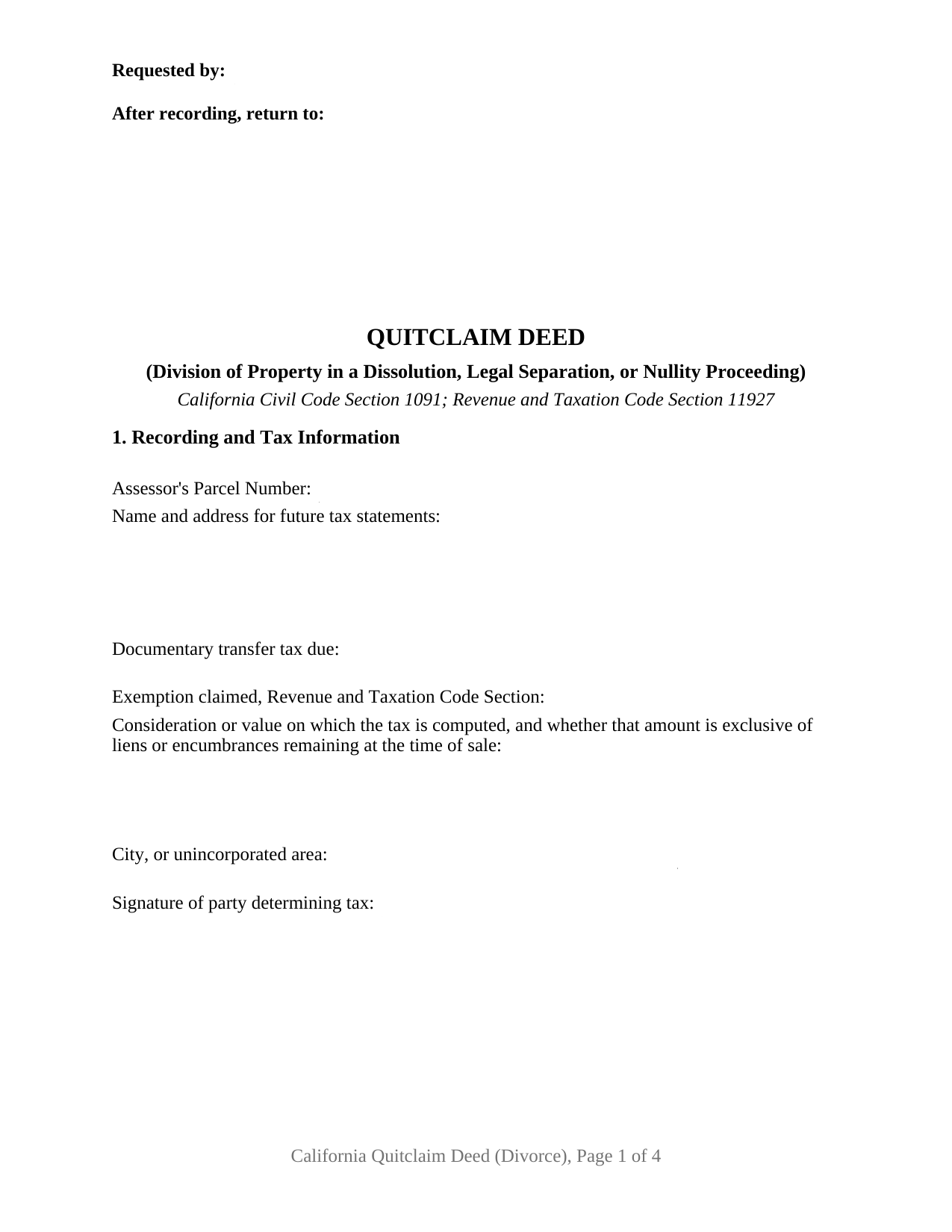
Mendocino County Quitclaim Deed (Divorce) Form
Fill in the blank Quitclaim Deed (Divorce) form formatted to comply with all California recording and content requirements.
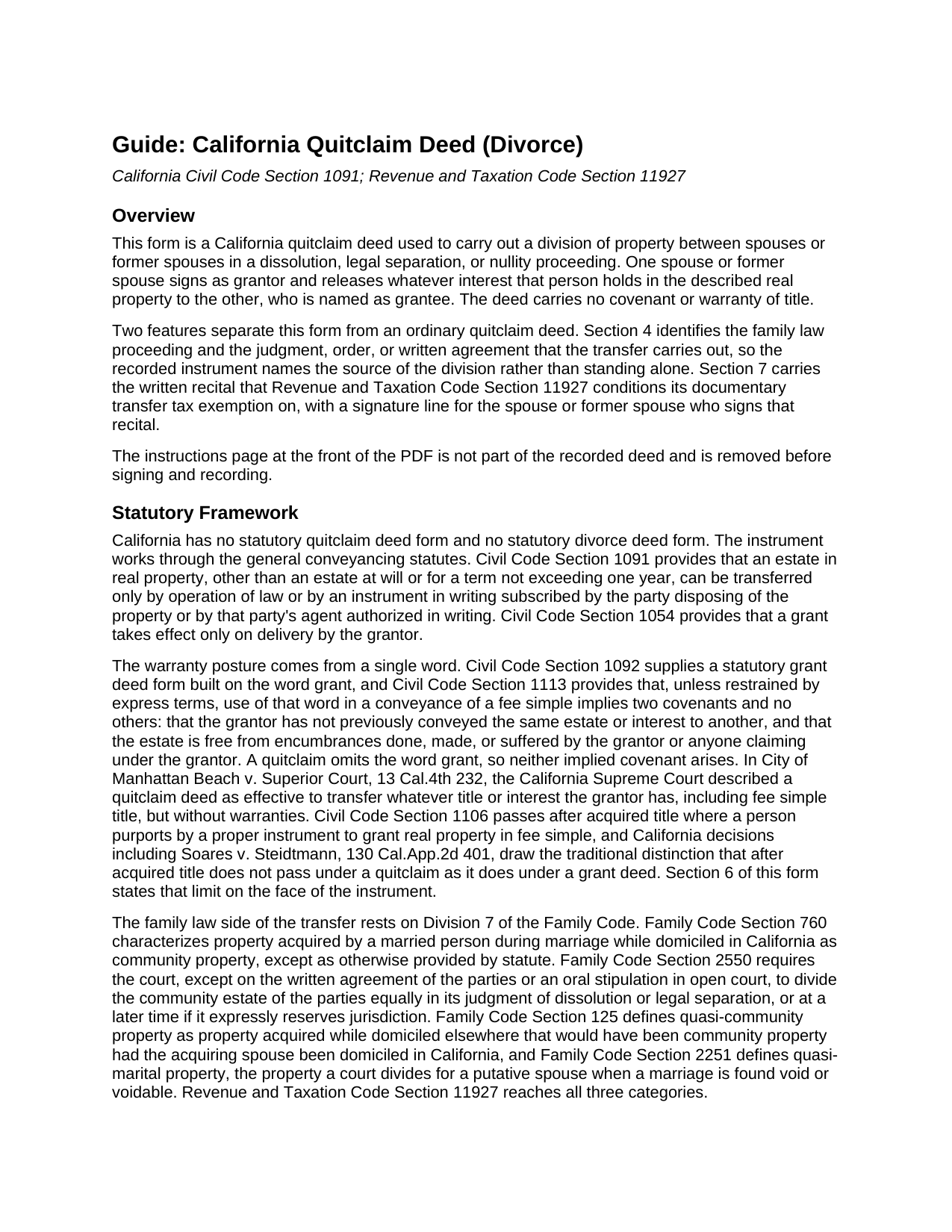
Mendocino County Quitclaim Deed (Divorce) Guide
Line by line guide explaining every blank on the Quitclaim Deed (Divorce) form.
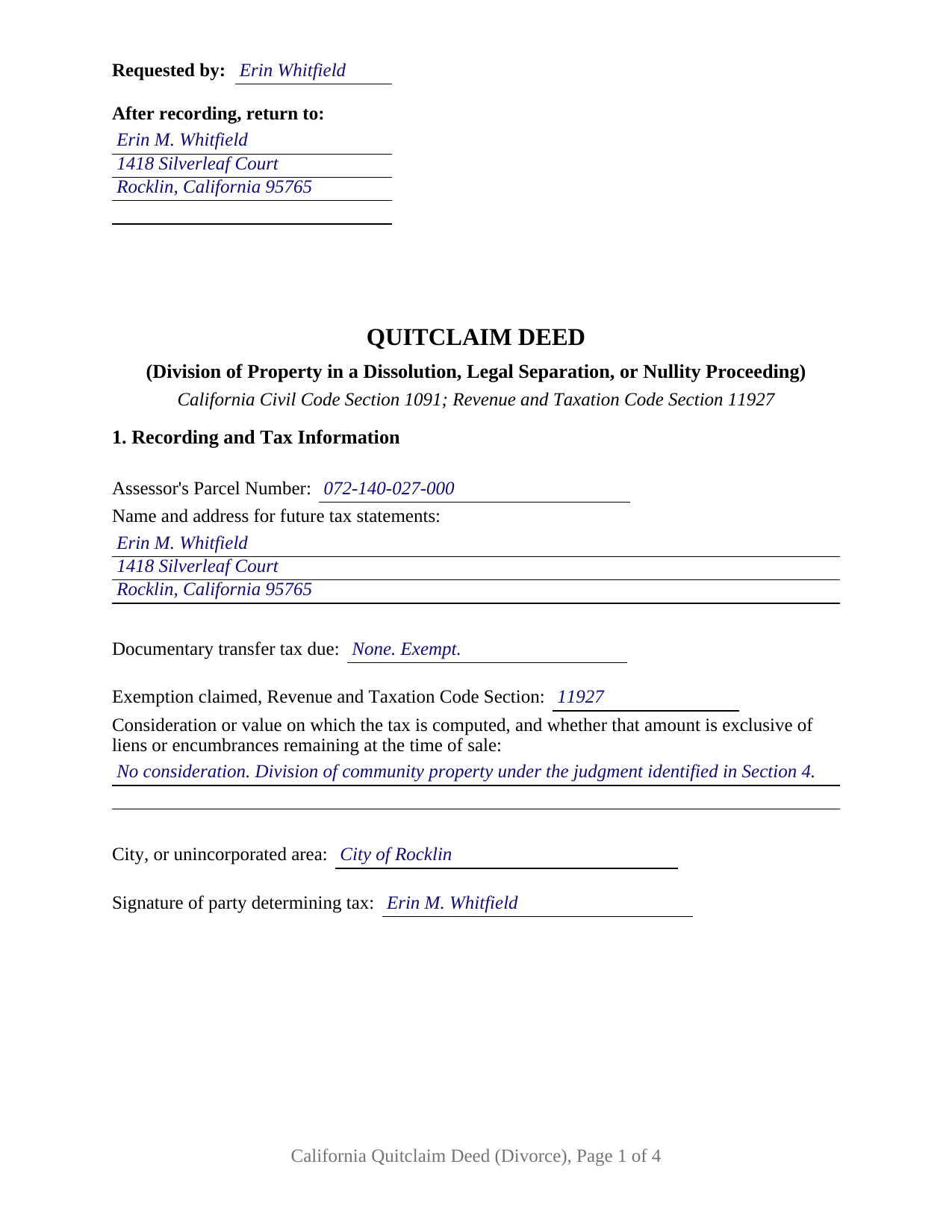
Mendocino County Completed Example of the Quitclaim Deed (Divorce) Document
Example of a properly completed California Quitclaim Deed (Divorce) document for reference.
All 3 documents above included • One-time purchase • No recurring fees
Immediate Download • Secure Checkout
Additional California and Mendocino County documents included at no extra charge:
Where to Record Your Documents
Mendocino County Recorder
Ukiah, California 95482-4438
Hours: Mon - Fri: 8:00 am to 5:00 pm
Phone: (707) 234-6822
Recording Tips for Mendocino County:
- Bring your driver's license or state-issued photo ID
- Ensure all signatures are in blue or black ink
- Recorded documents become public record - avoid including SSNs
- Recording fees may differ from what's posted online - verify current rates
- Request a receipt showing your recording numbers
Cities and Jurisdictions in Mendocino County
Properties in any of these areas use Mendocino County forms:
- Albion
- Boonville
- Branscomb
- Calpella
- Caspar
- Comptche
- Covelo
- Dos Rios
- Elk
- Fort Bragg
- Gualala
- Hopland
- Laytonville
- Leggett
- Little River
- Manchester
- Mendocino
- Navarro
- Philo
- Piercy
- Point Arena
- Potter Valley
- Redwood Valley
- Talmage
- Ukiah
- Westport
- Willits
- Yorkville
Hours, fees, requirements, and more for Mendocino County
How do I get my forms?
Forms are available for immediate download after payment. The Mendocino County forms will be in your account ready to download to your computer. An account is created for you during checkout if you don't have one. Forms are NOT emailed.
Are these forms guaranteed to be recordable in Mendocino County?
Yes. Our form blanks are guaranteed to meet or exceed the applicable formatting requirements used for recording in Mendocino County, including margin requirements, font requirements, and other layout standards. This guarantee applies to formatting, not to the legal sufficiency of information entered by the user or the suitability of a form for a particular transaction.
Can I reuse these forms?
Yes. You can reuse the forms for your personal use. For example, if you have multiple properties in Mendocino County you only need to order once.
What do I need to use these forms?
The forms are PDFs that you fill out on your computer. The free Adobe Acrobat Reader is recommended, and most PDF apps also work. You do NOT enter your property information online - you download the blank forms and complete them privately on your own computer.
Are there any recurring fees?
No. This is a one-time purchase. Nothing to cancel, no memberships, no recurring fees.
How much does it cost to record in Mendocino County?
Recording fees in Mendocino County vary. Contact the recorder's office at (707) 234-6822 for current fees.
Questions answered? Let's get started!
A California quitclaim deed drawn for a divorce carries something an ordinary release never needs: a case number, and a recital the tax statute writes for it. This form prepares that configuration, one spouse or former spouse releasing an interest to the other to carry out a division of property in a dissolution, legal separation, or nullity proceeding, with the judgment or agreement behind it named on the deed.
The Sentence Revenue and Taxation Code Section 11927 Asks For
Most transfer tax exemptions are claimed by entering a code section on a line; this one is drafted differently. Subdivision (a) of Section 11927 lifts the documentary transfer tax from a deed that transfers, divides, or allocates community, quasi-community, or quasi-marital property assets between spouses to effect a division required by a judgment of dissolution or legal separation, a judgment of nullity, another judgment or order rendered under the Family Code, or a written agreement executed in contemplation of such a judgment, incorporated into it or not. Subdivision (b) then conditions the exemption on a written recital, signed by either spouse, stating that the instrument is entitled to it. Section 7 of this deed is that recital, tracking the statutory language, with its own signature line and date. The statute takes the signature of either spouse, so either one may sign it.
A Deed That Names the Case Behind It
Section 4 identifies the source of the division: the county whose superior court holds the case, the case number, the judgment or order and the date it was entered, and any written agreement between the parties and its date. Both routes have lines because Section 11927 reaches both. Naming them ties the recorded conveyance to a proceeding a later title examiner can locate, which matters because the judgment itself commonly never reaches the county index. The deed records the transfer; the judgment decides the division.
Signing While the Case Is Open
Timing is its own subject in a dissolution. Family Code Section 2040 puts a temporary restraining order in the summons that restrains both parties from transferring, encumbering, hypothecating, concealing, or in any way disposing of property, real or personal, whether community, quasi-community, or separate, without the written consent of the other party or an order of the court, apart from the usual course of business and the necessities of life. A deed signed before judgment sits against that order, which names the two openings out of it: written consent, and a court order. A judgment awarding the property is such an order.
A Release Without Promises
Nothing about the state of the title is promised. California ties its two everyday implied covenants to conveyances drawn on the word grant under Civil Code Section 1113; this instrument, typed by many people as a quit claim deed, is drawn on other words. Section 6 states the rest expressly: what crosses is the interest the grantor holds at delivery, and title reaching the grantor afterward stays outside the deed.
One Grantor, Two Signature Lines, One Certificate
The form recites a single individual grantor, a spouse or former spouse signing personally, and a single grantee taking from that person, with a manner of taking title entry that on a divorce deed commonly reads as sole and separate property. One signature line closes the conveyance in Section 8, followed by a single California all-purpose acknowledgment certificate headed by the identity notice Civil Code Section 1189 prints in an enclosed box. The other signature line belongs to the tax recital and is not notarized. Patterns of this shape fill California grantor indexes: a former spouse executing after entry of a judgment that awarded the residence to the other party, a party executing during the case with the other party's written consent, a putative spouse conveying quasi-marital property under a nullity judgment, and a parcel bought while the couple lived elsewhere, which a California court treats as quasi-community property. Two owners conveying together to an outside buyer, and an entity, a trustee, or an agent under a power of attorney, sign through structures this block does not carry.
Three files come with this configuration: the deed as a fillable PDF, a completed example filled in for a Placer County release after a judgment of dissolution, and a plain language guide walking through each numbered section, the tax entries, the acknowledgment, and the county filing steps. Everything here describes California law in general terms; none of it is legal advice about a particular judgment, marriage, or parcel.
Important: Your property must be located in Mendocino County to use these forms. Documents should be recorded at the county recording office listed above.
This Quitclaim Deed (Divorce) meets all recording requirements specific to Mendocino County.
Our Promise
The documents you receive here are guaranteed to meet or exceed the applicable Mendocino County recording format requirements. If there is a rejection caused by our formatting, we will correct the issue or refund your payment. This guarantee applies to document formatting only and does not extend to information entered by the user, the selection of the form, or the legal effect of the completed document.
Save Time and Money
Get your Mendocino County Quitclaim Deed (Divorce) form done right the first time with Deeds.com Uniform Conveyancing Blanks. At Deeds.com, we understand that your time and money are valuable resources, and we don't want you to face a penalty fee or rejection imposed by a county recorder for submitting nonstandard documents. We constantly review and update our forms to meet rapidly changing state and county recording requirements for roughly 3,500 counties and local jurisdictions.
4.8 out of 5 - ( 4,818 Reviews )
Gary K. 4 out of 5 stars
Straightforward and pretty easy to use. The only downside is that there is no way to contact them directly. The number on the website is answered only by a voicemail with no return calls. Pricing seems fair compared to other services and much more efficient that filing "over the counter."
Thank you for your feedback. We really appreciate it. Have a great day!
Nancy R. 5 out of 5 stars
Deeds.com is very precise, helpful and friendly. I found the form I needed without any effort and everything worked perfect and smooth. I recommend it 100%. Thank you.
We are delighted to have been of service. Thank you for the positive review!
Karen S. 5 out of 5 stars
Excellent support! They were patient and knowledgeable.
Thank you!
Brandon O. 5 out of 5 stars
Simple and quick recording.
We appreciate your review and your business. Thank you.
Tamra L. 5 out of 5 stars
excellent instructions and clear forms. Thank you for your service!
Glad everything was clear and easy to follow. We appreciate you taking the time to share this.
Linda B. 5 out of 5 stars
Very simple, fast and efficient.
We appreciate your business and value your feedback. Thank you. Have a wonderful day!
Niki G. 5 out of 5 stars
Absolutely love the Golden Girls homage in the quit claim deed example. Funny stuff!
Thanks for the feedback Niki. Glad you enjoyed our attempt to spice up the mundane. Have an amazing day.
Jing H. 5 out of 5 stars
Excellent work. I have recommended some friends to your website and will continue. Thanks.
Thank you Jing. Have a fantastic day!
Stanley P. 5 out of 5 stars
Fast accurate service
We appreciate your business and value your feedback. Thank you. Have a wonderful day!
Fernando C. 5 out of 5 stars
I was happy with my purchase. I honestly received more than I expected . I recommend you expand to offer more forms such as Living Will.
We appreciate your business and value your feedback. Thank you. Have a wonderful day!
constance t. 5 out of 5 stars
Excellent service!
We appreciate your business and value your feedback. Thank you. Have a wonderful day!
Anna P. 5 out of 5 stars
Deeds.com was a life saver! I was able to have a document recorded the very same day of my request. Thank you for taking care of this! Top notch service.
Thank you!
Rosemary W. 5 out of 5 stars
considering the current epidemic your fees save me time and parking fees. with help from DC recorder of deeds I was directed to the correct link to process my deed
Thank you for your feedback. We really appreciate it. Have a great day!
Karen B. 5 out of 5 stars
Completed although having the sample really helped. Now to file.
Thank you for your feedback. We really appreciate it. Have a great day!
Jay W. 5 out of 5 stars
your service is more than I expected easy to navigate, great info, easy to understand. other other sites every time you go to next page there is something to buy to get the info you want. Jay
Thank you!