California Quitclaim Deed (Divorce)
County Specific Legal Forms Validated as recently as September 14, 2026 by our Forms Development Team
About the California Quitclaim Deed (Divorce)
How to Use This Form
- Select your county from the list
- Download the county-specific form
- Fill in the required information
- Have the document notarized if required
- Record with your county recorder's office
What Others Like You Are Saying
"had exactly what i needed and good price"
"I liked having the forms. Some may need to know they can look at the legal Description from online c…"
"This was my first experience with Deeds. Web site instructions are detailed and easy to understand. …"
"Very please with the service"
"Awesome same-day service!"
4.8/5 from 4,795 reviews. Read all
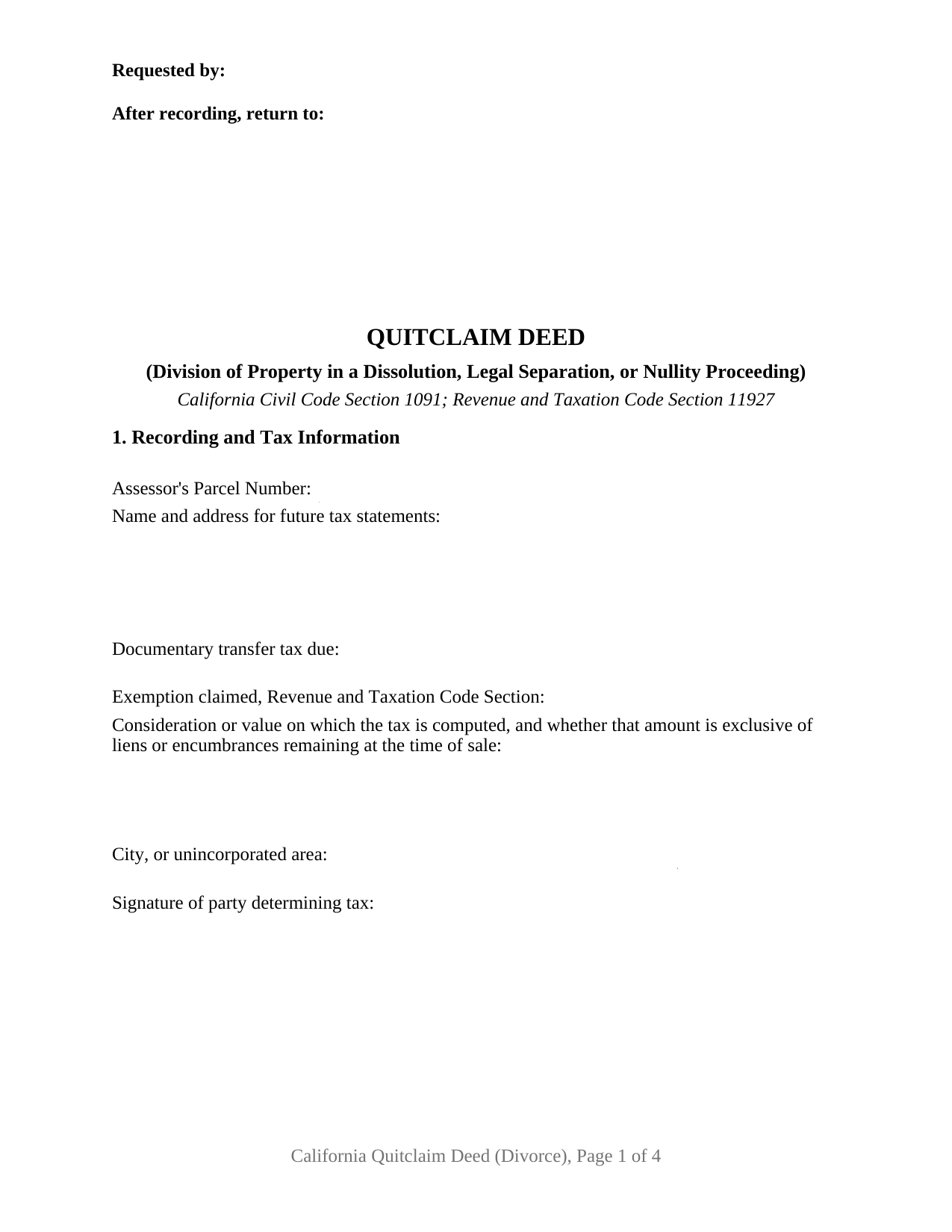
A California quitclaim deed drawn for a divorce carries something an ordinary release never needs: a case number, and a recital the tax statute writes for it. This form prepares that configuration, one spouse or former spouse releasing an interest to the other to carry out a division of property in a dissolution, legal separation, or nullity proceeding, with the judgment or agreement behind it named on the deed.
The Sentence Revenue and Taxation Code Section 11927 Asks For
Most transfer tax exemptions are claimed by entering a code section on a line; this one is drafted differently. Subdivision (a) of Section 11927 lifts the documentary transfer tax from a deed that transfers, divides, or allocates community, quasi-community, or quasi-marital property assets between spouses to effect a division required by a judgment of dissolution or legal separation, a judgment of nullity, another judgment or order rendered under the Family Code, or a written agreement executed in contemplation of such a judgment, incorporated into it or not. Subdivision (b) then conditions the exemption on a written recital, signed by either spouse, stating that the instrument is entitled to it. Section 7 of this deed is that recital, tracking the statutory language, with its own signature line and date. The statute takes the signature of either spouse, so either one may sign it.
A Deed That Names the Case Behind It
Section 4 identifies the source of the division: the county whose superior court holds the case, the case number, the judgment or order and the date it was entered, and any written agreement between the parties and its date. Both routes have lines because Section 11927 reaches both. Naming them ties the recorded conveyance to a proceeding a later title examiner can locate, which matters because the judgment itself commonly never reaches the county index. The deed records the transfer; the judgment decides the division.
Signing While the Case Is Open
Timing is its own subject in a dissolution. Family Code Section 2040 puts a temporary restraining order in the summons that restrains both parties from transferring, encumbering, hypothecating, concealing, or in any way disposing of property, real or personal, whether community, quasi-community, or separate, without the written consent of the other party or an order of the court, apart from the usual course of business and the necessities of life. A deed signed before judgment sits against that order, which names the two openings out of it: written consent, and a court order. A judgment awarding the property is such an order.
A Release Without Promises
Nothing about the state of the title is promised. California ties its two everyday implied covenants to conveyances drawn on the word grant under Civil Code Section 1113; this instrument, typed by many people as a quit claim deed, is drawn on other words. Section 6 states the rest expressly: what crosses is the interest the grantor holds at delivery, and title reaching the grantor afterward stays outside the deed.
One Grantor, Two Signature Lines, One Certificate
The form recites a single individual grantor, a spouse or former spouse signing personally, and a single grantee taking from that person, with a manner of taking title entry that on a divorce deed commonly reads as sole and separate property. One signature line closes the conveyance in Section 8, followed by a single California all-purpose acknowledgment certificate headed by the identity notice Civil Code Section 1189 prints in an enclosed box. The other signature line belongs to the tax recital and is not notarized. Patterns of this shape fill California grantor indexes: a former spouse executing after entry of a judgment that awarded the residence to the other party, a party executing during the case with the other party's written consent, a putative spouse conveying quasi-marital property under a nullity judgment, and a parcel bought while the couple lived elsewhere, which a California court treats as quasi-community property. Two owners conveying together to an outside buyer, and an entity, a trustee, or an agent under a power of attorney, sign through structures this block does not carry.
Three files come with this configuration: the deed as a fillable PDF, a completed example filled in for a Placer County release after a judgment of dissolution, and a plain language guide walking through each numbered section, the tax entries, the acknowledgment, and the county filing steps. Everything here describes California law in general terms; none of it is legal advice about a particular judgment, marriage, or parcel.
Important: County-Specific Forms
Our quitclaim deed (divorce) forms are specifically formatted for each of the 58 counties in California.
After selecting your county, you'll receive forms that meet all local recording requirements, ensuring your documents will be accepted without delays or rejection fees.