California Transfer on Death Revocation
County Specific Legal Forms Validated as recently as September 16, 2026 by our Forms Development Team
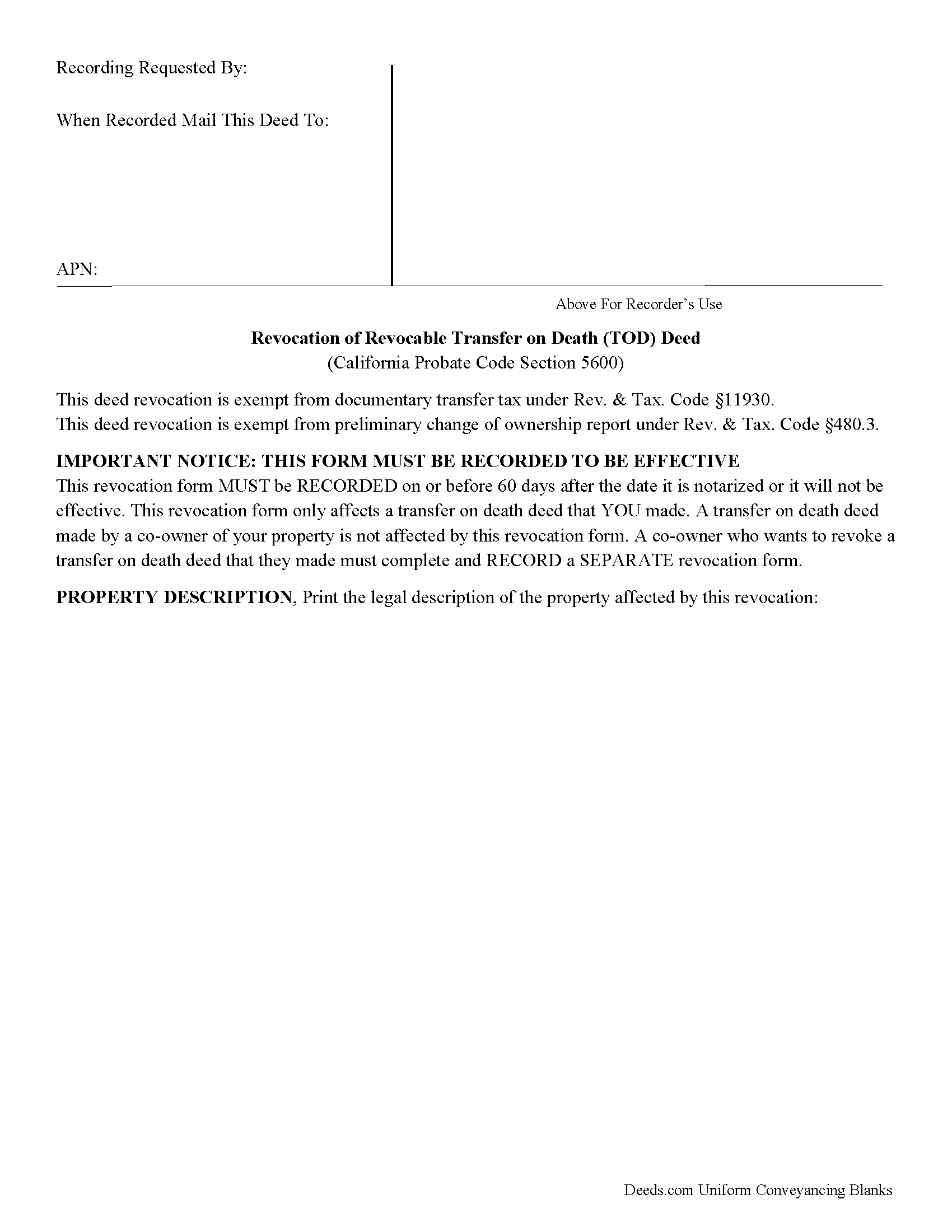
About the California Transfer on Death Revocation
How to Use This Form
- Select your county from the list
- Download the county-specific form
- Fill in the required information
- Have the document notarized if required
- Record with your county recorder's office
What Others Like You Are Saying
"This company and it's customer service ARE wonderful. GREAT tool to assist you with any situation yo…"
"Super easy to use! Totally satisfied. Thanks."
"Very helpful and quick customer service. Highly recommended"
"No review provided."
"Very easy to use and organized. When I needed the form I needed it immediately. I didn't want to get…"
4.8/5 from 4,828 reviews. Read all
A recorded California transfer on death deed does not expire, and it cannot be undone by a will. It sits in the county records and waits. The instrument that stops it is the Revocation of Revocable Transfer on Death (TOD) Deed, and the Legislature wrote the form: Probate Code Section 5644 provides that a transferor may revoke a revocable transfer on death deed by an instrument in substantially the form the section prints. This package prepares that California form, for a TOD deed, sometimes called a beneficiary deed, already recorded against residential property.
A form the statute prints, not a form drafted around it
Section 5644 is a form statute, so the page belongs to the statute. The title and citation line, the recitals that the document is exempt from documentary transfer tax under Revenue and Taxation Code Section 11930 and from the preliminary change of ownership report under Section 480.3, the recording notice, the property description lead, the revocation sentence, the captioned signature row, the witness columns, and the notary certificate all come from Section 5644. The revocation sentence is the operative line: I revoke any TOD deed to transfer the described property that I executed before executing this form. One sentence, and it reaches every transfer on death deed the signer executed before signing the revocation, not only the latest one.
Sixty days, counted from the notarization
Probate Code Section 5632 says the revoking instrument is executed and recorded in the same manner as the deed it revokes, which imports Section 5626: recordation falls on or before 60 days after the date the instrument was acknowledged before a notary. That clock, measured from the notarization rather than from the signing, arrived with SB 315, Chapter 215, Statutes of 2021, for instruments signed on or after January 1, 2022. A revocation form that is signed, witnessed, and notarized but left in a drawer accomplishes nothing, because Section 5644 works through the record, and the power to revoke ends at the transferor's death.
One signer, two witnesses, one certificate
The form carries one signature row under the statute's captions, Signature of Grantor, Date, and Typed or Printed Name of Grantor, and one acknowledgment certificate for that signer. Below it sit two witness columns. Probate Code Section 5624 requires two persons, both present at the same time, who witness either the signing or the signer's acknowledgment of it, and the statutory sentence on the form states that the witness signatures are not notarized. Section 5625 adds that a beneficiary who signs as a witness raises a statutory presumption of duress, menace, fraud, or undue influence. Section 5632 leaves the beneficiary out of the process altogether: joinder, consent, agreement, and notice are not required.
What the revocation reaches, and what it leaves alone
The statutory notice on the face of the form marks the boundary: it affects only a transfer on death deed made by the person who signs it. Where two co-owners each recorded a deed, each records a separate revocation form. Title itself does not move. The revocation transfers nothing, names no beneficiary, and leaves liens, easements, leases, and the form of vesting as they stood. Property held at death in joint tenancy or as community property with right of survivorship is governed by the right of survivorship under Probate Code Section 5664, whatever a transfer on death deed says.
Recording, with no tax declaration attached
The completed instrument is recorded with the county recorder where the property sits. Probate Code Section 5656 provides that execution, recordation, and revocation of a transfer on death deed are not a change in ownership and call for no documentary transfer tax, no tax declaration, and no preliminary change of ownership report, which is why the form prints exemption recitals rather than a tax line. Recording fees under Government Code Sections 27361 and 27388.1 still apply, and format rules govern the page: 2.5 inches reserved at the top of the first page, a title indexed from that page, and legible printed names beside every signature.
The package includes the fillable form, a completed example built on a Riverside County fact pattern, and a guide that walks the statutory form block by block with its citations. It is a form package and general information, not legal advice; a California attorney can address a specific title, family, or estate.
Important: County-Specific Forms
Our transfer on death revocation forms are specifically formatted for each of the 58 counties in California.
After selecting your county, you'll receive forms that meet all local recording requirements, ensuring your documents will be accepted without delays or rejection fees.