Colorado Revocation of Beneficiary Deed
County Specific Legal Forms Validated as recently as November 3, 2026 by our Forms Development Team
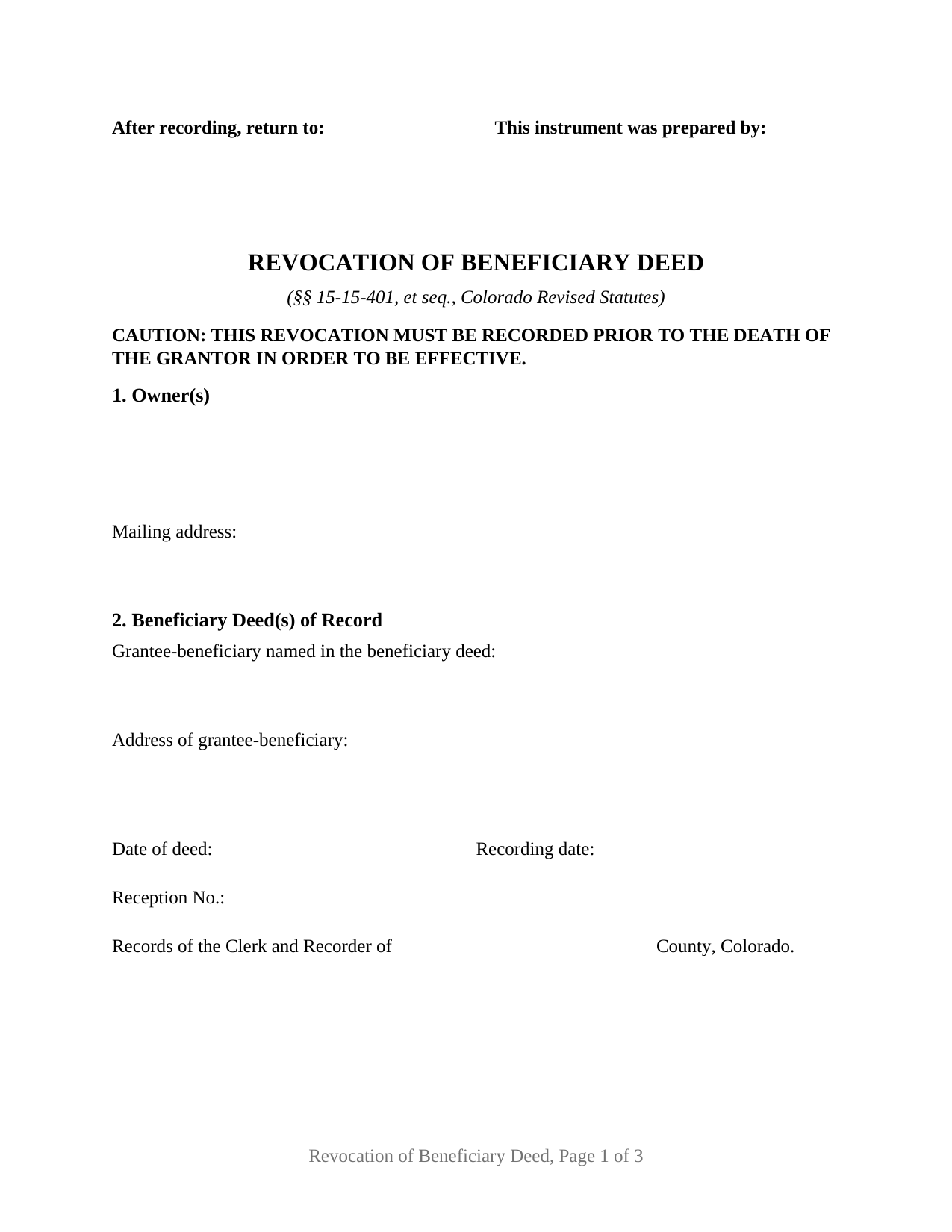
About the Colorado Revocation of Beneficiary Deed
How to Use This Form
- Select your county from the list
- Download the county-specific form
- Fill in the required information
- Have the document notarized if required
- Record with your county recorder's office
What Others Like You Are Saying
"The transaction was fairly simple. thank you"
"Very responsive and helpful. Made a big task quite easy and effecient. I would highly recommend. Rea…"
"AMAZING! Easy to use, reasonable fee - and get MUCH MORE than just a deed form. I ordered a "de…"
"Good organization and guidance."
"Works well. Very satisfied."
4.8/5 from 4,842 reviews. Read all
A Colorado beneficiary deed stays revocable for the owner's entire life, and section 15-15-405 of the Colorado Revised Statutes says exactly how the revocation is done: an instrument, executed by the owner, that describes the real property, revokes the deed, and is recorded with the county clerk and recorder before the owner dies. This fillable Colorado Revocation of Beneficiary Deed prepares that instrument for one or two owners who signed a recorded beneficiary deed in their own names.
A revocation that reaches every beneficiary deed on the property
Colorado's optional statutory revocation form does something many other states' forms do not. Its operative sentence does not cancel one identified deed; the grantor revokes all beneficiary deeds concerning the described real property. This form carries that sentence verbatim, so an owner who recorded a beneficiary deed and later a replacement clears the record for the described parcel in one instrument. The form still identifies the beneficiary deed of record by date, recording date, reception number, and county, with the grantee-beneficiary's name and address, and a closing sentence states that the identification does not narrow the revocation.
The grantee-beneficiary has no role in the process; section 15-15-405(1) provides that the grantee-beneficiary's joinder, signature, consent, agreement, or notice is not required for the revocation to be effective.
Recorded before death, ranked by the date signed
Two timing rules shape this instrument. The first is the caution printed at the top of the form in the statute's own capital letters: the revocation must be recorded prior to the death of the grantor in order to be effective. A signed revocation left unrecorded at the owner's death revokes nothing, and section 15-15-405(4) provides that a beneficiary deed cannot be revoked, altered, or amended by the owner's will.
The second rule is less familiar. Under section 15-15-405(3), among all beneficiary deeds and revocations recorded before the owner's death, the most recently executed one controls regardless of the order of recording. The date each owner writes in the signature block is therefore the date that ranks this revocation against any beneficiary deed signed before or after it.
One or two owners on a single instrument
The form is built for a natural-person owner or two natural-person owners signing in their own right. Section 1 is an open block that receives one name or two, each with whatever marital-status recital the owner writes, and the signature section carries a block headed OWNER and a block headed SECOND OWNER (if applicable), each followed by its own acknowledgment certificate. Two spouses or two siblings who signed one beneficiary deed as joint tenants, and co-owners who signed as tenants in common, present the two-owner pattern this form accommodates; a sole owner leaves the second block and its certificate blank. The form is not set up as a revocation by a trustee, an entity, an attorney-in-fact, or three or more owners.
What the Colorado recording statutes ask of it
Because section 15-15-406 makes a revocation subject to the grantee-address rule of section 38-35-109(2), the form carries the grantee-beneficiary's address, the item a clerk is directed to look for before accepting a deed for record. It also carries the statutory form's Known and numbered as line for the street address beside the legal description, which section 38-35-122 asks of every document of title, and its margins follow section 30-10-406(3)(a). No state documentary fee is due on a revocation, because it conveys no title and recites no consideration, and the transfer declaration that accompanies a conveyance document does not reach it.
Recording and what follows
The signed and acknowledged revocation is recorded in the office of the clerk and recorder of the county where the property is located, for the per-document fee the county publishes. Once it is of record, the property passes at the owner's death under the owner's will, by intestacy, or under a survivorship estate. A new beneficiary deed naming a different grantee-beneficiary is a separate instrument, prepared and recorded separately and not included in this package, and under section 15-15-405(2) it revokes the earlier designation on its own.
The package includes the fillable revocation form, a completed example filled in for a Jefferson County fact pattern, and the guide that walks through every numbered section, the signing and notarization rules, and the recording process. This description and the guide describe the form and the governing Colorado statutes in general terms; they are not legal advice.
Important: County-Specific Forms
Our revocation of beneficiary deed forms are specifically formatted for each of the 64 counties in Colorado.
After selecting your county, you'll receive forms that meet all local recording requirements, ensuring your documents will be accepted without delays or rejection fees.