Colorado Affidavit of Deceased Grantor
County Specific Legal Forms Validated as recently as November 3, 2026 by our Forms Development Team
About the Colorado Affidavit of Deceased Grantor
How to Use This Form
- Select your county from the list
- Download the county-specific form
- Fill in the required information
- Have the document notarized if required
- Record with your county recorder's office
What Others Like You Are Saying
"Awesome, so far. Thanks"
"Good documents good price saved me a lot of money and time."
"WOW!!! Deeds.com came through with shinning colors. when I needed something recorded in a hurry and …"
"It was everything that I needed. The county clerk's office kept telling me to get a lawyer for this …"
"Thank you, easy to fill out forms. Now I can relax, knowing that this is done."
4.8/5 from 4,853 reviews. Read all
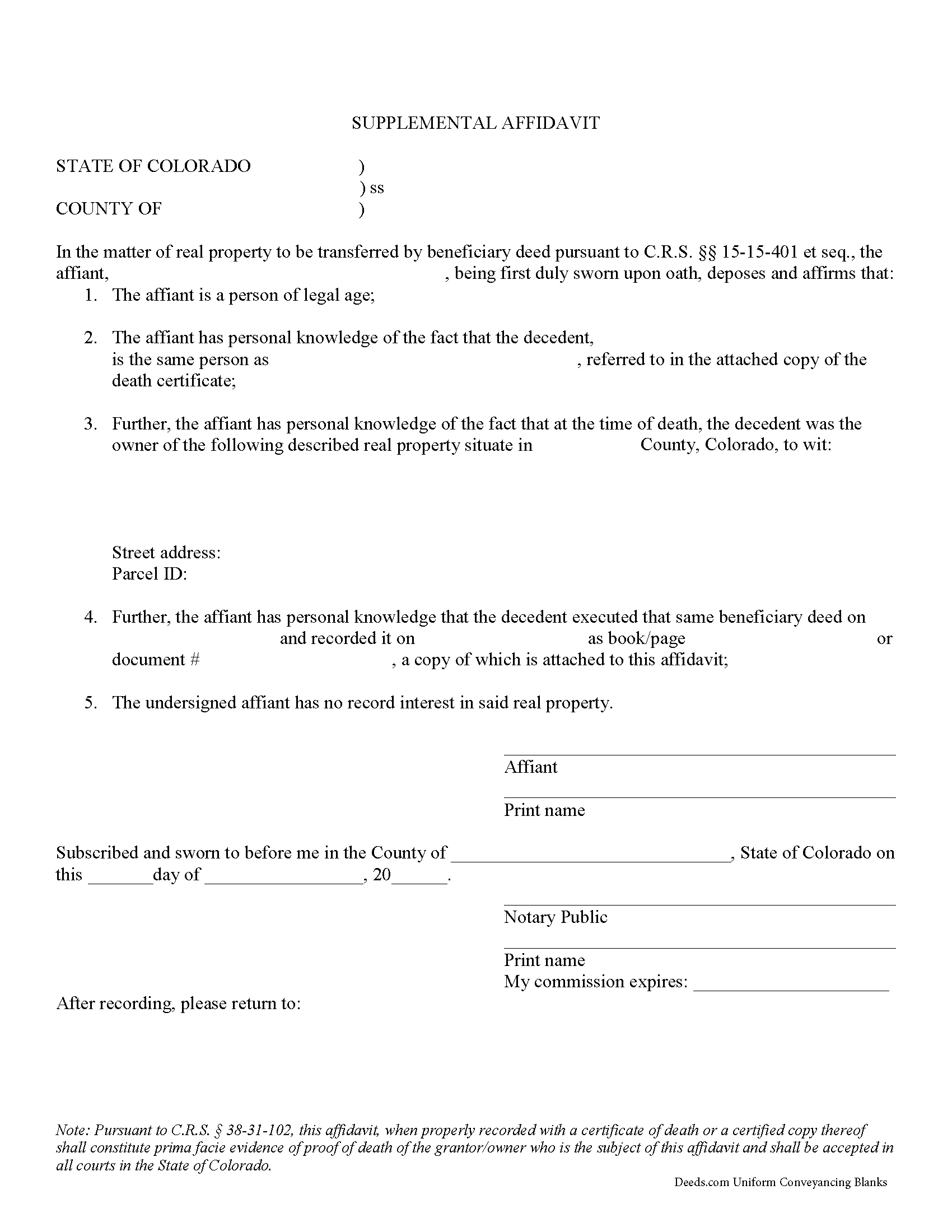
A Colorado beneficiary deed moves title to the named grantee-beneficiary at the moment the owner dies, but the public record does not know the owner has died until someone tells it. The Colorado Affidavit of Deceased Grantor is how the record is told: the supplementary affidavit that C.R.S. 38-31-102 pairs with a certificate of death, applied to the owner under a beneficiary deed through C.R.S. 15-15-413, recorded in the county where the land lies so the chain of title shows the death and the identity of the person who died with the grantor of record.
What the statute asks the affidavit to say
Colorado publishes no official form for this affidavit; it names the elements. The supplementary affidavit is sworn to or affirmed by a person of legal age with personal knowledge of the facts, it contains the legal description of the real property, and it states that the person referred to in the certificate of death is the same person named in a specific recorded instrument, here the beneficiary deed, identified by its date, recording date, and reception number. This form carries each of those elements, adds the date of death, the grantee-beneficiaries the deed names, and which of them survived the owner, and closes with the sworn statements that tie them together. Once recorded, the certificate and the affidavit must be accepted in every Colorado court as prima facie proof of the death.
Proof of death, not a transfer
The affidavit conveys nothing. Under C.R.S. 15-15-407(1), title vests in the grantee-beneficiary only on the death of the owner, by force of the deed the owner recorded during life; a beneficiary deed never recorded, or recorded after the death, transfers nothing an affidavit can repair. Recording the proof of death places the transfer in the index under the deceased owner's name and starts one of the limitation periods in C.R.S. 15-15-411, which bars certain claims against a grantee-beneficiary one year after that recording.
Who swears, and how
Since 2016 the affiant may be anyone of legal age with personal knowledge, including a grantee-beneficiary who holds the very interest the affidavit supports. The form carries a free-form affiant block for one or two natural persons swearing in their own right, two signature blocks captioned AFFIANT and SECOND AFFIANT, and a separate jurat certificate for each; a single affiant leaves the second block and certificate blank. The certificate is the Colorado verification on oath or affirmation short form, Signed and sworn to (or affirmed) before me on, a different notarial act from the acknowledgment on a deed. A false affidavit is perjury in the second degree under C.R.S. 38-31-104.
Where the deceased owner was a joint tenant
Under C.R.S. 15-15-408(1), a beneficiary deed signed by a joint tenant vests title in the grantee-beneficiary only if that joint tenant was the last of the joint tenants to die. The form states, conditionally, that if the deceased owner held as a joint tenant, the deceased owner survived every other joint tenant of that interest, a sentence that is simply inapplicable where the owner held alone. It also records which grantee-beneficiaries survived the owner, because C.R.S. 15-15-407(5) adds a non-surviving grantee-beneficiary's share to the surviving shares when the deed makes no other provision.
Recording in a flat-fee state
The affidavit and the death record go together to the clerk and recorder of the county where the property is located. Since July 1, 2025, Colorado recording fees are a flat charge per document regardless of page count, published by the counties at $43, and the statute allows no fee for a certificate of death or verification of death document. No documentary fee is due, because C.R.S. 39-13-104(1)(m) exempts any document necessary to transfer title as a result of an owner's death, and no real property transfer declaration accompanies a document on which no documentary fee is imposed. Where no certificate of death can be obtained, C.R.S. 38-31-103 provides a different affidavit sworn by two disinterested persons, a separate instrument not included in this package.
The package includes the fillable Colorado Affidavit of Deceased Grantor, a completed example filled in for a Larimer County fact pattern with two affiants, and the guide that walks through every numbered section, the oath, and the recording process. This description and the guide describe the form and the governing statutes in general terms; they are not legal advice.
Important: County-Specific Forms
Our affidavit of deceased grantor forms are specifically formatted for each of the 64 counties in Colorado.
After selecting your county, you'll receive forms that meet all local recording requirements, ensuring your documents will be accepted without delays or rejection fees.