Connecticut Grant Deed
County Specific Legal Forms Validated as recently as October 12, 2026 by our Forms Development Team
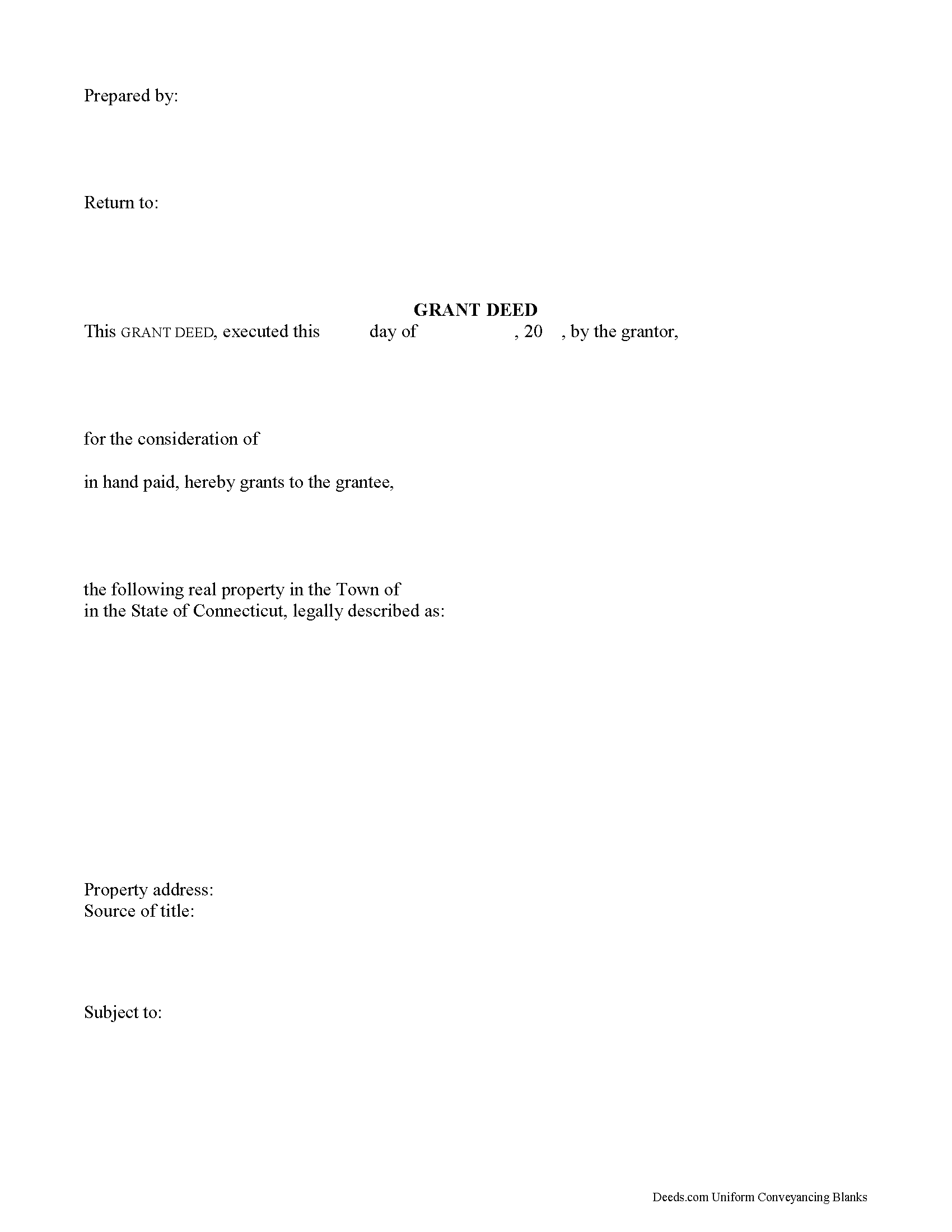
About the Connecticut Grant Deed
How to Use This Form
- Select your county from the list
- Download the county-specific form
- Fill in the required information
- Have the document notarized if required
- Record with your county recorder's office
What Others Like You Are Saying
"Very easy to use and I had no issues submitting my deed."
"Great experience. Easy."
"This was a very easy and organized system to use."
"Just found this site, what a great resource ! Thank you so much for providing affordable help to tho…"
"I loved the fact that the forms came with examples of the required info. That was helpful and made f…"
4.8/5 from 4,828 reviews. Read all
The list of Connecticut statutory forms of deeds (section 47-36c) does not include a form for a grant deed. However, the list of forms provided by statute does not preclude the use of any other type of legal deed. Grant deeds may also be referred to as special or limited warranty deeds in this state.
A grant deed transfers real property in Connecticut from one person or entity to another person or entity. Grant deeds warrant that the grantor actually owned the title that he or she is purporting to transfer. It guarantees that the property has not been sold to anyone else, and also that the property is not under any liens or restrictions that have not already been disclosed to the buyer.
The grantor to a grant deed in this state must sign the conveyance document and have his or her signature acknowledged. If acknowledged in Connecticut, acknowledgements can be made before a judge of a court of record, a clerk or commissioner of the Superior Court, a justice of the peace, a notary public, or a town clerk (47-5a). If acknowledged in a state other than Connecticut, acknowledgements may be made before any of the officers listed in 47-5a. Grant deeds executed out of state will be valid in Connecticut, so long as they have been executed and acknowledged according to the laws of that state (47-4).
Connecticut does not authorize county recording, so all real estate deeds should be recorded in the office of the town or city clerk where the property is located. Unless a grant deed is recorded in the office of the town clerk in the town where the property is located, it will not be effective to hold any land against any person other than the grantor and his heirs. Priority is given to the first recorded deed for the same real estate. Upon delivery to the grantee, a grant deed is effective as against the world, provided that it is recorded within a reasonable period of time following the delivery (47-10).
Important: County-Specific Forms
Our grant deed forms are specifically formatted for each of the 8 counties in Connecticut.
After selecting your county, you'll receive forms that meet all local recording requirements, ensuring your documents will be accepted without delays or rejection fees.