District Of Columbia Affidavit of Death (Surviving Joint Tenant)
County Specific Legal Forms Validated as recently as October 21, 2026 by our Forms Development Team
About the District Of Columbia Affidavit of Death (Surviving Joint Tenant)
How to Use This Form
- Select your county from the list
- Download the county-specific form
- Fill in the required information
- Have the document notarized if required
- Record with your county recorder's office
What Others Like You Are Saying
"Documents were provided quickly and as promised. Very Satisfied."
"Received exactly what you said I would get. Good Quick Service"
"Quick and easy, however, I couldn't get the guide to download."
"Yes it was awsome experience,thank you"
"Have used two times. Smooth transaction both times. Fast, simple and easy to use system. Would use t…"
4.8/5 from 4,850 reviews. Read all
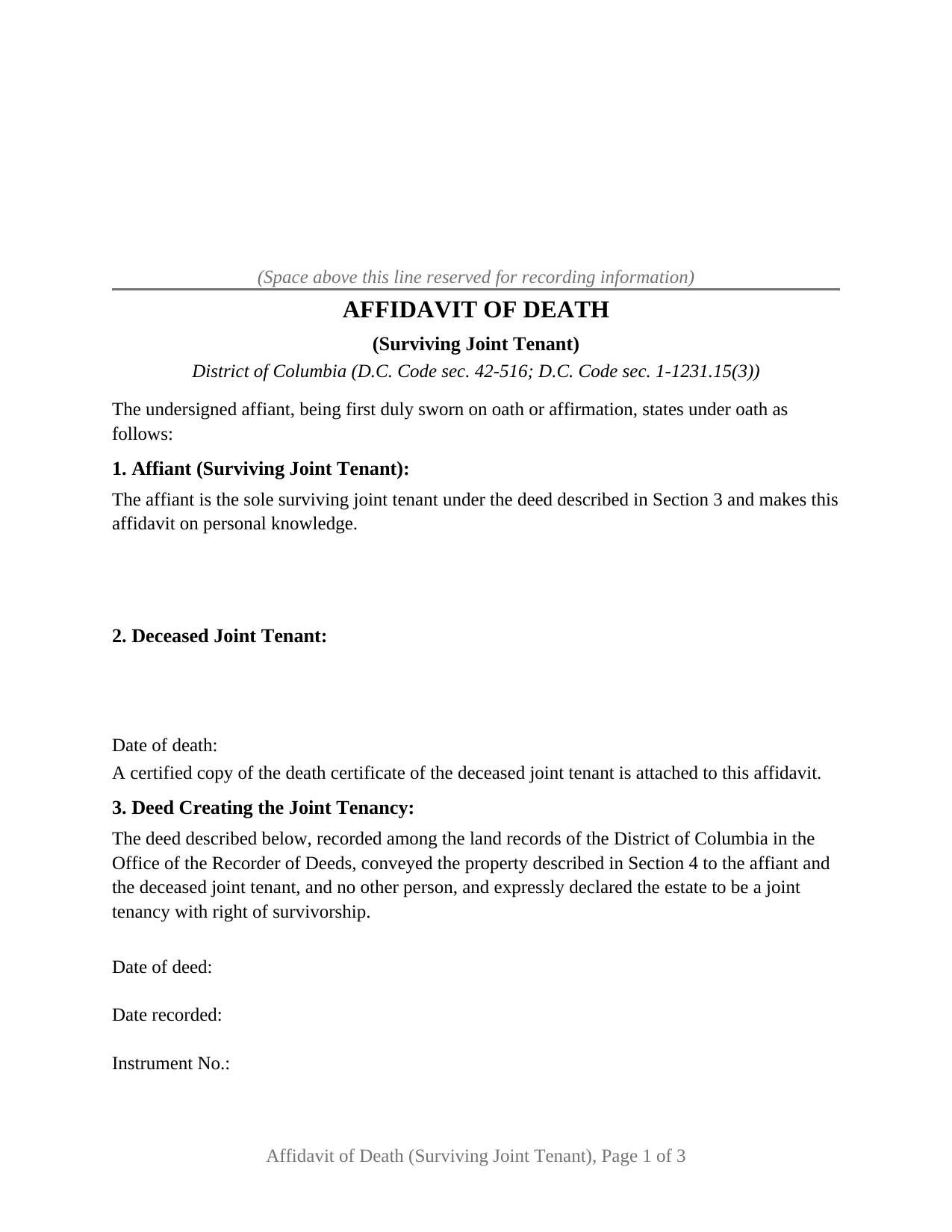
When one of two joint tenants dies, District of Columbia title passes to the survivor by the right of survivorship built into the estate, without probate and without a new deed from anyone. This Affidavit of Death prepares the sworn statement a sole surviving joint tenant records with the Office of the Recorder of Deeds, with a certified copy of the death certificate attached, to put that fact into the chain of title for District of Columbia real property.
A joint tenancy the District creates only with express words
The District is unusual in how it treats co-owners. Under D.C. Code section 42-516(a), every estate granted to two or more people, including a married couple or domestic partners, is a tenancy in common unless the deed expressly declares a joint tenancy. There is no survivorship by default, so the affidavit is built around the deed that said the words. Its statements identify that deed by date, recording date, and instrument number, and swear that it conveyed the property to exactly two people as joint tenants with right of survivorship. A deed to three or more joint tenants, a tenancy by the entirety between spouses, and a deed that is silent on vesting each describe a different ownership pattern from the one this affidavit recites.
What the surviving joint tenant swears to
The affidavit is sworn, not merely signed. Its opening sentence states that the affiant, being first duly sworn on oath or affirmation, states under oath as follows, and the numbered sections carry the facts a title examiner looks for after a co-owner's death: the affiant's identity as the sole surviving joint tenant; the deceased joint tenant's name and date of death; the deed that created the joint tenancy; the property by square, suffix, lot, and the full legal description the Recorder's published requirements call for on every document; and printed sworn statements that the deceased joint tenant is the grantee named in the deed, that the affiant survived, that the joint tenancy was not severed of record during the deceased joint tenant's lifetime, and that the affiant holds the entire estate by survivorship. The statement that a certified copy of the death certificate is attached has no blank, because the certificate travels with the affidavit when it is recorded.
A verification, not an acknowledgment
Because the instrument is an affidavit, the certificate below the notary line is a verification on oath or affirmation under D.C. Code section 1-1231.15(3), and the form prints that statutory sentence verbatim: Signed and sworn to (or affirmed) before me on a stated date by the named individual. The District's notarial law requires the certificate to be dated, to identify the jurisdiction where the act takes place, to carry the officer's title and commission expiration, and, on a paper record, to bear the notary's official seal, so the form reserves an area for the impression. An affiant who appears before a notary in Maryland or Virginia uses that state's officer and certificate; section 1-1231.10 gives the act the same effect as one performed in the District, and the Recorder's FAQ confirms that the office accepts notarial acts of other jurisdictions.
Where the affidavit fits with the Recorder's own practice
The Recorder of Deeds is a single office for the whole District, at 1101 4th Street SW, and its fee schedule lists $25 plus the $5 statutory surcharge to record documents other than deeds of trust. Its FAQ describes, for a transfer of title from a surviving joint tenant, a package of a newly drafted deed, Form FP-7/C, a copy of the death certificate, and the recorded prior deed, and states that a recital of the date of death in a deed does not take the place of the certificate. That package is a conveyance by the survivor, prepared separately and not included here. The affidavit is a different instrument: it conveys nothing, and it records sworn evidence of the death and the survivorship, with the death certificate attached, where lenders, title insurers, and later purchasers search. The guide describes both so the two are not confused, along with the fee, the return-address and legibility rules, and where each entry comes from.
The package includes the fillable affidavit, a completed example filled in for a realistic District of Columbia fact pattern, and the guide that explains every section and the recording process. This description and the guide describe the form and the governing District law in general terms; they are not legal advice.
Important: County-Specific Forms
Our affidavit of death (surviving joint tenant) forms are specifically formatted for each of the 1 counties in District Of Columbia.
After selecting your county, you'll receive forms that meet all local recording requirements, ensuring your documents will be accepted without delays or rejection fees.