Indian River County Agreement for Deed Form
Last validated October 7, 2026 by our Forms Development TeamFormatted for recording in Indian River County, for property anywhere in the county: rural and unincorporated areas as well as Fellsmere, Roseland, Sebastian, Vero Beach, Wabasso, Winter Beach.
- 5 documents included
- Immediate PDF download
- Formatting guarantee
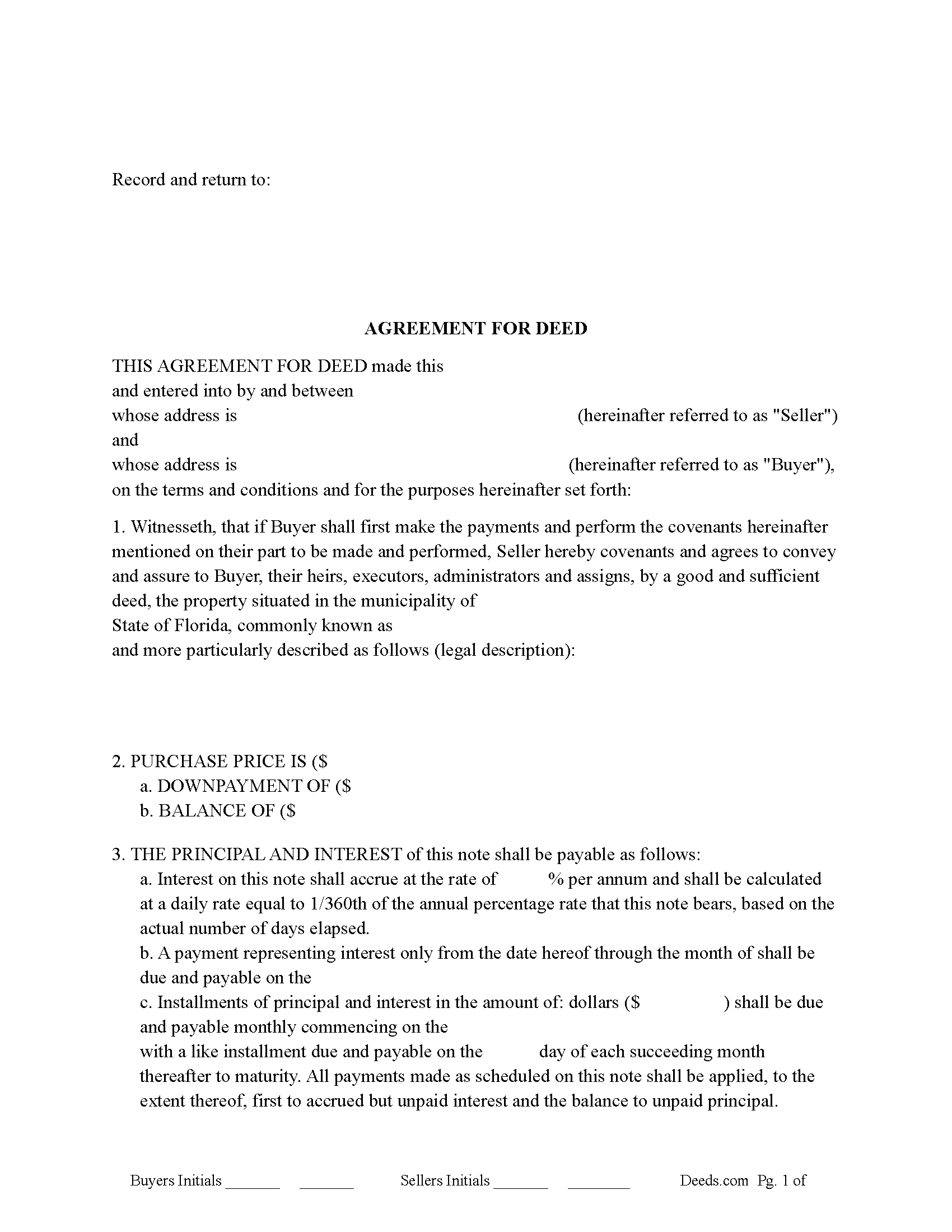
Indian River County Agreement for Deed Form
Fill in the blank Agreement for Deed form formatted to comply with all Florida recording and content requirements.
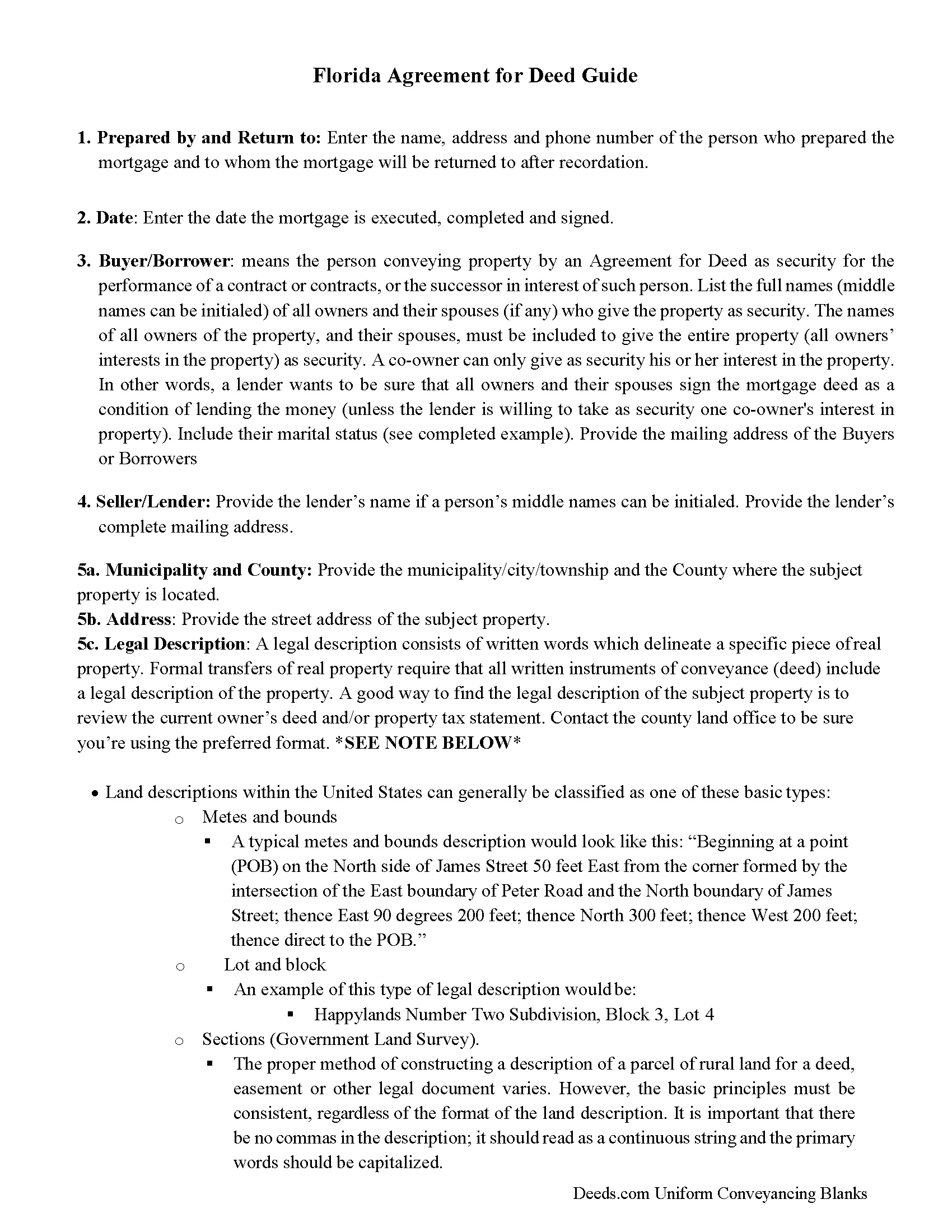
Indian River County Agreement for Deed Guide
Line by line guide explaining every blank on the Agreement for Deed form.
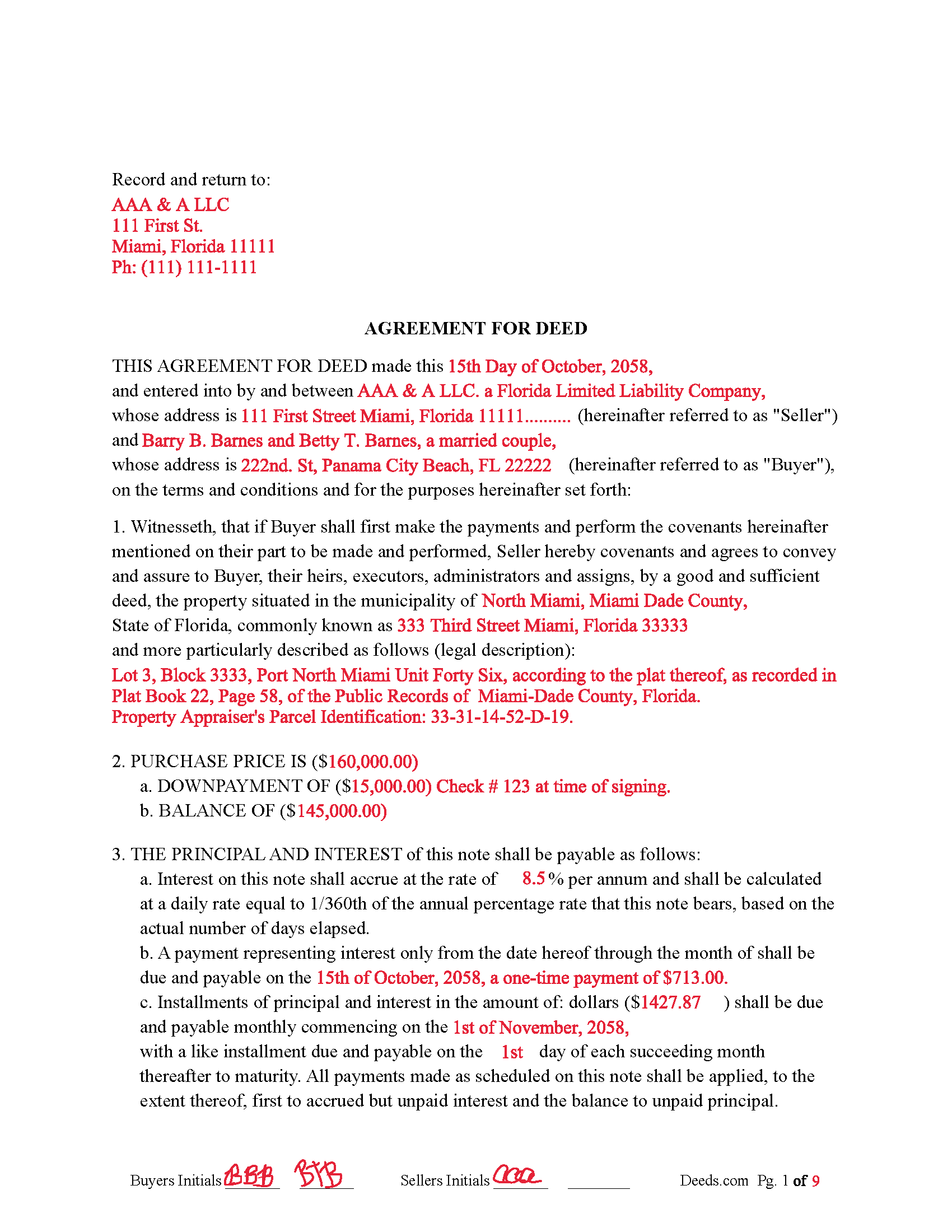
Indian River County Completed Example of the Agreement for Deed Document
Example of a properly completed Florida Agreement for Deed document for reference.
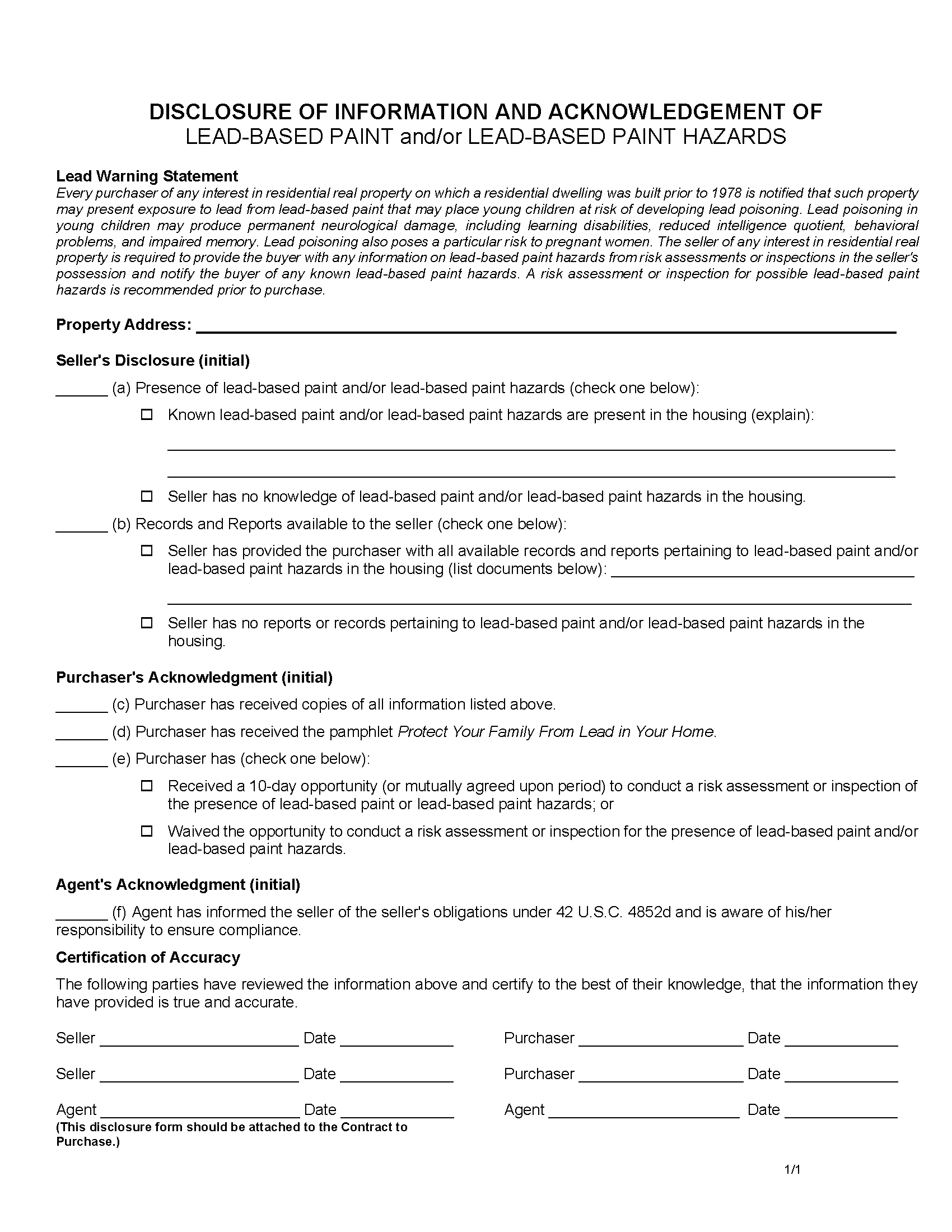
Indian River County Lead Based Paint Disclosure Form
Required for residential property built before 1978.
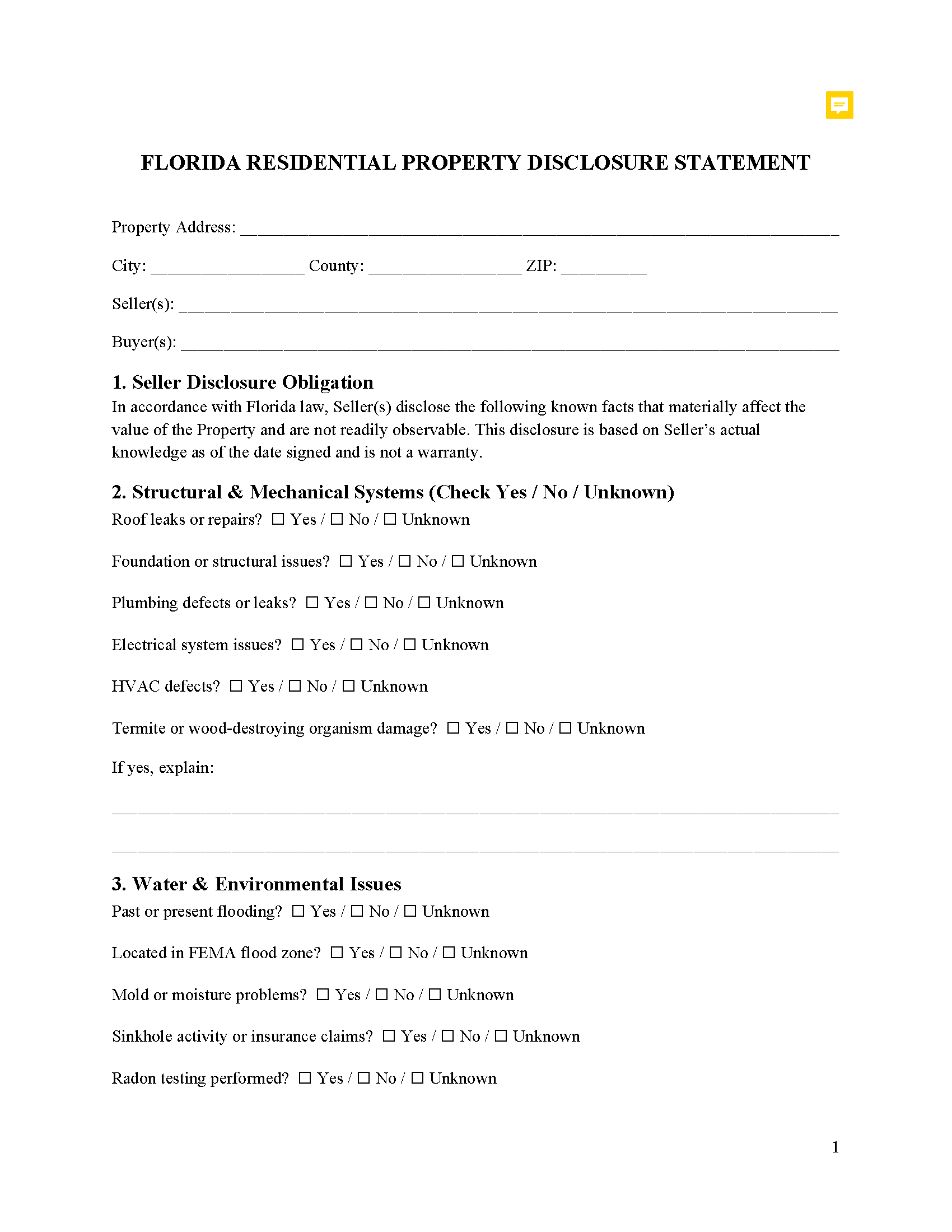
Indian River County Sellers Residential Property Disclosure Form
Required form for residential property.
All 5 documents above included • One-time purchase • No recurring fees
Immediate Download • Secure Checkout
Additional Florida and Indian River County documents included at no extra charge:
Where to Record Your Documents
Recording - County Courthouse
Vero Beach, Florida 32960
Hours: 8:30am to 4:30pm M-F
Phone: (772) 770-5185, Ext 3175 and 3135
Recording Tips for Indian River County:
- Bring your driver's license or state-issued photo ID
- Ensure all signatures are in blue or black ink
- Verify all names are spelled correctly before recording
- White-out or correction fluid may cause rejection
- Ask about their eRecording option for future transactions
Cities and Jurisdictions in Indian River County
Properties in any of these areas use Indian River County forms:
- Fellsmere
- Roseland
- Sebastian
- Vero Beach
- Wabasso
- Winter Beach
Hours, fees, requirements, and more for Indian River County
How do I get my forms?
Forms are available for immediate download after payment. The Indian River County forms will be in your account ready to download to your computer. An account is created for you during checkout if you don't have one. Forms are NOT emailed.
Are these forms guaranteed to be recordable in Indian River County?
Yes. Our form blanks are guaranteed to meet or exceed the applicable formatting requirements used for recording in Indian River County, including margin requirements, font requirements, and other layout standards. This guarantee applies to formatting, not to the legal sufficiency of information entered by the user or the suitability of a form for a particular transaction.
Can I reuse these forms?
Yes. You can reuse the forms for your personal use. For example, if you have multiple properties in Indian River County you only need to order once.
What do I need to use these forms?
The forms are PDFs that you fill out on your computer. The free Adobe Acrobat Reader is recommended, and most PDF apps also work. You do NOT enter your property information online - you download the blank forms and complete them privately on your own computer.
Are there any recurring fees?
No. This is a one-time purchase. Nothing to cancel, no memberships, no recurring fees.
How much does it cost to record in Indian River County?
Recording fees in Indian River County vary. Contact the recorder's office at (772) 770-5185, Ext 3175 and 3135 for current fees.
Questions answered? Let's get started!
A Florida Agreement for Deed — also called a land contract or contract for deed — is a seller-financing instrument in which the seller keeps legal title and the buyer takes possession and pays the purchase price over time. What sets the Florida Agreement for Deed apart from versions used in other states is its tax and remedy treatment. Florida charges documentary stamp tax on the full purchase price when the contract is recorded, and Florida courts treat installment land contracts as equitable mortgages, which means a defaulting buyer cannot simply be locked out — the seller has to follow foreclosure procedures to recover the property and clear the buyer's equitable interest.
When a Florida Agreement for Deed Is Used
This instrument is commonly used when a buyer cannot qualify for conventional mortgage financing — credit history issues, self-employment income that traditional lenders discount, or a property type lenders avoid such as raw acreage, a small lot, or a non-warrantable condominium. Sellers use it to convert a property into a stream of monthly payments rather than a lump sum, to attract buyers in a slow market, or to retain title as security without going through a separate mortgage closing. The arrangement gives both parties flexibility on down payment, interest rate, payment schedule, and balloon terms — but in Florida that flexibility comes with a specific set of statutory and judicial overlays that must be honored to keep the contract enforceable.
Florida Execution and Recording Requirements
Although an Agreement for Deed is technically a contract rather than a deed of conveyance, Florida treats the recordable version like any other instrument that affects title to real property. Execution must satisfy the same formalities Florida uses for conveyances:
- The seller's signature must be made in the presence of two subscribing witnesses (F.S. 689.01). The witness requirement is a recurring Florida trap because most states require only notarization — Florida requires both two witnesses and an acknowledgment.
- The seller's signature must be acknowledged before a notary public or other officer authorized to take acknowledgments under F.S. 695.03.
- The instrument must include a "prepared by" block with the name and address of the natural person who drafted it, plus the post office address of each grantee — here, the buyer (F.S. 695.26).
- The legal description must be sufficient to identify the parcel; a street address alone will not satisfy a title examiner or insure-against-defect review.
- The buyer's signature is customarily included even though Florida recording statutes only require the grantor to sign, because the contract creates obligations that run against the buyer.
Record the contract in the official records of the county where the property is located (F.S. 695.01). Until the contract is recorded, a subsequent bona fide purchaser or judgment lienholder without notice can take priority over the buyer's equitable interest.
Documentary Stamp Tax on the Full Purchase Price
Florida's documentary stamp tax (F.S. 201.02) is the single biggest tax difference between a Florida Agreement for Deed and a land contract used in most other states. The Florida Department of Revenue treats execution of an Agreement for Deed as a present transfer of an interest in real property, so doc stamp tax is calculated on the full purchase price stated in the contract — not the down payment, not the payments received to date. The current rate is $0.70 per $100 of consideration ($0.60 per $100 in Miami-Dade County for single-family residences, with a county surtax applying to other property types). The tax is due when the contract is recorded.
Two practical consequences follow from this rule. First, recording the Agreement for Deed is not a free filing — on a $200,000 contract the doc stamps run $1,400 before the clerk will accept the instrument. Second, when the buyer eventually pays in full and the seller delivers a warranty deed or other conveyance, the doc stamp tax has already been paid on the underlying transfer; the closing deed itself can record for nominal consideration to avoid double taxation. The contract should specify which party bears the doc stamp burden at recording and at final conveyance.
The Equitable Mortgage Doctrine
This is the trap that surprises out-of-state sellers. In many states, a contract for deed includes a forfeiture clause — if the buyer defaults, the seller keeps the payments received and reclaims the property without a foreclosure suit. That remedy does not work in Florida. Florida courts have long held that an installment land contract operates as an equitable mortgage: the buyer holds equitable title, the seller holds legal title only as security, and the seller's remedy on default is judicial foreclosure under Chapter 702, not summary forfeiture or eviction. The principle traces to F.S. 697.01, which provides that any instrument intended as security for a debt is deemed a mortgage regardless of its form.
The drafting consequences are concrete. A forfeiture clause buried in the contract will not be enforced as written if the buyer has built up substantial equity, and an attempt to remove a defaulting buyer through county court will be redirected into circuit court as a foreclosure action. Sellers should price the down payment, interest rate, and acceleration terms with the understanding that the recovery process is judicial foreclosure — several months at a minimum and a year or longer if contested.
Homestead Property and Spousal Joinder
If the seller is a natural person and the property is the seller's homestead, Article X, Section 4(c) of the Florida Constitution requires the spouse to join in the conveyance regardless of how title is held. The rule applies even if only one spouse appears on the recorded deed and even if the spouses are separated. An Agreement for Deed signed by only one spouse on homestead property is voidable at the non-joining spouse's election, and a title examiner reviewing the recorded contract will flag the missing signature as a cloud. The marital status of the seller should be recited in the body of the contract, and if the seller is married, the spouse should sign and have the signature witnessed and acknowledged on the same terms as the seller — even when the spouse holds no record interest.
Subdivided Lands Disclosure Under F.S. 498.028
If the property is part of a subdivided lands offering and title will not be conveyed to the buyer within 180 days, F.S. 498.028 imposes additional requirements. The buyer has an absolute right to cancel within seven business days of execution, and any funds paid must be refunded within 20 days of the cancellation notice. The contract must also include — in conspicuous type immediately above the buyer's signature line — a statutory warning that the buyer may not receive the land if the subdivider files for bankruptcy or otherwise fails to perform before delivering the deed. The warning language is mandatory and must appear verbatim. This requirement does not apply to ordinary improved residential resales, but it is the rule that catches sellers using an Agreement for Deed to sell raw subdivided lots over an extended payment period.
What's Included in the Download Package
The package includes the Florida Agreement for Deed form, a completed example showing where each piece of information goes, and a guide explaining the document and the surrounding Florida requirements. The form is suitable for residential property, vacant land, rental property, condominiums, and planned unit developments, and is for use in Florida only. Files are delivered as an instant download in formats that can be filled in on screen or printed and completed by hand.
Important: Your property must be located in Indian River County to use these forms. Documents should be recorded at the county recording office listed above.
This Agreement for Deed meets all recording requirements specific to Indian River County.
Our Promise
The documents you receive here are guaranteed to meet or exceed the applicable Indian River County recording format requirements. If there is a rejection caused by our formatting, we will correct the issue or refund your payment. This guarantee applies to document formatting only and does not extend to information entered by the user, the selection of the form, or the legal effect of the completed document.
Save Time and Money
Get your Indian River County Agreement for Deed form done right the first time with Deeds.com Uniform Conveyancing Blanks. At Deeds.com, we understand that your time and money are valuable resources, and we don't want you to face a penalty fee or rejection imposed by a county recorder for submitting nonstandard documents. We constantly review and update our forms to meet rapidly changing state and county recording requirements for roughly 3,500 counties and local jurisdictions.
4.8 out of 5 - ( 4,825 Reviews )
Toshimi M. 4 out of 5 stars
Sofar very good. Especially an example helps.
Thank you for your feedback. We really appreciate it. Have a great day!
TIFFANY C. 5 out of 5 stars
It would be nice if the notary State was fillable, we are having to notarize in another State. Also, need more room to add 2 beneficiaries with two different addresses.
Thank you for your feedback. We really appreciate it. Have a great day!
Edward S. 5 out of 5 stars
Easy to use and comprehensive in content. Would recommend to anyone that is looking for a cheaper alternative to a lawyer. (They hate services that cut into their business)
Thank you!
Michael D. 5 out of 5 stars
Your Guide is very good but does not explain precisely where one can find the Instrument Number for the originally filed Claim of Lien.
Thank you for your feedback. We really appreciate it. Have a great day!
Karen F. 5 out of 5 stars
Very easy to understand instructions. I was able to order, download and print.
Thank you for your feedback. We really appreciate it. Have a great day!
oscar r. 5 out of 5 stars
VERY MUCH HELPFUL SAVED ME 600 on not having to hire attorney
Thank you!
Colleen B. 5 out of 5 stars
Looks good. We will see how it goes.
Thank you!
Maria Lucy A. 4 out of 5 stars
Very good service. Directions were easy to follow to obtain the document I needed.
Thank you!
ALAN C. 5 out of 5 stars
Everything was as advertised, and easily downloaded.
We appreciate your business and value your feedback. Thank you. Have a wonderful day!
Michael L. G. 5 out of 5 stars
Thank you, Deed.com provided the needed forms to change county and state information after the passing of my father, saved me a trip to law office, especially after the lawyers would not return my calls, so I would recommend you check Deed.com for information, saved my family money for lawyer fees, would use Deed.com again. Mike
Thank you for your feedback. We really appreciate it. Have a great day!
Stuart C. 5 out of 5 stars
Quit, clear, simple...just the way it shouldbe! Thank you!
We appreciate your business and value your feedback. Thank you. Have a wonderful day!
Daniel A. 5 out of 5 stars
First time using Deeds.com. Downloaded the PDF forms for creating an Illinois Mortgage and Promissory Note. Filled them out, saved them, and printed them out. Going to send them to my Title Company for closing on a property. Save a bunch of money on not have to pay lawyer fees for creating the same legal documents that Deeds.com provided.
We appreciate your business and value your feedback. Thank you. Have a wonderful day!
Daniel V. 5 out of 5 stars
Awesome service Recorded a deed within 24hrs and saved my self a 14hr+ journey
Thank you for your feedback. We really appreciate it. Have a great day!
Jennifer L L. 5 out of 5 stars
So far this has been a great experience. Very easy to use the deeds.com website and download the forms. Very nice that they give example forms and guides to help you fill out the forms. I just have to wait to make sure that the forms are accepted and recorded with no issues.
Your insights are invaluable to us and help us strive for better service. Thank you for taking the time to share your thoughts.
Brad T. 5 out of 5 stars
I didn't spend a lot of time there but seems to be a good site with a valuable service.
Thank you!