Florida Enhanced Life Estate Deed Without Warranties (Unmarried Sole Owner)
County Specific Legal Forms Validated as recently as October 15, 2026 by our Forms Development Team
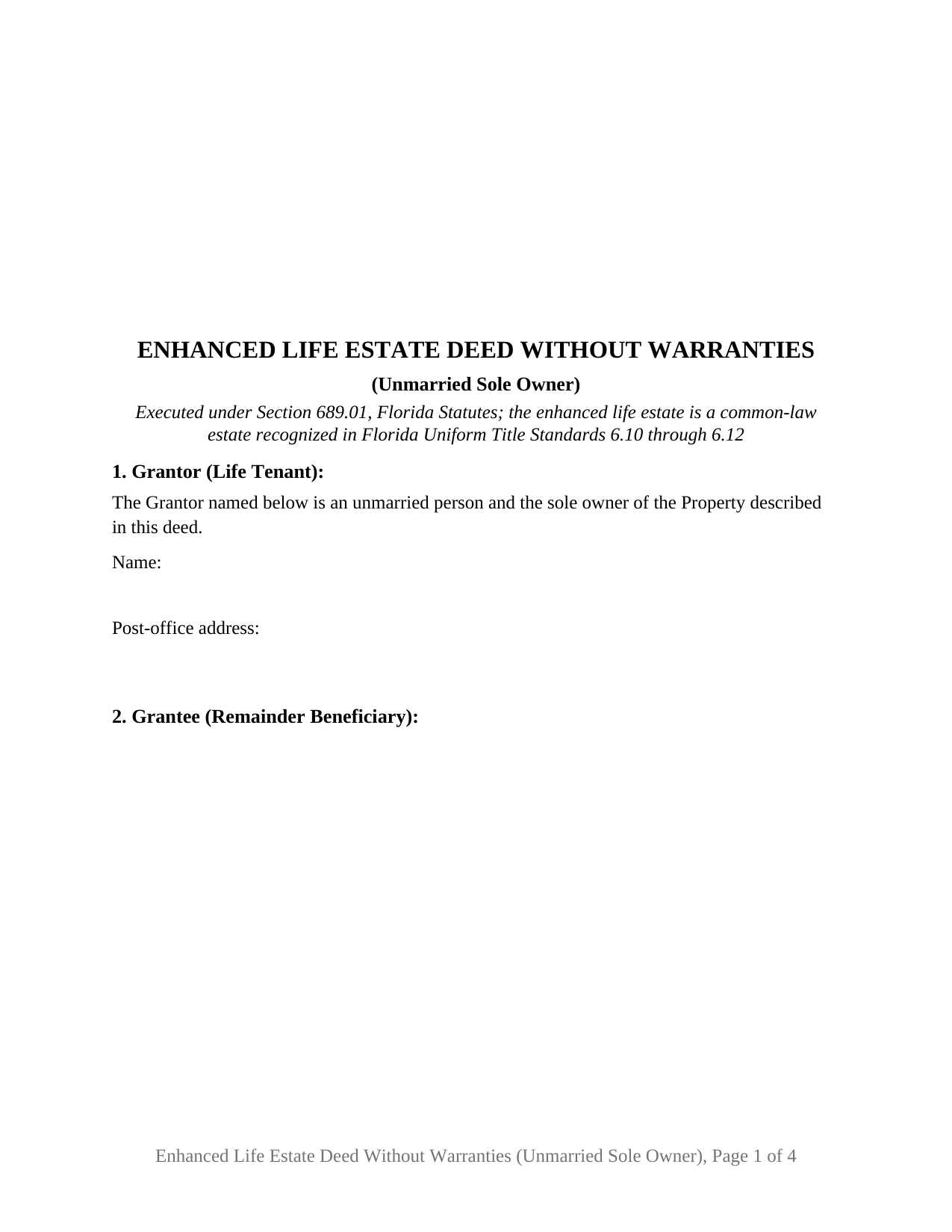
About the Florida Enhanced Life Estate Deed Without Warranties (Unmarried Sole Owner)
How to Use This Form
- Select your county from the list
- Download the county-specific form
- Fill in the required information
- Have the document notarized if required
- Record with your county recorder's office
What Others Like You Are Saying
"amazing job!!"
"Simple and easy to download. After reading the instructions/sample pages I did still have some quest…"
"Very well organized and easy to understand. Will probably use your service again in the future for o…"
"very easy make sense instructions. Thank you."
"needed to prepare a corrective deed and found this great website to print the corrective deed and in…"
4.8/5 from 4,828 reviews. Read all
One signature, two witnesses, one notary certificate. This Florida enhanced life estate deed, commonly searched for as a lady bird deed, is prepared for a single owner who is unmarried and holds the whole title. The remainder passes to a named grantee at death without probate, every power of ownership stays with the owner during life, and Section 1 prints the owner's status and sole ownership as fixed text.
Why an unmarried owner's deed reads differently
Article X, Section 4(c) of the Florida Constitution lets a married owner alienate homestead only when joined by the spouse. An unmarried owner has no spouse to join, so this deed carries no second signature line and no marital-status blank: the recital that the grantor is an unmarried person and the sole owner is printed on the deed.
Lifetime control stays with the life tenant
The deed conveys the remainder now and reserves to the grantor a life estate coupled with the unrestricted power to sell, convey, mortgage, lease, gift, or encumber the property in fee simple, without the grantee's joinder, consent, or notice and with the right to keep all proceeds. A later instrument under that power divests the grantee to the extent it says, and a later recorded instrument may revoke the deed or substitute a grantee. Florida Uniform Title Standards 6.10 and 6.11 state that a life tenant holding those powers can convey or encumber the fee simple during life without the remainderman, and the Third District described the same arrangement in Hirschenson v. Compu-Link Corp. of MI (2023). No Florida statute creates the instrument, and Florida has no transfer on death deed.
The minor-child question an unmarried owner faces
Joinder drops out for an unmarried owner; the restriction on devise of homestead does not. Article X, Section 4(c) bars devise of the homestead where the owner is survived by a spouse or a minor child, and Title Standard 6.12 provides that the remainderman under a deed of this kind acquires fee simple title at the life tenant's death only when that restriction is not violated. Section 732.4017, Florida Statutes, treats a lifetime transfer of homestead as not a devise only where the owner retains no power to revoke or revest the interest, and this deed reserves exactly that power. The guide walks through what those authorities say in each case.
What the deed recites and what it leaves open
The form recites one grantor and carries one acknowledgment certificate in the Section 695.25(1) short form, where the notary marks physical presence or online notarization inside the certificate sentence, and reserves a rectangle for the rubber-stamp seal Section 117.05 requires. The grantee side is open to one or two persons named with their post-office addresses; where two are named, the words after their names set the form of co-ownership. The deed states its own survival rule: a grantee not living at the grantor's death drops out in favor of those then living, and if none survives the conveyance lapses and the property stays in the grantor's estate. A widowed parent passing the home to an adult child, a divorced owner naming a sibling, and a never-married owner naming a niece present the pattern this deed recites; two co-owners, a married owner, a trustee, an attorney in fact, and a holder of a fractional interest beside another owner follow patterns this form is not set up as.
No warranty, and the recording desk
Section 7 makes the conveyance without any warranty or covenant of title and states that the deed is not in the Section 689.02 statutory form, so the Section 689.03 warranty effect does not arise. Section 689.01 requires the grantor to sign before two subscribing witnesses, and since January 1, 2024, Section 695.26 makes each witness's printed name and post-office address recording data, so each witness block carries an address field. In Technical Assistance Advisement 20B4-004 the Department of Revenue treated a deed of this kind, on property free of any mortgage, as passing no present beneficial interest and therefore owing no documentary stamp tax; the guide describes collection at recording.
The package contains the fillable Florida Enhanced Life Estate Deed Without Warranties (Unmarried Sole Owner), a completed example prepared for a Pinellas County parent-to-child transfer, and a guide covering each section of the deed, witness and notary mechanics, the homestead rules for an unmarried owner, and the recording process. Form, example, and guide describe the instrument and Florida law in general terms; none of them is legal advice.
Important: County-Specific Forms
Our enhanced life estate deed without warranties (unmarried sole owner) forms are specifically formatted for each of the 67 counties in Florida.
After selecting your county, you'll receive forms that meet all local recording requirements, ensuring your documents will be accepted without delays or rejection fees.