Florida Enhanced Life Estate Deed Without Warranties
County Specific Legal Forms Validated as recently as October 14, 2026 by our Forms Development Team
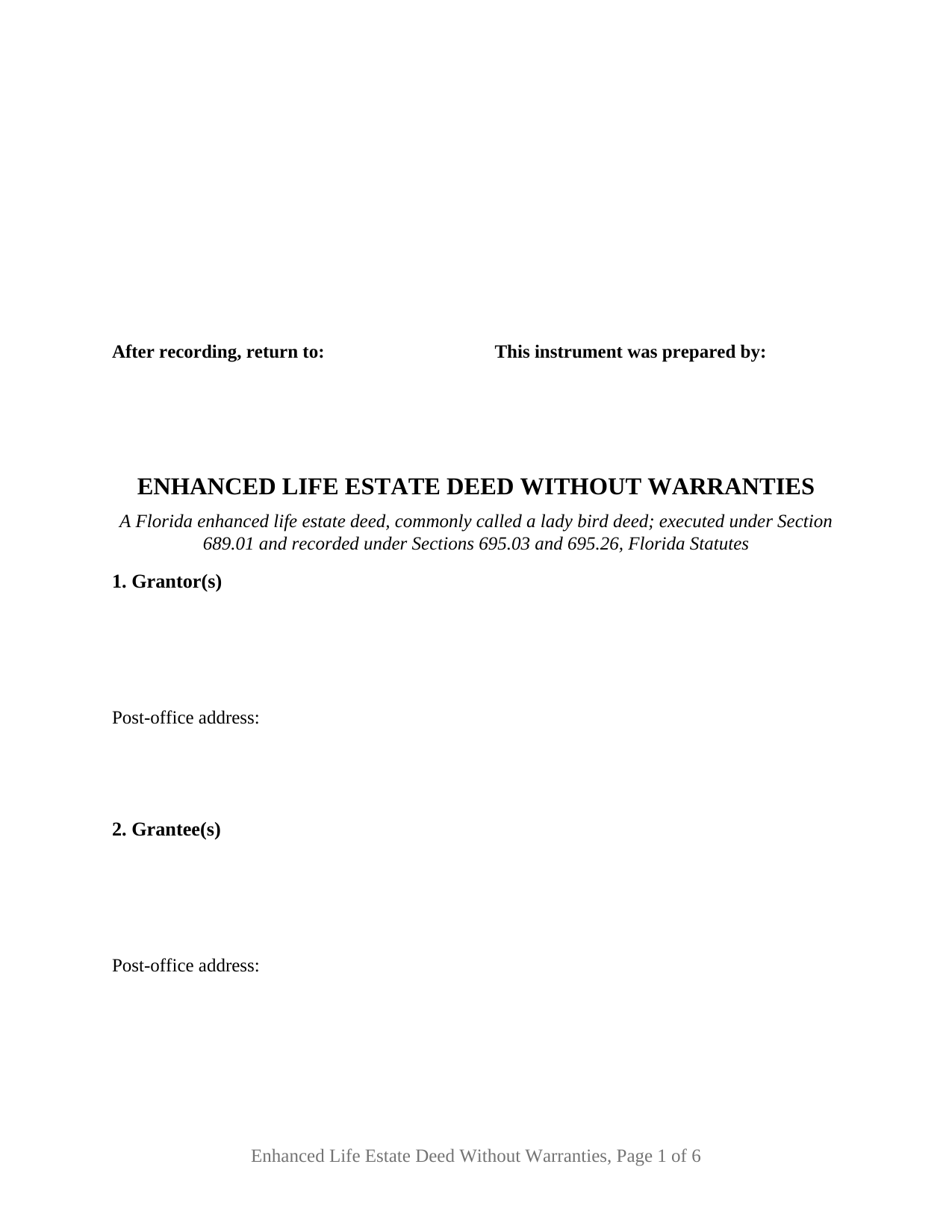
About the Florida Enhanced Life Estate Deed Without Warranties
How to Use This Form
- Select your county from the list
- Download the county-specific form
- Fill in the required information
- Have the document notarized if required
- Record with your county recorder's office
What Others Like You Are Saying
"Easy and fast. Thank you so much!!"
"Excellent service! Incorrectly ordered a document and order was immediately canceled when I requeste…"
"Very nice. Especially liked that I could re-use the form since I have a couple of properties."
"I was overwhelmed with information about what forms I needed to complete the probate process, and th…"
"I am happy with the document but did not know that it would still have to go before the court. Thoug…"
4.8/5 from 4,825 reviews. Read all
A Florida enhanced life estate deed, the instrument most people call a lady bird deed, conveys the remainder in real property to a named grantee today while the owner keeps a life estate with the power to sell, mortgage, lease, give away, or revoke, all without the grantee's signature. This form prepares that deed for one or two Florida owners conveying to one or two grantees, without any warranty of title. At death, whatever has not been sold or divested vests in the grantee without probate.
A remainder the owner can still take back
The clause that does the work is the reservation. Section 5 of the deed reserves a life estate coupled with the full and unrestricted power to sell, convey, mortgage, lease, gift, encumber, or otherwise dispose of the property in fee simple, with or without consideration, without the joinder, consent, or notice of the grantee and without liability for waste. A conveyance under that power divests the grantee's interest to the extent the later instrument states, and the deed may be revoked, or the grantee changed, by a later recorded instrument. The Florida Bar's Uniform Title Standards 6.10 through 6.12 describe this arrangement, and the Third District Court of Appeal addressed it in Hirschenson v. Compu-Link Corp. of MI (2023). No Florida statute creates the instrument, and Florida has no transfer on death deed statute.
What happens at death
At the grantor's death, or with two grantors at the death of the survivor, the property still subject to the deed vests in fee simple in the grantee then living, subject to any encumbrance then of record. The deed states its own lapse rule: the share of a grantee who is not then living passes to the grantees who survive, and if none survives the deed lapses and the property stays in the last grantor's estate. The guide describes how the constitutional restriction on devise of homestead and Title Standard 6.12 bear on homestead property where the owner leaves a spouse or a minor child.
Without warranties
This version of the deed carries no covenant of title. Section 6 states that the deed is made without any warranty or covenant of title, express or implied, that the grantor does not undertake to defend the title, and that the deed is not in the Section 689.02 statutory form, so the warranty effect Section 689.03 gives that form does not arise. The grantee takes the title the grantor has.
One or two grantors, one or two grantees
The form is the general configuration of the Florida enhanced life estate deed. Its grantor and grantee blocks are free-form, with nothing about marital status, vesting, or capacity preprinted: a single owner writes one name, two spouses write two, and the grantee entry carries whatever vesting words the deed records call for. The deed carries two grantor signature blocks, each with two subscribing witness blocks, and a separate acknowledgment certificate for each grantor, so two grantors may sign on different days or before different notaries. A sole owner leaves the second block blank; a spouse joining a deed of homestead under Article X, Section 4(c) signs it. Corporate, trustee, and attorney-in-fact grantors, and three or more persons on either side, follow patterns this form is not set up as.
Florida execution and recording
Section 689.01 requires each grantor to sign before two subscribing witnesses, and Section 695.26 makes each witness's printed name and post-office address recording data, along with the preparer's and each grantee's address and a blank three-inch square at the top right of page one for the clerk. The acknowledgment certificate is the Section 695.25(1) short form, with its boxes for physical presence or online notarization and a reserved area for the notary's rubber-stamp seal. On documentary stamp tax, the Department of Revenue concluded in Technical Assistance Advisement 20B4-004 that an enhanced life estate deed of unencumbered property transfers no present beneficial interest and is not subject to the tax; the guide describes how clerks handle the nominal consideration a deed recites.
The package includes the fillable Florida Enhanced Life Estate Deed Without Warranties, a completed example for an Orange County family transfer, and the guide that walks through every section, the witness and notary requirements, the homestead rules, and recording. The form, the example, and the guide describe the instrument and Florida law in general terms and are not legal advice.
Important: County-Specific Forms
Our enhanced life estate deed without warranties forms are specifically formatted for each of the 67 counties in Florida.
After selecting your county, you'll receive forms that meet all local recording requirements, ensuring your documents will be accepted without delays or rejection fees.