Florida Gift Deed
County Specific Legal Forms Validated as recently as October 11, 2026 by our Forms Development Team
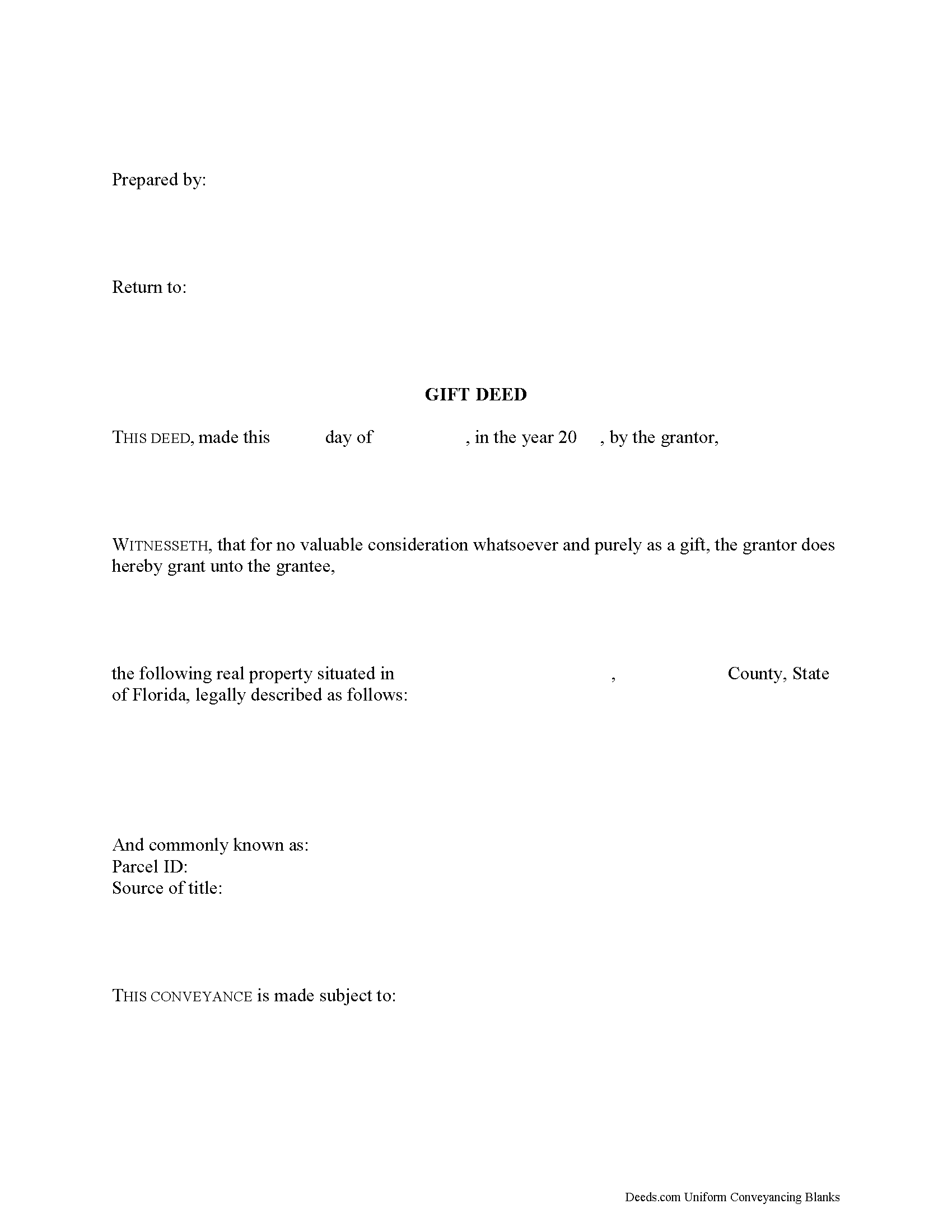
About the Florida Gift Deed
How to Use This Form
- Select your county from the list
- Download the county-specific form
- Fill in the required information
- Have the document notarized if required
- Record with your county recorder's office
What Others Like You Are Saying
"good forms thanks, irene"
"got what I needed."
"Very convenient"
"Hi! Is there a setting that I can click on that will make sure I'm notified via email when an update…"
"The team is very responsive and gets the job done. Thank you."
4.8/5 from 4,836 reviews. Read all
A Florida gift deed moves real property from one or two owners to one or two recipients for love and affection alone, with the deed itself saying that no money or other valuable consideration changes hands. This Florida Gift Deed is built for natural persons signing in their own capacity: one or two grantors, one or two grantees, and nothing about marital status, vesting, or capacity preprinted on the instrument.
Love and affection as the whole consideration
Florida has no gift deed statute and no official gift deed form; a gift of land is an ordinary conveyance that says what it is. The Florida Supreme Court settled the underlying question in Chase Federal Savings and Loan Association v. Schreiber, 479 So. 2d 90 (Fla. 1985), holding that a deed reciting love and affection as its consideration passed legal title even though nothing of value was paid and the parties were unrelated. This deed recites love and affection, calls the conveyance a gift, and states that no money or other valuable consideration has been or will be paid. It names no dollar amount: the Department of Revenue's documentary stamp tax rules treat a gift of unencumbered realty as not taxable, while a recital of love and affection together with one dollar draws at least the minimum tax, and a gift of mortgaged property is taxed on the unpaid mortgage balance.
A gift with the statutory warranty behind it
The deed conveys with the granting and warranty words of the statutory warranty deed in Section 689.02, Florida Statutes: the grantor grants, bargains, sells, and conveys the property to the grantee and the grantee's heirs and assigns forever, and fully warrants the title against the lawful claims of all persons whomsoever. Under Section 689.03 a conveyance substantially in that form carries the full common-law covenants. A permitted exceptions entry holds the recorded easements, restrictions, and any mortgage that stays on the property, so those matters stand outside the warranty instead of contradicting it, and the parcel identification number blank of Section 689.02(2) sits beside the legal description.
One or two grantors, one or two grantees
The grantor and grantee entries are open blocks that take the names, the marital status recitals Florida practice supplies, and any vesting designation after the grantee names, in the style as joint tenants with right of survivorship. Parents passing a lake lot to two adult children and a sole owner conveying a rental house to a sibling present the patterns this deed accommodates. The form is not set up as an entity, trustee, or attorney-in-fact deed or a conveyance by three or more owners, and its second signature block and certificate stay empty when one grantor conveys.
Homestead joinder and the two-witness rule
Section 689.01 requires a deed conveying a freehold to be signed in the presence of two subscribing witnesses, and since January 1, 2024, Section 695.26 requires each witness's printed name and post-office address on the instrument, so the deed carries two witness blocks for each grantor. Article X, Section 4(c) of the Florida Constitution conditions a married owner's alienation of homestead by mortgage, sale, or gift on the joinder of the spouse, which is why a gift of a married owner's residence puts the spouse on the signing side as the second grantor, while a gift of property that is not homestead is signed by the titled owner alone. Each grantor has a separate acknowledgment certificate in the statutory short form of Section 695.25(1), with its physical presence or online notarization boxes and a reserved area for the notary's rubber-stamp seal.
Recording with the clerk of the circuit court
The first page leaves the 3 inch by 3 inch space at the top right that Section 695.26 reserves for the clerk, each later page leaves the 1 inch by 3 inch space, and the preparer block, the post-office addresses, and the printed names beneath every signature satisfy the rest of that section's checklist. Documentary stamp tax is collected at recording; the guide covers the gift rules, the Miami-Dade County rate structure, and the reassessment Section 193.155 attaches to a change of ownership of homestead property.
The package includes the fillable gift deed form, a completed example filled in for a realistic Orange County fact pattern, and the guide that explains each section, the signing rules, and the recording and tax treatment of a Florida gift. This description and the guide describe the form and the governing law in general terms; they are not legal advice.
Important: County-Specific Forms
Our gift deed forms are specifically formatted for each of the 67 counties in Florida.
After selecting your county, you'll receive forms that meet all local recording requirements, ensuring your documents will be accepted without delays or rejection fees.