Florida Notice to Owner
County Specific Legal Forms Validated as recently as September 30, 2026 by our Forms Development Team
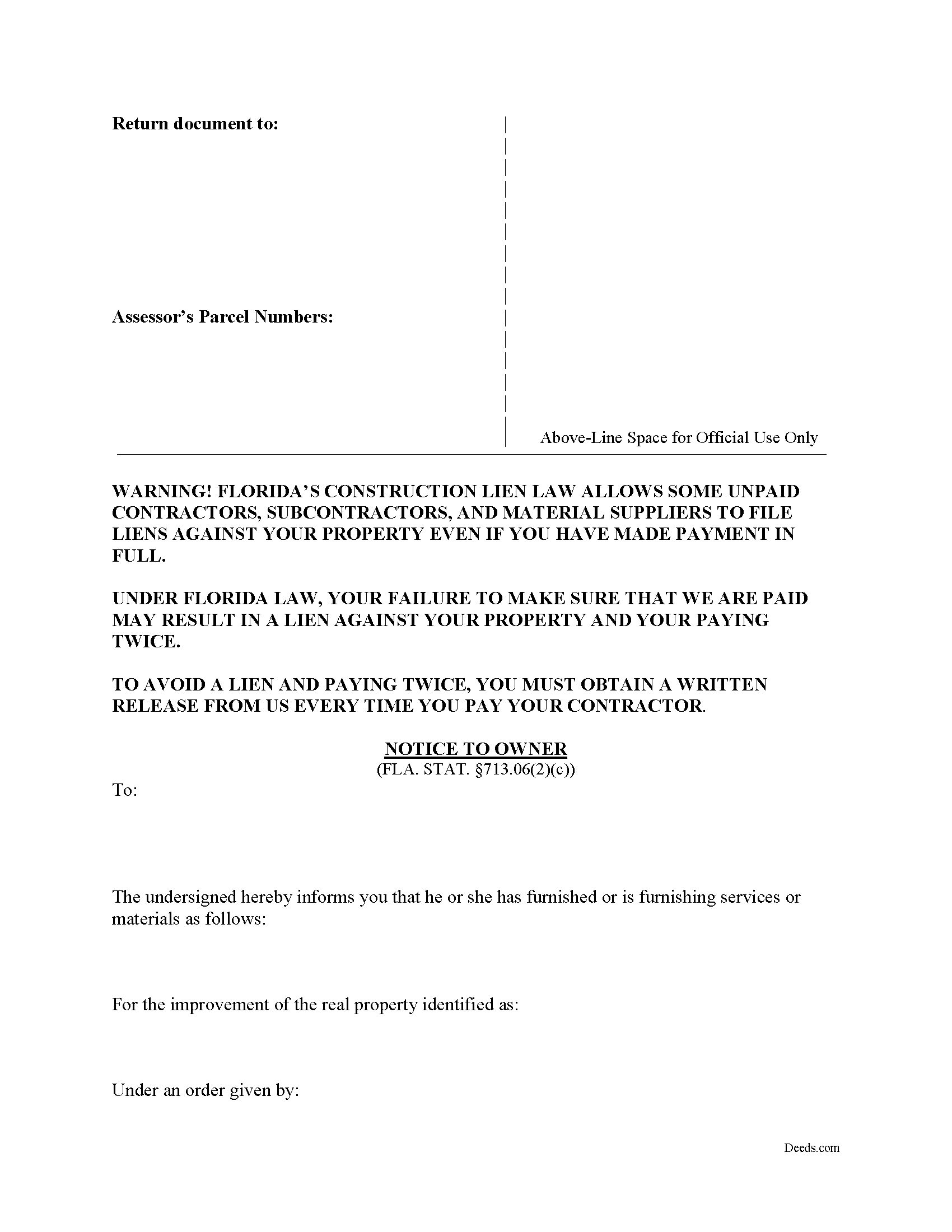
About the Florida Notice to Owner
How to Use This Form
- Select your county from the list
- Download the county-specific form
- Fill in the required information
- Have the document notarized if required
- Record with your county recorder's office
What Others Like You Are Saying
"very good. received what i ordered in a timely fashion despite my incompetence."
"My case was a deed recording. The process was extremely smooth and carried out by the agents profess…"
"Outstanding service. Docs delivered to recorder as expected without issue. Happy our recorder recomm…"
"unbelievable Deeds Rocks Start to finish 2=Day Recommended by Coconino County Recorders office in Ar…"
"This was a very easy process to find the correct documents and download them. The price was also rea…"
4.8/5 from 4,823 reviews. Read all
A Florida Notice to Owner is not a generic mechanic's lien notice. Florida requires a specific statutory warning, a strict service window tied to the first furnishing of labor, services, or materials, and service rules that connect the notice to the notice of commencement, building permit information, and the contractor's final payment affidavit. Using a Florida-specific form helps the sender include the Chapter 713 language and recipient details needed for Florida private construction projects (Fla. Stat. § 713.06(2)).
What a Florida Notice to Owner Does
A Florida Notice to Owner is commonly used by a subcontractor, sub-subcontractor, material supplier, or other non-laborer lienor who has furnished or will furnish labor, services, or materials for a private improvement and does not have a direct contract with the property owner. The notice identifies the lienor, the real property, and the work or materials so the owner can track potential lien claimants before making payments to the contractor, while preserving the sender's ability to later record a claim of lien if payment is not made (Fla. Stat. § 713.06(1)-(2)).
Florida Notice to Owner Requirements
Florida's Construction Lien Law requires the Notice to Owner to contain information that is more specific than a simple payment reminder. The statutory form must include the warning language that tells the owner unpaid contractors, subcontractors, and suppliers may file liens even if the owner has paid the contractor in full (Fla. Stat. § 713.06(2)(c)).
- Sender information: The notice must state the lienor's name and address (Fla. Stat. § 713.06(2)(a)).
- Property identification: The notice must include a description sufficient to identify the Florida real property being improved (Fla. Stat. § 713.06(2)(a)).
- Work or materials: The notice must describe the nature of the services or materials furnished or to be furnished (Fla. Stat. § 713.06(2)(a)).
- Timing: The notice must be served before commencing, or not later than 45 days after commencing, to furnish labor, services, or materials, and in any event before the owner's final payment after the contractor's final payment affidavit (Fla. Stat. § 713.06(2)(a), § 713.06(3)(d)).
- Required copies: A sub-subcontractor or a material supplier to a subcontractor must serve a copy on the contractor, and a material supplier to a sub-subcontractor must serve the contractor and the subcontractor if the subcontractor's name and address are known (Fla. Stat. § 713.06(2)(a)).
- Additional recipient: If the owner designates another person to receive lienor notices in the notice of commencement, the lienor must serve a copy on that person as well (Fla. Stat. § 713.06(2)(b), § 713.13(1)(b)).
Signing, Copies, and Service in Florida
The Florida statutory Notice to Owner form calls for the lienor's signature but is not a deed, claim of lien, or other recorded conveyance. That means Florida deed formalities such as two witnesses, marital status recitals, documentary stamp tax, homestead joinder, and preparer identification do not control the Notice to Owner itself. The notice is a written Chapter 713 service document, and written notices under Florida's Construction Lien Law must be in writing unless a specific exception applies (Fla. Stat. § 713.012, § 713.06(2)(c)).
Service must follow Florida's statutory methods. A Notice to Owner may be served by hand delivery, by common carrier delivery service, by registered mail, Global Express Guaranteed, or certified mail with evidence of delivery, or by posting at the site of the improvement if hand delivery and mail or carrier delivery cannot be accomplished (Fla. Stat. § 713.18(1)).
Florida also has a mailing rule that is easy to miss: service of a Notice to Owner is effective as of the date of mailing when it is mailed by registered, Global Express Guaranteed, or certified mail within 40 days after the lienor first furnishes labor, services, or materials, and the sender keeps the required mail log or approved tracking records (Fla. Stat. § 713.18(2)).
Florida Timing and Service Traps
Florida treats the Notice to Owner deadline differently from many states because the 45-day period is measured from the first furnishing of labor, services, or materials, not from billing, nonpayment, completion, or discovery of a payment dispute. Florida allows some content errors or omissions if there is substantial compliance and no adverse effect, but the time requirements must be strictly followed (Fla. Stat. § 713.06(2)(f)).
- Day 40 and day 45 are not the same rule: The 45-day rule is the outside service deadline, while the 40-day mailing rule is the safe harbor that can make service effective as of the date of mailing if the statutory mailing records are kept (Fla. Stat. § 713.18(2)).
- Final payment can matter before day 45: The notice must be served before the owner disburses final payment after receiving the contractor's final payment affidavit, even if the 45-day period has not yet expired (Fla. Stat. § 713.06(2)(a), § 713.06(3)(d)).
- The notice of commencement can control addresses: Florida lienors commonly use the recorded notice of commencement to identify the owner, contractor, lender, surety, and any designated notice recipient; if no notice of commencement is recorded, the lienor may rely on the building permit application for service information (Fla. Stat. § 713.06(2)(e), § 713.13(1)).
- Serving one owner has a statutory effect: A document served by a lienor on one owner of the real property is deemed served on all owners (Fla. Stat. § 713.18(4)).
- Small direct contracts have a Florida exemption: An improvement with a direct contract price of $2,500 or less is exempt from the other provisions of Part I of Chapter 713 except the lien provisions for persons in privity with the owner (Fla. Stat. § 713.02(5)).
- Bonded private projects may use combined wording: A Florida Notice to Owner may be combined with a Notice to Contractor for certain payment-bond projects and titled "Notice to Owner/Notice to Contractor" (Fla. Stat. § 713.06(2)(c), § 713.23(1)(c)).
- The notice does not create lien priority: Serving a Notice to Owner does not give the sender priority over other lienors in the same category (Fla. Stat. § 713.06(2)(a)).
- Licensing can affect lien rights: Florida provides that no lien exists in favor of an unlicensed contractor, subcontractor, or sub-subcontractor as described in the applicable licensing statutes (Fla. Stat. § 713.02(7)).
How the Notice Fits With Florida Recording
The Notice to Owner is served, not recorded. Florida states that the notice is not a lien, cloud, encumbrance, or actual or constructive notice of any of them, and serving it does not replace the later step of recording a claim of lien when a lien is pursued (Fla. Stat. § 713.06(2)(a)).
A later Florida claim of lien may be recorded during the progress of the work or after completion, but not later than 90 days after the lienor's final furnishing of labor, services, or materials. The claim of lien is recorded in the clerk's office for the county where the property is located, and if the property lies in more than one county, it must be recorded in each county (Fla. Stat. § 713.08(5)).
Florida's priority rules tie many construction liens to the notice of commencement. Liens under sections 713.05 and 713.06 attach and take priority as of the recording of the notice of commencement; if no notice of commencement is filed, priority runs from recording the claim of lien (Fla. Stat. § 713.07(2)).
After a claim of lien is recorded, Florida also imposes enforcement deadlines. A lien generally does not continue longer than one year after recording unless an action to enforce it is commenced, and an owner or the owner's attorney may shorten the enforcement period to 60 days by recording and serving a notice of contest of lien (Fla. Stat. § 713.22(1)-(2)).
What Is Included in the Florida Notice to Owner Download
The Florida Notice to Owner download package is designed for Chapter 713 notice practice and includes:
- A Florida Notice to Owner form prepared by Deeds.com's forms development team
- Florida-specific instructions for completing the owner, property, lienor, and service information
- A completed example showing how the statutory information appears on the form
- A service checklist addressing the 45-day service period, the 40-day mailing rule, and required copies to the contractor or other recipients
- Guidance for using notice of commencement or building permit information to identify Florida project recipients
Important: County-Specific Forms
Our notice to owner forms are specifically formatted for each of the 67 counties in Florida.
After selecting your county, you'll receive forms that meet all local recording requirements, ensuring your documents will be accepted without delays or rejection fees.