Georgia Transfer on Death Deed (Joint Tenants with Right of Survivorship)
County Specific Legal Forms Validated as recently as October 19, 2026 by our Forms Development Team
About the Georgia Transfer on Death Deed (Joint Tenants with Right of Survivorship)
How to Use This Form
- Select your county from the list
- Download the county-specific form
- Fill in the required information
- Have the document notarized if required
- Record with your county recorder's office
What Others Like You Are Saying
"Your forms, guides, sample deeds and submission process were accessible, easy to understand and simp…"
"It was very easy to e-file. I liked it."
"Great system!"
"Found correct form right away, easy to download and print. Thank you!"
"This is a great service if you know what youre looking for. Unfortunately it just wasnt right for me…"
4.8/5 from 4,830 reviews. Read all
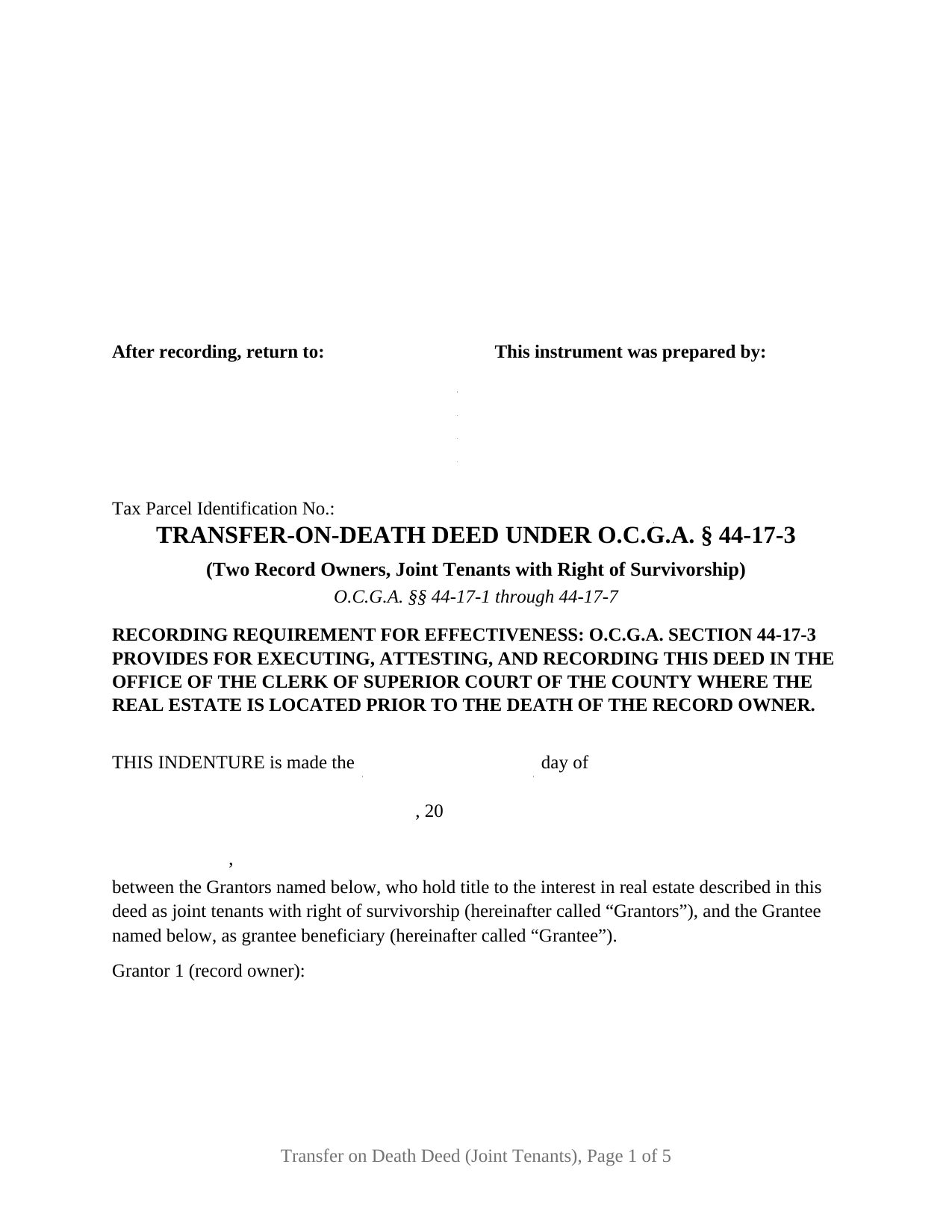
A joint tenancy with right of survivorship settles the first death by itself: the surviving co-owner takes the whole interest by force of the vesting deed. O.C.G.A. § 44-17-6 settles the second one, on a condition worth reading twice: a record joint owner may put an interest in transfer-on-death form, but title vests in the named grantee beneficiary only if that owner is the last of the joint owners to die. This deed is built for that condition: two record owners, one instrument, one beneficiary designation that waits.
The survivorship in the vesting deed comes first
Georgia wrote the interaction into the chapter rather than leaving it to construction. Under § 44-17-6 a deed in transfer-on-death form does not sever a joint tenancy, so signing this beneficiary deed leaves the estate the co-owners already hold undisturbed. At the first death, survivorship in the title controls: the deceased co-owner's interest vests in the survivor, and the grantee beneficiary receives nothing at that point. The deed states that sequence in its own operative paragraph, then states the second half, that the designation operates on the death of the last surviving Grantor.
Two record owners on one instrument
The configuration is visible on the page. The deed opens with two Grantor blocks in the style of the § 44-17-3 statutory form, each naming a record owner and county of residence, and a source-of-title line recites the deed book, page, and county of the instrument under which the two hold as joint tenants, the instrument that has to carry the express § 44-6-190 survivorship words. Execution is drawn twice over, because Georgia deeds are attested rather than acknowledged: each Grantor gets a signature block, an unofficial witness line, and an officer attestation certificate captioned for that Grantor, so the two executions can carry different dates and different notaries. Married couples whose vesting deed uses the § 44-6-190 language, siblings who took title jointly with survivorship, and a parent and adult child holding the same way present the two-owner pattern this deed recites; a designation by an owner holding title alone follows a different pattern, and this form recites exactly two. Naming more than one grantee beneficiary is permitted, and where the deed says nothing further, those beneficiaries take as tenants in common in equal shares under § 44-6-120.
What the last death sets in motion
Ownership does not land on the beneficiary automatically. After the death of the last surviving owner, the grantee beneficiary executes the acceptance affidavit described in § 44-17-2, attaches the death certificate, and records it, with a real estate transfer tax declaration form, in the same superior court clerk's office; until that acceptance is recorded the interest remains part of the deceased owner's estate. That affidavit is a separate instrument, prepared after the death and not included here. Two features of the 2026 amendments (Act 379, HB 413) depart from what a reader may have seen elsewhere: the amended section carries no filing deadline for the acceptance affidavit and no reversion of an unaccepted interest to the estate. No transfer tax declaration accompanies the owners' own recording.
Full control while either owner lives
Nothing shifts during the owners' lives. Section 44-17-7 leaves each record owner the legal and equitable owner, absolute as to creditors and purchasers, so the property can still be sold, mortgaged, or leased, and the beneficiary holds no present interest and need not be told the deed exists. The designation can be withdrawn by a recorded revocation instrument referring back to this deed, attested by an officer and one other witness after the 2026 amendments, or by recording a later transfer-on-death deed, and a sale before death revokes it by operation of law. A will does not revoke it, and an attorney in fact cannot sign it for an owner, both of which the deed states in capital letters on its face.
The instrument follows the § 44-17-3 statutory form architecture, from the indenture opening to the capitalized limitation notice and a warranty reaching only claims by, under, or through the Grantors, and its first page reserves the three inch band O.C.G.A. § 15-6-61(a)(10) leaves for the clerk. The download is the fillable deed formatted to Georgia recording standards, a completed example built on a Cobb County fact pattern, and a plain-language guide that walks the blanks, the witness and officer formalities, and the recording steps; the materials are informational and are not legal advice.
Important: County-Specific Forms
Our transfer on death deed (joint tenants with right of survivorship) forms are specifically formatted for each of the 159 counties in Georgia.
After selecting your county, you'll receive forms that meet all local recording requirements, ensuring your documents will be accepted without delays or rejection fees.