Georgia Transfer on Death Deed (Individual Grantor)
County Specific Legal Forms Validated as recently as October 15, 2026 by our Forms Development Team
About the Georgia Transfer on Death Deed (Individual Grantor)
How to Use This Form
- Select your county from the list
- Download the county-specific form
- Fill in the required information
- Have the document notarized if required
- Record with your county recorder's office
What Others Like You Are Saying
"good form, reasonable fee"
"You made a very confusing process very easy. Your response was timely. I will definitely use you aga…"
"Quick and easy ordering and download. Appreciated that I could get the form that is used in my count…"
"Great!"
"Easy to follow instructions"
4.8/5 from 4,828 reviews. Read all
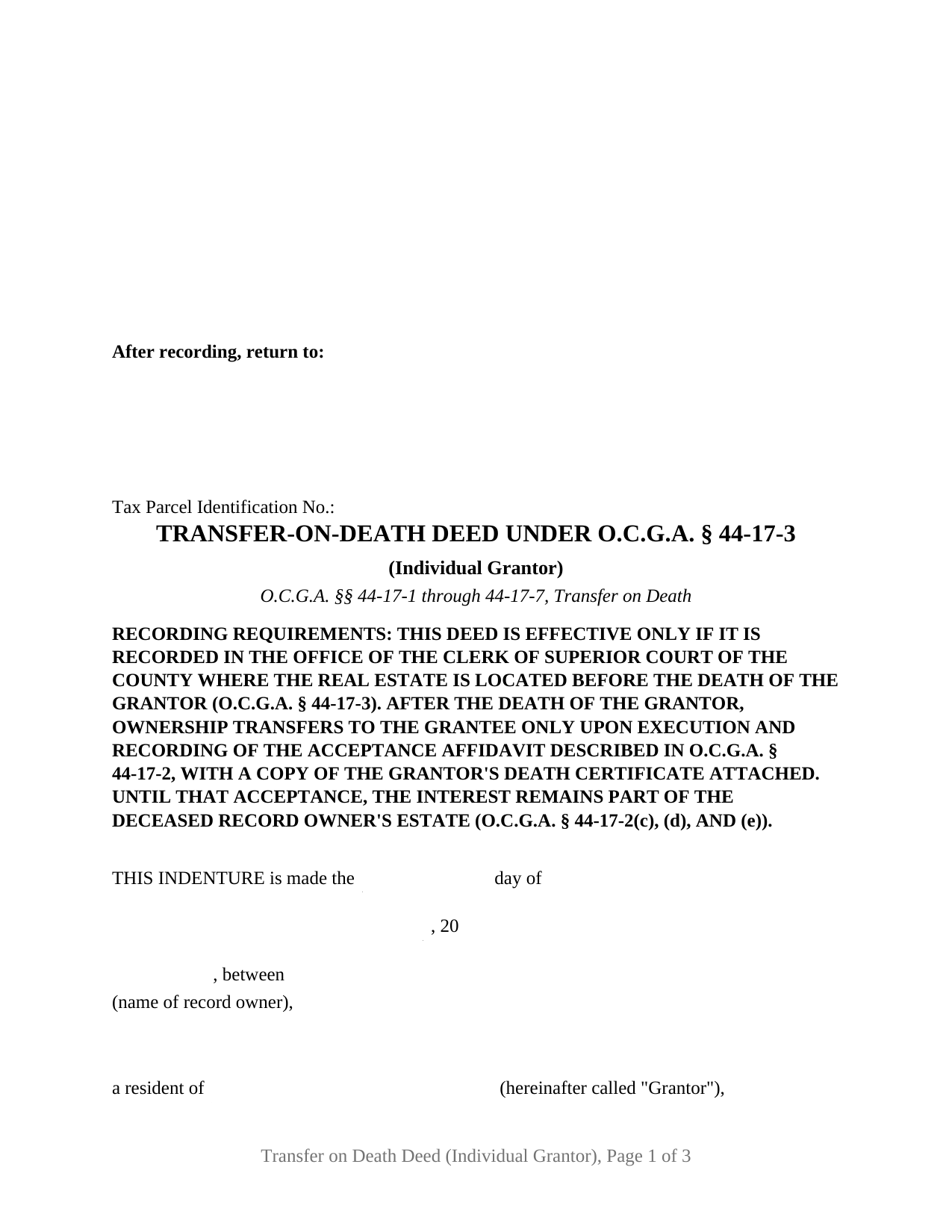
A Georgia transfer on death deed made by one record owner is a short instrument with a long reach: one signature line, one attesting officer, one unofficial witness, and one named grantee beneficiary who takes the described real estate after the owner dies, outside probate. This form prepares that deed for a sole record owner under O.C.G.A. § 44-17-1 through § 44-17-7, on the statutory form supplied by § 44-17-3. Searched elsewhere as a beneficiary deed or TOD deed, the Georgia instrument's statutory name is the transfer-on-death deed.
One owner, one signature line
The single grantor configuration shapes every block on the page. The indenture opening names one record owner as Grantor and one beneficiary as Grantee; the granting clause runs from that owner alone, in the statutory words that grant, bargain, sell, transfer, alien, convey, and confirm on death; and the execution page carries one signature line with the seal notation, one unofficial witness block, and one officer attestation certificate. Sole ownership reaches the record in several shapes, and each presents this pattern: an unmarried owner, an owner who already took the whole parcel when a co-owner died, and a married owner holding title in that owner's own name, since Georgia recognizes neither community property nor tenancy by the entirety in real property. Co-owners signing one deed together are a different arrangement this form does not recite. One limit is absolute: § 44-17-2(a)(3) states that an attorney in fact is not authorized to execute a transfer-on-death deed for a record owner, so no power of attorney reaches this signature line.
What stays with the owner
Everything, until death. Under § 44-17-7 the record owner remains the legal and equitable owner and, as to creditors and purchasers, an absolute owner, free to sell, mortgage, or lease the property with no beneficiary in the conversation; § 44-17-2(b) removes any need for the beneficiary's signature, consent, or notice during the owner's life, and § 44-17-2(a)(4) removes any need for consideration. The designation comes undone in more than one way: a recorded revocation referring to this deed, attested by an officer and one other witness after the 2026 amendments; a later transfer-on-death deed for the same interest, which the capitalized notice on this deed's face announces in advance; or operation of law under the new § 44-17-4(d), when the owner sells the interest, conveys it to the trustee of the owner's own trust, or a sole beneficiary dies before accepting. A will revokes none of it.
Two recordings, and no deadline between them
Recording is what gives this deed its statutory effect: § 44-17-3 titles the interest in transfer-on-death form only when the deed is executed, attested, and recorded with the clerk of superior court of the county where the land lies before the record owner's death. A second recording finishes the job. Under § 44-17-2(c) ownership passes to the beneficiary upon execution and recording of the acceptance affidavit described in that section, with a copy of the death certificate attached, and until that acceptance the interest remains part of the deceased owner's estate. The 2026 amendments (Act 379, effective April 22, 2026) struck the acceptance deadline and the reversion clause the 2024 statute had imposed, so the section as it now reads sets no filing deadline for the affidavit. Both recording points appear in capitals on the face of the deed, and the guide covers each, including the rule under which the owner's recording carries no PT-61 while the beneficiary's later filing does.
Georgia formalities, drawn into the form
Georgia deeds are attested at the signing rather than acknowledged afterward: O.C.G.A. § 44-5-30 calls for the maker's signature, an officer named in § 44-2-15 (a notary public in ordinary practice), and one other witness, and the form carries a line for each. The first page reserves the full three inches that § 15-6-61(a)(10) leaves for the clerk's notation, the § 44-2-14(b) return-to name and address sits as the first content below that reserve, and a tax parcel identification line follows, which is what DeKalb County asks to see atop a deed of conveyance. Recording runs twenty five dollars under § 15-6-77(f), and a filer outside the statute's professional categories files electronically with a verified photo identification.
The download includes the fillable deed formatted to Georgia recording standards, a completed example built on a Cobb County fact pattern, and a plain-language guide covering every entry, the attestation formalities, and both recording steps; the materials are informational and are not legal advice.
Important: County-Specific Forms
Our transfer on death deed (individual grantor) forms are specifically formatted for each of the 159 counties in Georgia.
After selecting your county, you'll receive forms that meet all local recording requirements, ensuring your documents will be accepted without delays or rejection fees.