Georgia Revocation of Transfer on Death Deed
County Specific Legal Forms Validated as recently as September 30, 2026 by our Forms Development Team
About the Georgia Revocation of Transfer on Death Deed
How to Use This Form
- Select your county from the list
- Download the county-specific form
- Fill in the required information
- Have the document notarized if required
- Record with your county recorder's office
What Others Like You Are Saying
"So far, I'm pleased. I am a first-time user, as most of my clients are in California. I look forward…"
"Very easy to find what I needed. Really liked the instructions included with the forms and also the …"
"Easy to use,makes things easier,Thanks! Great Idea!"
"I had a nice surprise seeing how fast the process was to download in a safe manner the documents. Th…"
"EXCELLENT JOB DEEDS.COM I AM SO PROUD I WAS ABLE TO RECEIVE A COPY OF THE REAL ESTATE DEED FROM MY O…"
4.8/5 from 4,815 reviews. Read all
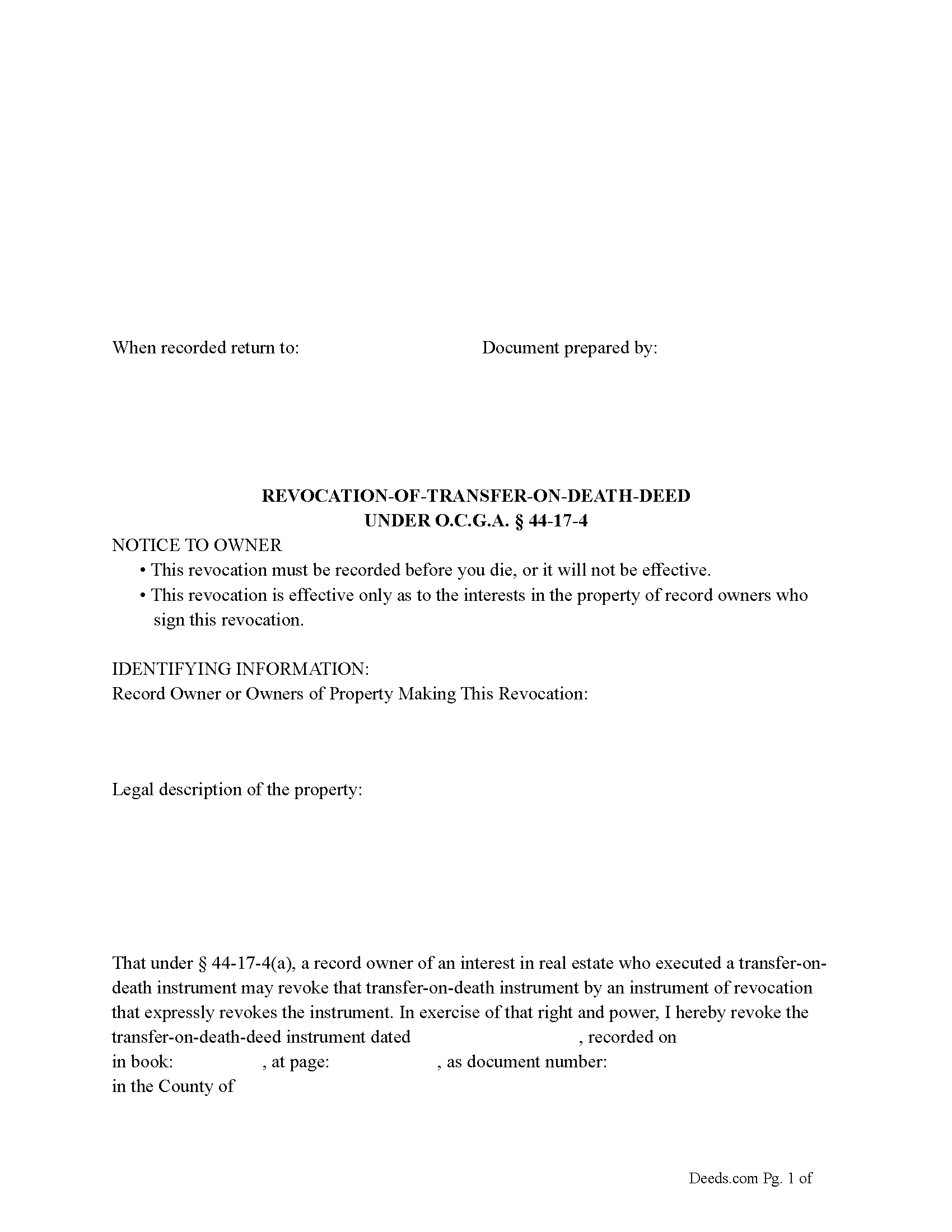
Georgia's Revocation of Transfer on Death Deed is the instrument a record owner uses to cancel a previously recorded TOD deed and remove the beneficiary designation from the public record before their death. What makes Georgia's version distinct is the elevated witness requirement: while the original TOD deed requires only two witnesses total (with the notary counting as one), revoking that deed under O.C.G.A. § 44-17-4(a) requires attestation by an officer and two additional witnesses — three persons in all. That distinction catches many property owners off guard and is the most common reason Georgia revocations are rejected at the Clerk of Court's office.
When a Georgia Revocation of Transfer on Death Deed Is Used
This form is used when a record owner who previously recorded a Georgia TOD deed wants to cancel that beneficiary designation entirely without immediately replacing it with a new one. Common situations include a change in family circumstances, a decision to sell or refinance that warrants clearing the public record, or an estate plan revision that replaces the TOD deed with a different arrangement. The revocation has no effect until it is recorded, and it must be recorded before the record owner's death to be valid.
Georgia-Specific Statutory Requirements
The revocation instrument must expressly refer to the original TOD deed being canceled. A general statement of intent to revoke is insufficient — the revocation must identify the original deed with enough specificity that it can be located in the public record (O.C.G.A. § 44-17-4(a)). That means including the date the original deed was executed, the date it was recorded, the book and page number or document number assigned by the clerk, and the county in which it was recorded.
A TOD deed cannot be revoked by will. Any attempt to cancel a beneficiary designation through a will is ineffective under Georgia law, regardless of the language used (O.C.G.A. § 44-17-4(c)). Revocation must occur during the owner's lifetime through a separately executed and recorded instrument.
Execution Requirements — Who Must Sign and Witness
The record owner — or their duly authorized attorney-in-fact — must sign the revocation. For a single-owner TOD deed, only that owner signs. For a jointly executed TOD deed where two joint tenants signed the original deed together, all surviving record owners must sign the revocation. If one joint owner has since died, the surviving owner signs alone as the now-sole record owner and should attach a copy of the deceased owner's death certificate to the revocation instrument.
Georgia's three-person witness requirement for revocations differs from the execution standard for the original deed itself. The revocation must be:
- Signed by the record owner or attorney-in-fact
- Attested by a notary public or other officer as provided in O.C.G.A. § 44-2-15
- Attested by two additional witnesses — separate from and in addition to the notary
The notary does not count toward the two-witness requirement for a revocation. All signatures must be made at the same time, in the presence of both witnesses and the notary. Do not sign the revocation before appearing before the notary.
Georgia-Specific Traps
Preparer Identification and Return Address
Under O.C.G.A. § 44-2-14, the name and mailing address of the person who prepared the revocation instrument and the name and address of the person to whom the recorded document should be returned must both appear on the first page. Missing either item will result in rejection at the Clerk of Court's window.
The Three-Inch Top Margin
The first page of any instrument recorded in Georgia must have a three-inch blank margin at the top, reserved for the Clerk of Court's recording stamp. Content placed in that space causes rejection. This form is pre-formatted to that standard.
Must Reference the Original Deed by Recording Information
A revocation that identifies the original TOD deed only by date — without the book, page, or document number from the recording stamp — is insufficient under O.C.G.A. § 44-17-4(a). The recording reference is what ties the revocation to a specific instrument in the chain of title. If the recording information from the original deed is not available, it can be obtained from the Clerk of Superior Court in the county where the property is located.
Must Be Recorded in the Same County
The revocation must be recorded with the Clerk of Superior Court in the same county where the original TOD deed was recorded. Recording in a different county has no effect on the original designation.
No Beneficiary Consent Required — But No Beneficiary Notice Either
The consent, agreement, or notice of the designated grantee beneficiary is not required for a revocation (O.C.G.A. § 44-17-4(a)). Georgia law does not require the record owner to notify the beneficiary that the designation has been canceled. However, because beneficiaries are often unaware a TOD deed exists in the first place, good practice is to inform them — and to keep a copy of the recorded revocation with other estate planning documents.
Jointly Executed Deeds Cannot Be Revoked Unilaterally
When both joint tenants signed a single TOD deed together, neither owner can revoke it alone while the other is living. The revocation requires both surviving owners to sign. An attempted single-owner revocation of a jointly executed deed is ineffective as to the entire interest (O.C.G.A. § 44-17-4(a)).
Homestead and Spousal Considerations
When the property subject to the TOD deed serves as the primary residence of a married couple, Georgia's homestead and marital property laws may be relevant to the revocation. If the non-owning spouse signed the original TOD deed to address homestead rights, the same considerations apply to the revocation instrument. Confirm the appropriate signatories based on the circumstances of the original deed.
Recording the Revocation
The executed revocation must be filed with the Clerk of Superior Court in the county where the original TOD deed was recorded, and must be recorded before the record owner's death. An unrecorded revocation has no legal effect, regardless of when it was signed. Submit the original document — not a copy — with applicable recording fees. Print on 8.5" × 11" white paper, single-sided. Do not bind, staple, or highlight the instrument. Include a self-addressed stamped envelope for return of the recorded original.
What Is Included
The download includes the Georgia Revocation of Transfer on Death Deed formatted to meet state and county recording requirements, including the three-inch first-page margin, preparer and return-address fields, the statutory revocation language required by O.C.G.A. § 44-17-4, fields for complete identification of the original deed by recording reference, and an exhibit page for the legal description. Also included are a completed example showing a joint-owner revocation and an instruction guide covering Georgia's elevated three-witness requirement, the single-owner and joint-owner scenarios, the survivor signing rule, and recording requirements.
Important: County-Specific Forms
Our revocation of transfer on death deed forms are specifically formatted for each of the 159 counties in Georgia.
After selecting your county, you'll receive forms that meet all local recording requirements, ensuring your documents will be accepted without delays or rejection fees.