Indiana Grant Deed
County Specific Legal Forms Validated as recently as April 30, 2026 by our Forms Development Team
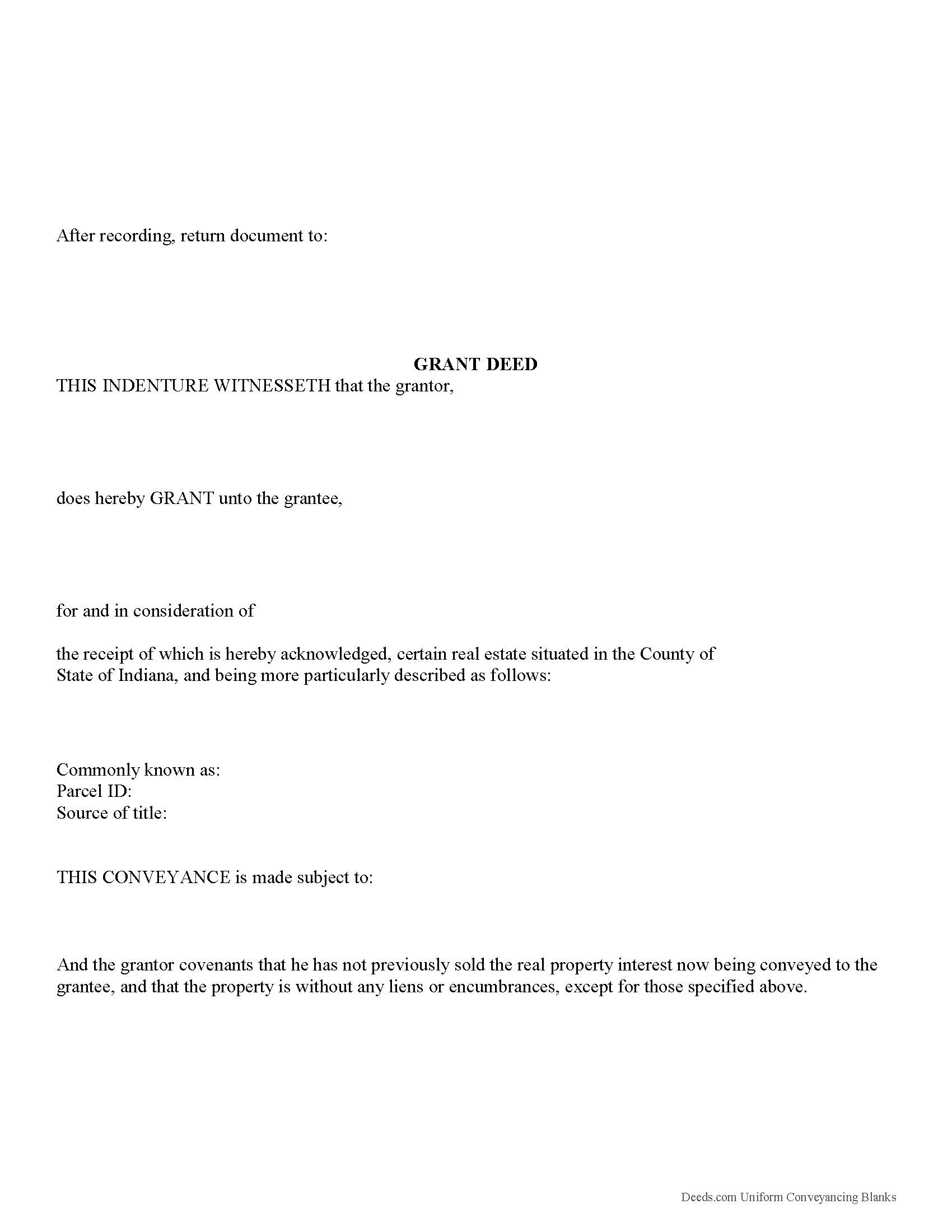
About the Indiana Grant Deed
How to Use This Form
- Select your county from the list on the left
- Download the county-specific form
- Fill in the required information
- Have the document notarized if required
- Record with your county recorder's office
What Others Like You Are Saying
"Responses to my needs were prompt and professional. I found the service easy to use and clearly outl…"
"It was confusing at first, but the customer service was excellent and fast and I got everything take…"
"You charge too much for a form. Your business model is shortsighted. I would not try to use your ser…"
"Amazingly easy. Thank you"
"Re: Idaho Affidavit of Successor: Decedent's residence may be a state other than Idaho. Death certif…"
A grant deed is a legal document used to transfer, or convey, rights in real property from a grantor (seller) to a grantee (buyer). It contains implied covenants that the grantor has not previously sold the real property interest and that the property is conveyed without any undisclosed liens or encumbrances. Grant deeds typically do not require the grantor to defend title claims.
A lawful deed includes the grantor's full name and marital status, as well as the grantee's full name, marital status, mailing address, and vesting. Vesting describes how the grantee holds title to the property. For Indiana residential property, the primary methods for holding title in co-ownership are tenancy in common, joint tenancy, and tenancy by entirety (I.C. 32-21-10-2). An estate conveyed to two or more people is presumed a tenancy in common, unless otherwise specified (I.C. 32-17-2-1). An estate conveyed to a married couple vests as tenancy by the entirety unless otherwise specified (I.C. 32-17-3-1). Joint tenancy must be written into the text of the document.
As with any conveyance of real estate, a grant deed requires a complete legal description of the parcel. Recite the source of title to establish a clear chain of title, and detail any restrictions associated with the property. The amount of consideration does not need to be in writing on the deed, but may be proved (I.C. 32-21-1-2). Finally, the form must meet all state and local standards for recorded documents.
Before submitting a grant deed to a county recorder in Indiana, the grantor must sign it in the presence of a notary public. Record the completed and signed deed, along with any supplemental documentation necessary for the specific transaction, in the recorder's office in the county where the property is located. Unless a deed is recorded in the manner provided by the Indiana Code, it is not valid against any person other than the grantor, the grantor's heirs and devisees, and those with notice of the conveyance (I.C. 32-21-3-3). Indiana gives priority of title to the party that records first, but only if the party also lacked notice of prior unrecorded claims on the same property.
This article is provided for informational purposes only and is not a substitute for the advice of an attorney. Contact a lawyer with questions about grant deeds or for any other issues related to the transfer of real property in Indiana.
(Indiana Grant Deed Package includes form, guidelines, and completed example)
How to Use This Form
- Select your county from the list above
- Download the county-specific form
- Fill in the required information
- Have the document notarized if required
- Record with your county recorder's office
What Others Like You Are Saying
"Responses to my needs were prompt and professional. I found the service easy to use and clearly outl…"
"It was confusing at first, but the customer service was excellent and fast and I got everything take…"
"You charge too much for a form. Your business model is shortsighted. I would not try to use your ser…"
"Amazingly easy. Thank you"
"Re: Idaho Affidavit of Successor: Decedent's residence may be a state other than Idaho. Death certif…"
Common Uses for Grant Deed
- Transfer property to avoid probate
- Transfer ownership to a living trust
- Convey property received through inheritance
- Transfer property between family members
- Change the vesting or ownership structure of a property
Compare other Indiana deed forms and documents
Important: County-Specific Forms
Our grant deed forms are specifically formatted for each county in Indiana.
After selecting your county, you'll receive forms that meet all local recording requirements, ensuring your documents will be accepted without delays or rejection fees.