Jennings County Quitclaim Deed (Corrective) Form
Last validated October 28, 2026 by our Forms Development TeamFormatted for recording in Jennings County, for property anywhere in the county: rural and unincorporated areas as well as Butlerville, Commiskey, Hayden, North Vernon, Paris Crossing, Scipio, Vernon.
- 3 documents included
- Immediate PDF download
- Formatting guarantee
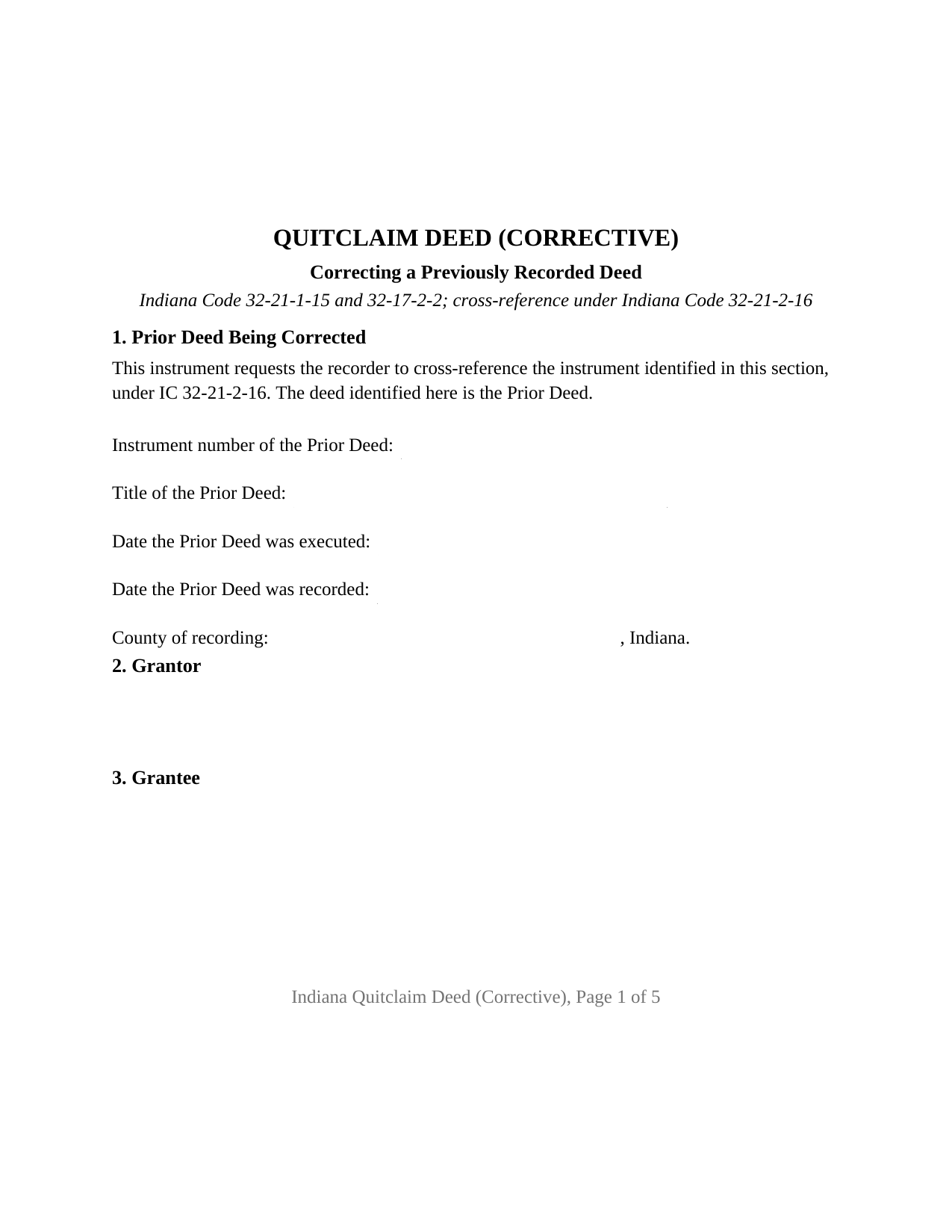
Jennings County Quitclaim Deed (Corrective) Form
Fill in the blank Quitclaim Deed (Corrective) form formatted to comply with all Indiana recording and content requirements.
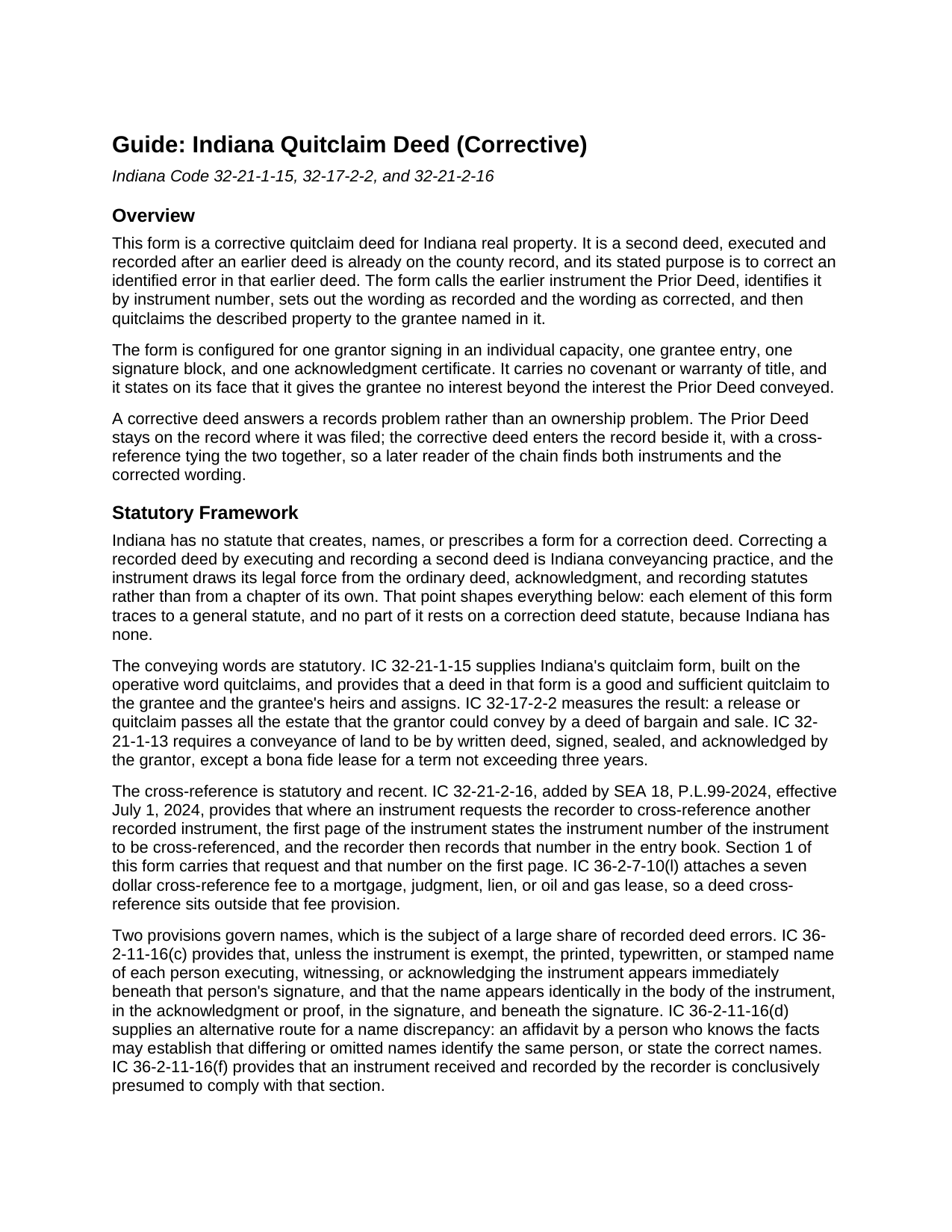
Jennings County Quitclaim Deed (Corrective) Guide
Line by line guide explaining every blank on the Quitclaim Deed (Corrective) form.
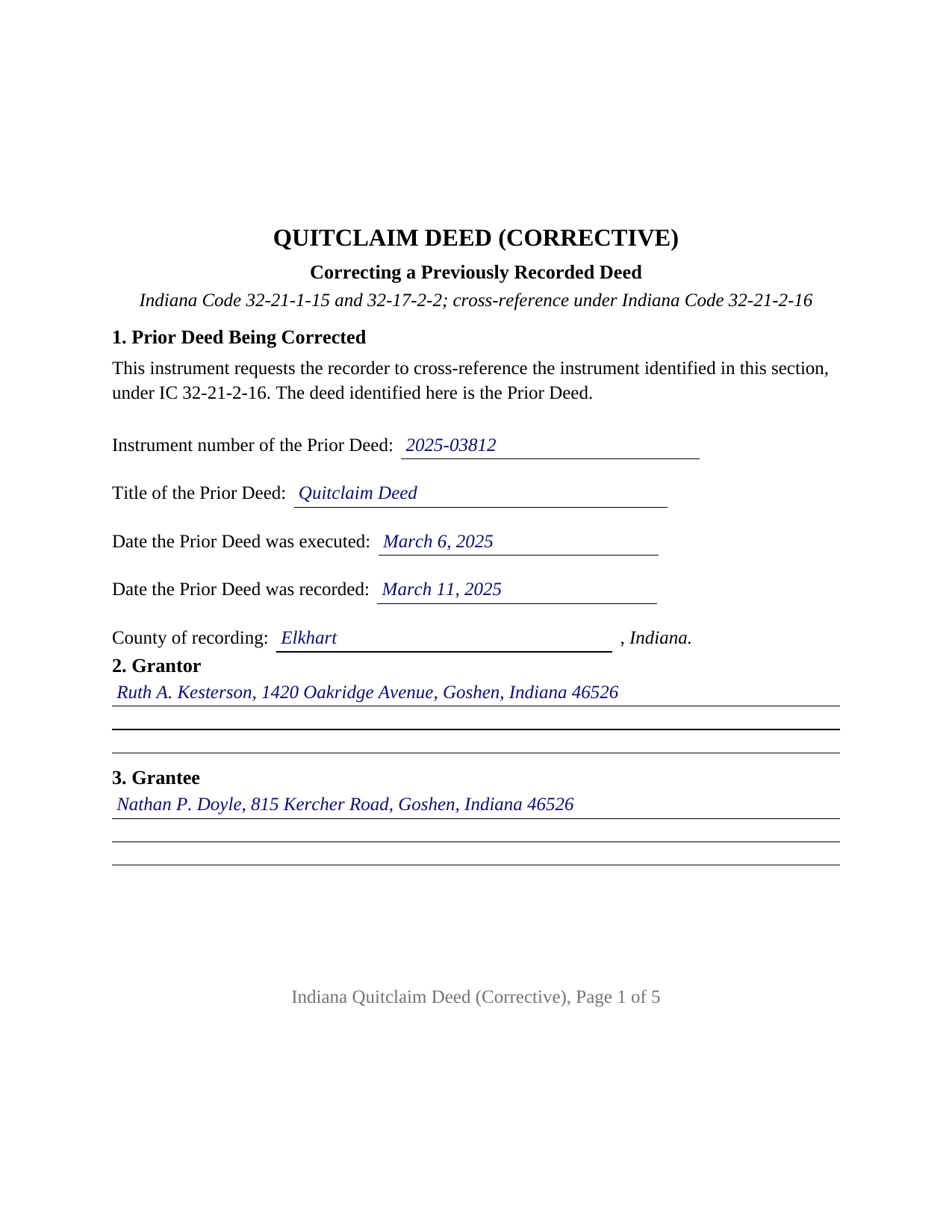
Jennings County Completed Example of the Quitclaim Deed (Corrective) Document
Example of a properly completed Indiana Quitclaim Deed (Corrective) document for reference.
All 3 documents above included • One-time purchase • No recurring fees
Immediate Download • Secure Checkout
Additional Indiana and Jennings County documents included at no extra charge:
Where to Record Your Documents
Jennings County Recorder
Vernon, Indiana 47282
Hours: 8:00 to 4:00 Monday through Friday
Phone: (812) 352-3053
Recording Tips for Jennings County:
- Bring your driver's license or state-issued photo ID
- Ensure all signatures are in blue or black ink
- Request a receipt showing your recording numbers
- Ask about accepted payment methods when you call ahead
- Ask for certified copies if you need them for other transactions
Cities and Jurisdictions in Jennings County
Properties in any of these areas use Jennings County forms:
- Butlerville
- Commiskey
- Hayden
- North Vernon
- Paris Crossing
- Scipio
- Vernon
Hours, fees, requirements, and more for Jennings County
How do I get my forms?
Forms are available for immediate download after payment. The Jennings County forms will be in your account ready to download to your computer. An account is created for you during checkout if you don't have one. Forms are NOT emailed.
Are these forms guaranteed to be recordable in Jennings County?
Yes. Our form blanks are guaranteed to meet or exceed the applicable formatting requirements used for recording in Jennings County, including margin requirements, font requirements, and other layout standards. This guarantee applies to formatting, not to the legal sufficiency of information entered by the user or the suitability of a form for a particular transaction.
Can I reuse these forms?
Yes. You can reuse the forms for your personal use. For example, if you have multiple properties in Jennings County you only need to order once.
What do I need to use these forms?
The forms are PDFs that you fill out on your computer. The free Adobe Acrobat Reader is recommended, and most PDF apps also work. You do NOT enter your property information online - you download the blank forms and complete them privately on your own computer.
Are there any recurring fees?
No. This is a one-time purchase. Nothing to cancel, no memberships, no recurring fees.
How much does it cost to record in Jennings County?
Recording fees in Jennings County vary. Contact the recorder's office at (812) 352-3053 for current fees.
Questions answered? Let's get started!
A corrective deed is written against a document that already exists. The county record holds a deed carrying an error, and this Indiana quitclaim deed goes on the record beside it: it names that earlier instrument by its recorded number, sets the wording as recorded next to the wording as corrected, and quitclaims the parcel to the grantee the earlier deed named, with no warranty of title.
The Number That Joins Two Instruments
Indiana gave that pairing a statute in 2024. IC 32-21-2-16, added by SEA 18, P.L.99-2024, provides that an instrument asking the recorder to cross-reference another recorded document states that document's instrument number on its first page, and the recorder carries the number into the entry book. Section 1 holds the request and the number, which is why it sits at the top of page one. Nothing is removed from an Indiana chain: the earlier deed stays where it was filed, and the corrected wording arrives as a second entry a title examiner reads together with the first.
What a Correction Deed Reaches
A scrivener's error deed ordinarily addresses wording that misdescribes a transaction the parties agree on: a misspelled grantee name, a lot number or plat book page taken down wrong, an omitted survivorship phrase that left IC 32-17-2-1 to supply its tenancy in common default. A boundary runs through that work. Restating what a deed meant to say is correction; adding a party, dropping one, or moving a different parcel is a fresh conveyance whatever the caption reads. Where the parties do not agree that the earlier deed was wrong, Indiana sends the question to reformation on the clear and convincing evidence standard of Estate of Reasor v. Putnam County, 635 N.E.2d 153 (Ind. 1994), applied to a deed description in Meyer v. Marine Builders, Inc., 797 N.E.2d 760 (Ind. Ct. App. 2003), a court proceeding filed separately from any deed.
Statutory Words for an Instrument With No Statute
No Indiana chapter creates a correction deed or prescribes a form for one, so it borrows the ordinary conveyancing statutes whole. The operative verb is the one IC 32-21-1-15 supplies for a quit claim deed, and IC 32-17-2-2 measures the release at all the estate the signer could pass by a deed of bargain and sale, so a mortgage, a docketed judgment, and a recorded easement survive it untouched. IC 36-2-11-16(c) asks that a signer's name read identically in the body, in the certificate, and beneath the signature, and IC 36-2-11-16(d) opens a separate path for a name discrepancy: an affidavit by someone who knows the facts, prepared on its own and not part of this package.
One Grantor, One Certificate, Two Statements
The form names exactly one grantor signing in an individual capacity, one grantee entry holding the grantee as the earlier deed named it, one signature block above the printed name line, and one acknowledgment certificate. The grantee signs nothing. Section 6 carries the pair of statements that does the correcting, and Section 8 performs the conveyance while stating that the deed gives the grantee no interest beyond what the earlier deed conveyed. Record patterns presenting this configuration include a deed indexed under a misspelled grantee name, a description naming the wrong lot in a platted addition, and a deed whose survivorship words dropped out in typing. It is not set up for two grantors on the corrective instrument, for an entity or trustee signer, for a signer acting under a power of attorney, or for entireties property, which IC 32-17-3-4 leaves to the joint deed of both spouses.
The Filing Question a Correction Raises
Consideration decides the sales disclosure route. IC 6-1.1-5.5-1 defines a conveyance as a transfer for valuable consideration, IC 6-1.1-5.5-2(b)(4) excludes a quitclaim deed not serving as a source of title, and Department of Local Government Finance instructions state that re-recording a prior transaction to correct an error is not a conveyance under that chapter. The auditor's endorsement under IC 36-2-11-14 remains a condition of recording, and its statutory wording includes not taxable. The recorder's charge is the flat twenty five dollars of IC 36-2-7-10, with no Indiana transfer tax.
Three files come with the purchase: the fillable deed built to the format rules of IC 36-2-11-16.5, a completed example in which an Elkhart County owner corrects a misspelled grantee name, and a guide covering every entry, the certificate, and the county filing sequence. These pages describe Indiana law in general terms and are informational; they are not legal advice.
Important: Your property must be located in Jennings County to use these forms. Documents should be recorded at the county recording office listed above.
This Quitclaim Deed (Corrective) meets all recording requirements specific to Jennings County.
Our Promise
The documents you receive here are guaranteed to meet or exceed the applicable Jennings County recording format requirements. If there is a rejection caused by our formatting, we will correct the issue or refund your payment. This guarantee applies to document formatting only and does not extend to information entered by the user, the selection of the form, or the legal effect of the completed document.
Save Time and Money
Get your Jennings County Quitclaim Deed (Corrective) form done right the first time with Deeds.com Uniform Conveyancing Blanks. At Deeds.com, we understand that your time and money are valuable resources, and we don't want you to face a penalty fee or rejection imposed by a county recorder for submitting nonstandard documents. We constantly review and update our forms to meet rapidly changing state and county recording requirements for roughly 3,500 counties and local jurisdictions.
4.8 out of 5 - ( 4,857 Reviews )
Lara T. 5 out of 5 stars
Made recording my document so much easier and faster. First attempt failed due to illegible blue ink, got that fixed and deeds.com resubmitted and doc was recorded within a couple of hours, all from the comfort of my home.
Thank you for your feedback. We really appreciate it. Have a great day!
Randal R. 5 out of 5 stars
While disappointed that my request could not be filled, I understand the issue, and appreciate the attempt and the responsiveness. I certainly will be back if the occasion arises!
Thank you!
Jacqueline B. 5 out of 5 stars
The service was very clear and direct. I was able to get everything I need right now. Your website is set up well. Thank you
Thank you for your feedback. We really appreciate it. Have a great day!
Patricia P. 5 out of 5 stars
Easy to use and super convenient.
Thank you for your feedback. We really appreciate it. Have a great day!
Raymond R C. 4 out of 5 stars
Old document deeds were not available and my cost was returned. Was referred to another location and was able to get some help there.
Thank you for your feedback. We really appreciate it. Have a great day!
Sharon S. 5 out of 5 stars
very satisfied...
Thank you!
Stephanie B. 5 out of 5 stars
Really great, relevant and straight forward forms. Deeds.com is excellent and helps you avoid costly errors on documents.
Thank you for your feedback. We really appreciate it. Have a great day!
Susan M. 5 out of 5 stars
It was easy to use and clear directions.
Thank you!
Paul N. 5 out of 5 stars
Had what I needed, service was excellent.
We appreciate your business and value your feedback. Thank you. Have a wonderful day!
Jan K. 5 out of 5 stars
Very simple and easy, quick!
Thank you for your feedback. We really appreciate it. Have a great day!
dorothy f. 5 out of 5 stars
Thank you, for help.
Anytime Dorothy, have a great day.
Jeffrey M. 5 out of 5 stars
Great service. It had all the forms I needed.
Thank you!
Katie G. 5 out of 5 stars
I haven't used the forms yet but it appears, with your tutelage, that they should not be too difficult to fill out and file. Your site was easy to navigate. Thank You
Thank you for the kinds words Katie. have a fantastic day!
A. S. 3 out of 5 stars
First, I am glad that you gave a blank copy, an example copy, and a 'guide'. It made it much easier to do. Overall I was very happy with your products and organization... however, things got pretty confusing and I have a pretty 'serious' law background in Real Estate and Civil law. With that said, I spent about 10+ hours getting my work done, using the Deed of Trust and Promissory note from you and there were a few problems: First, it would be FANTASTIC if you actually aligned your guide to actually match the Deed or Promissory Note. What I mean is that if the Deed says 'section (E)' then your guide shouldn't be 'randomly' numbered as 1,2,3, for advice/instructions, but should EXACTLY match 'section (E)'. Some places you have to 'hunt' for what you are looking for, and if you did it based on my suggestion, you wouldn't need to 'hunt' and it would avoid confusion. 2nd: This one really 'hurt'... you had something called the 'Deed of Trust Master Form' yet you had basically no information on what it was or how to use it. The only information you had was a small section at the top of the 'Short Form Deed of Trust Guide'. Holy Cow, was that 'section' super confusing. I still don't know if I did it correctly, but your guide says only put a return address on it and leave the rest of the 16 or so page Deed of Trust beneath it blank... and then include your 'Deed of Trust' (I had to assume the short form deed that I had just created) as part of it. I had to assume that I had to print off the entire 17 page or so title page and blank deed. I also had to assume that the promissory note was supposed to be EXHIBIT A or B on the Short Form Deed. It would be great if someone would take a serious look at that short section in your 'Short Form Deed of Trust Guide' and realize that those of us using your products are seriously turning this into a county clerk to file and that most of us, probably already have a property that has an existing Deed... or at least can find one in the county records if necessary... and make sure that you make a distinction between the Deed for the property that already exists, versus the Deed of Trust and Promissory note that we are trying to file. Thanks.
Thank you for your feedback. We'll have staff review the document for clarity. Have a great day!
RICHARD M. 5 out of 5 stars
After a little glitch due to heavy volume at the County Recorder, my document was recorded. County Recorder was closed to public access at the office (due to the coronavirus issues) so all documents were either mailed to them or sent in electronically. Deeds.com was very efficient at their end with very quick responses to my questions and concerns. I would definitely use their services again.
Thank you for your feedback. We really appreciate it. Have a great day!