Indiana Quitclaim Deed (Corrective)
County Specific Legal Forms Validated as recently as October 22, 2026 by our Forms Development Team
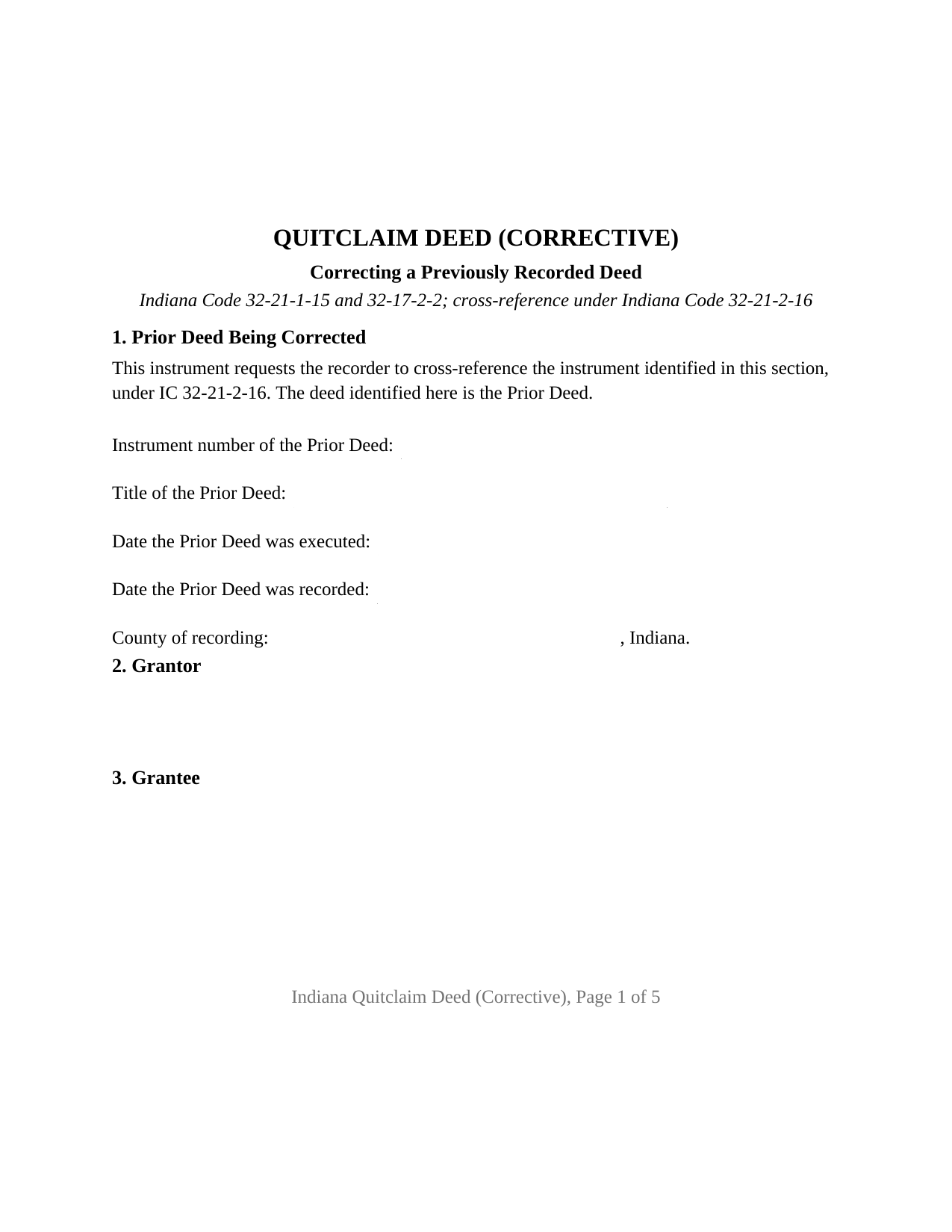
About the Indiana Quitclaim Deed (Corrective)
How to Use This Form
- Select your county from the list
- Download the county-specific form
- Fill in the required information
- Have the document notarized if required
- Record with your county recorder's office
What Others Like You Are Saying
"was very helpfull, It provided the refernces to the stat laws so I coul have a deeper look into the …"
"I haven't used the forms yet but it appears, with your tutelage, that they should not be too difficu…"
"good place to get documents and it seems like a sound place to get forms. Self explainitory and help…"
"Very fast service. Wish I knew about this earlier."
"I don't have any experience with real estate legal forms and these were fairly easy to understand. T…"
4.8/5 from 4,833 reviews. Read all
A corrective deed is written against a document that already exists. The county record holds a deed carrying an error, and this Indiana quitclaim deed goes on the record beside it: it names that earlier instrument by its recorded number, sets the wording as recorded next to the wording as corrected, and quitclaims the parcel to the grantee the earlier deed named, with no warranty of title.
The Number That Joins Two Instruments
Indiana gave that pairing a statute in 2024. IC 32-21-2-16, added by SEA 18, P.L.99-2024, provides that an instrument asking the recorder to cross-reference another recorded document states that document's instrument number on its first page, and the recorder carries the number into the entry book. Section 1 holds the request and the number, which is why it sits at the top of page one. Nothing is removed from an Indiana chain: the earlier deed stays where it was filed, and the corrected wording arrives as a second entry a title examiner reads together with the first.
What a Correction Deed Reaches
A scrivener's error deed ordinarily addresses wording that misdescribes a transaction the parties agree on: a misspelled grantee name, a lot number or plat book page taken down wrong, an omitted survivorship phrase that left IC 32-17-2-1 to supply its tenancy in common default. A boundary runs through that work. Restating what a deed meant to say is correction; adding a party, dropping one, or moving a different parcel is a fresh conveyance whatever the caption reads. Where the parties do not agree that the earlier deed was wrong, Indiana sends the question to reformation on the clear and convincing evidence standard of Estate of Reasor v. Putnam County, 635 N.E.2d 153 (Ind. 1994), applied to a deed description in Meyer v. Marine Builders, Inc., 797 N.E.2d 760 (Ind. Ct. App. 2003), a court proceeding filed separately from any deed.
Statutory Words for an Instrument With No Statute
No Indiana chapter creates a correction deed or prescribes a form for one, so it borrows the ordinary conveyancing statutes whole. The operative verb is the one IC 32-21-1-15 supplies for a quit claim deed, and IC 32-17-2-2 measures the release at all the estate the signer could pass by a deed of bargain and sale, so a mortgage, a docketed judgment, and a recorded easement survive it untouched. IC 36-2-11-16(c) asks that a signer's name read identically in the body, in the certificate, and beneath the signature, and IC 36-2-11-16(d) opens a separate path for a name discrepancy: an affidavit by someone who knows the facts, prepared on its own and not part of this package.
One Grantor, One Certificate, Two Statements
The form names exactly one grantor signing in an individual capacity, one grantee entry holding the grantee as the earlier deed named it, one signature block above the printed name line, and one acknowledgment certificate. The grantee signs nothing. Section 6 carries the pair of statements that does the correcting, and Section 8 performs the conveyance while stating that the deed gives the grantee no interest beyond what the earlier deed conveyed. Record patterns presenting this configuration include a deed indexed under a misspelled grantee name, a description naming the wrong lot in a platted addition, and a deed whose survivorship words dropped out in typing. It is not set up for two grantors on the corrective instrument, for an entity or trustee signer, for a signer acting under a power of attorney, or for entireties property, which IC 32-17-3-4 leaves to the joint deed of both spouses.
The Filing Question a Correction Raises
Consideration decides the sales disclosure route. IC 6-1.1-5.5-1 defines a conveyance as a transfer for valuable consideration, IC 6-1.1-5.5-2(b)(4) excludes a quitclaim deed not serving as a source of title, and Department of Local Government Finance instructions state that re-recording a prior transaction to correct an error is not a conveyance under that chapter. The auditor's endorsement under IC 36-2-11-14 remains a condition of recording, and its statutory wording includes not taxable. The recorder's charge is the flat twenty five dollars of IC 36-2-7-10, with no Indiana transfer tax.
Three files come with the purchase: the fillable deed built to the format rules of IC 36-2-11-16.5, a completed example in which an Elkhart County owner corrects a misspelled grantee name, and a guide covering every entry, the certificate, and the county filing sequence. These pages describe Indiana law in general terms and are informational; they are not legal advice.
Important: County-Specific Forms
Our quitclaim deed (corrective) forms are specifically formatted for each of the 92 counties in Indiana.
After selecting your county, you'll receive forms that meet all local recording requirements, ensuring your documents will be accepted without delays or rejection fees.