Indiana Transfer on Death Revocation
County Specific Legal Forms Validated as recently as October 12, 2026 by our Forms Development Team
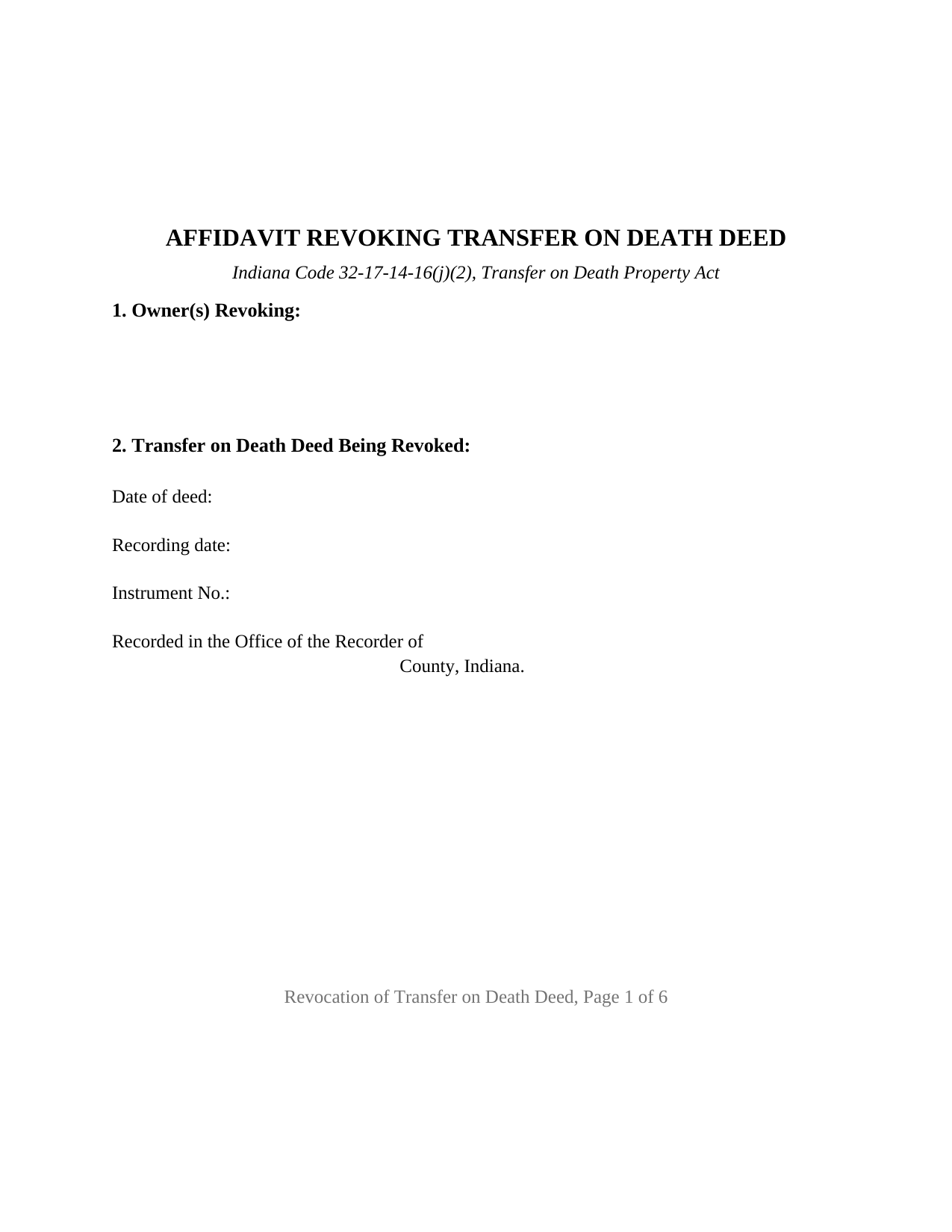
About the Indiana Transfer on Death Revocation
How to Use This Form
- Select your county from the list
- Download the county-specific form
- Fill in the required information
- Have the document notarized if required
- Record with your county recorder's office
What Others Like You Are Saying
"I needed a Missouri Notice of Intent to Sell without a named designated buyer. Mo Statutes require n…"
"Quick, easy, and accurate. And if there's ever a problem, the resolution is also quick, easy, and ac…"
"So far I like the ease of availability of the site and the help guides."
"Wonderful service, forms were great. Completed and ready for recording. Will check back in after rec…"
"I gave your site and forms 5 stars because it is very easy to use and included all the information n…"
4.8/5 from 4,824 reviews. Read all
An Indiana transfer on death deed stays revocable for the owner's whole life, but taking it back is a recording event, not a change of mind. This form prepares the affidavit Indiana Code 32-17-14-16(j)(2) names for the purpose: an acknowledged affidavit that revokes the beneficiary designation made in a recorded transfer on death deed, void unless recorded before the owner's death in the county where the property is situated. It holds one or two owners of record.
A revocation that has to reach the record
Section 16 of the Transfer on Death Property Act recognizes two recorded instruments that revoke a designation made in a transfer on death deed, also called a TOD deed or beneficiary deed: a subsequent deed of conveyance that revokes, omits, or changes the designation, and an affidavit that revokes or changes it. This package is the affidavit, limited to a revocation in its entirety. The chapter is equally clear about what does not work: under subsections (g) and (l) a will or trust does not revoke or modify a transfer on death deed, under subsection (k) writing on the recorded deed or tearing it up has no effect, and under subsection (j) an affidavit left unrecorded at the owner's death revokes nothing. The form restates that recording condition in capitals above the signature lines.
What the affidavit recites
The affidavit identifies the owners revoking, the deed being revoked by its date, recording date, instrument number, and recording county, and the real property by county, legal description, and street address. The operative paragraph revokes the designation as to the signing owners' interest, affirms under the penalties for perjury that the statements are true, and asks the recorder to cross-reference the affidavit to the deed. Because of that request the deed's instrument number sits on the first page, where IC 32-21-2-16 puts the number of a cross-referenced instrument, so a title examiner finds the revocation from the deed itself.
Who joins in the revocation
Indiana ties the signers to the form of ownership. For property held by spouses as tenants by the entirety, IC 32-17-14-16(b) requires the agreement of both tenants while both are alive, and after one spouse dies it lets the surviving spouse revoke or change the designation alone. For property held by joint owners with a right of survivorship, subsection (d) requires the agreement of each living owner. A tenant in common revokes the designation of that owner's own interest.
One or two owners on one affidavit
The owner block is free-form and preprints nothing about marital status or the form of ownership; the names are written as the recorded deed shows them, and the completed example shows two spouses who hold as tenants by the entirety signing together. The form carries two signature blocks and a separate acknowledgment certificate for each signer as a matter of design, so two owners may acknowledge on different days or before different officers, and a sole owner or surviving spouse leaves the second block blank; Indiana's certificate statute does not require separate certificates. The form is not set up for an entity, a trustee, an attorney in fact, a legal representative, or three or more owners, and it does not change or substitute a beneficiary; a new designation is made by a new transfer on death deed, prepared and recorded separately and not included in this package.
Two county offices, in order
Since July 1, 2024, IC 36-2-11-14 has allowed the recorder to record an instrument made under the Transfer on Death Property Act only after the county auditor endorses it, and bars the auditor from refusing on that ground. The affidavit goes to the auditor first and the recorder second. The form is laid out to Indiana's recording format statute, with two inch top and bottom margins on the first and last pages and black 12 point text over the 10 point minimum, and it carries the certificate content IC 33-42-9-12 requires, including the notary's county of commission, and the prepared-by statement and Social Security redaction affirmation IC 36-2-11-15 places at the conclusion of a recorded instrument. The recorder's statewide fee for a non-mortgage instrument is $25.
The package includes the fillable affidavit, a completed example filled in for a realistic Hamilton County fact pattern, and the guide that walks through every section, the joinder rules, and the auditor and recorder steps. This description and the guide describe the form and the governing Indiana statutes in general terms; they are not legal advice.
Important: County-Specific Forms
Our transfer on death revocation forms are specifically formatted for each of the 92 counties in Indiana.
After selecting your county, you'll receive forms that meet all local recording requirements, ensuring your documents will be accepted without delays or rejection fees.