Indiana Transfer on Death Deed Beneficiary Affidavit
County Specific Legal Forms Validated as recently as October 13, 2026 by our Forms Development Team
About the Indiana Transfer on Death Deed Beneficiary Affidavit
How to Use This Form
- Select your county from the list
- Download the county-specific form
- Fill in the required information
- Have the document notarized if required
- Record with your county recorder's office
What Others Like You Are Saying
"So far have only done the download, will come back with further review at a later date."
"Your PDF form Personal Representative's Deed was exceedingly helpful."
"Very easy to us & thanks for all the info to fill out the form."
"My county clerks office referred me to this website and I am so glad she did. This site is very easy…"
"So glad I found this form. Very easy to download and looks like all the instructions are there to co…"
4.8/5 from 4,837 reviews. Read all
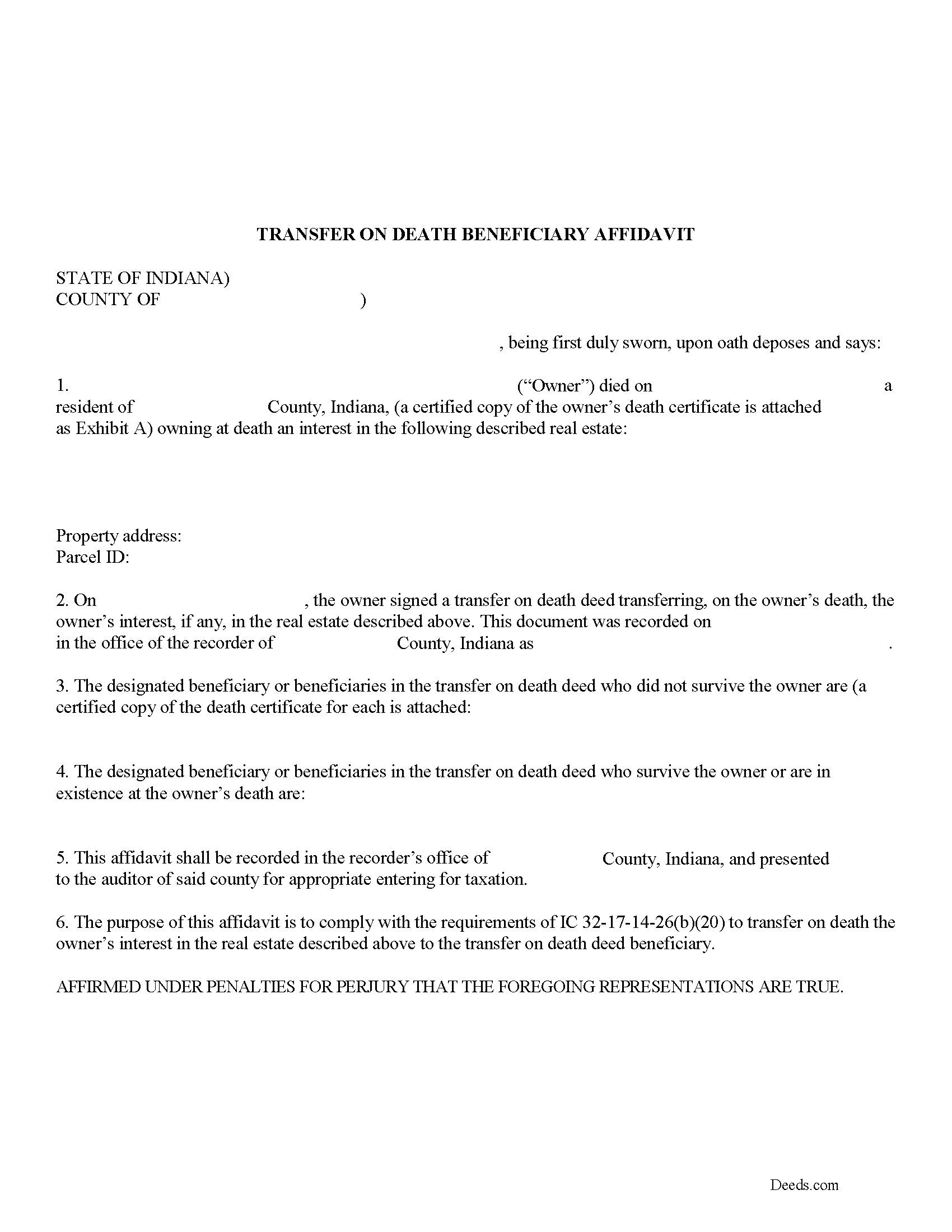
When an Indiana owner who recorded a transfer on death deed dies, the deed finishes its work on its own: under IC 32-17-14-26(b)(18) the transfer occurs automatically at death, with no request, no court, and no new conveyance. What does not happen on its own is the record catching up: the recorder's index still shows the deceased owner, and the auditor's tax rolls still bill that owner, until a beneficiary files the affidavit IC 32-17-14-26(b)(20) requires. This Indiana Transfer on Death Deed Beneficiary Affidavit is that filing.
The transfer already happened; the record has to catch up
The deed, recorded during the owner's life and not part of this package, is what passed title. Whether called a transfer on death deed, a TOD deed, or a beneficiary deed, it passed the owner's interest at the moment of death, subject under IC 32-17-14-19(a) to every mortgage, lien, and easement that bound the owner. The affidavit is the sworn record of that transfer, not the transfer itself: a failure to file it, or a recorder's delay in recording it, does not affect the validity of the transfer. The statute attaches a cost to waiting instead. Until the affidavit is recorded, the beneficiaries named in the deed and the deceased owner's estate are jointly and severally liable for the property taxes assessed for the years beginning with the year of death.
Five facts the statute lists, and a cross-reference on page one
IC 32-17-14-26(b)(20) spells out the contents: the legal description; the owner's date of death; the name and address of each designated beneficiary who survived the owner or was in existence at the owner's death; the name of each designated beneficiary who did not; and a cross-reference to the recorded deed. Each item has its own numbered section, and because the affidavit asks the recorder to cross-reference the deed, IC 32-21-2-16 places the deed's instrument number on the first page, where the form puts it.
Through the auditor's office before the recorder's
The county auditor endorses the affidavit first: IC 36-2-11-14 lets the recorder record an instrument made under IC 32-17-14 only with that endorsement, and since July 1, 2024 the auditor may not refuse it because the instrument is a transfer on death instrument. Each county collects a ten dollar endorsement fee per deed or per parcel under IC 36-2-9-18(e), and the parcel number, the tax statement mailing address, and the beneficiaries' addresses appear on the form because the auditor transfers the parcel on the tax records from it. The recorder's fee is a flat twenty-five dollars under IC 36-2-7-10, Indiana has no transfer tax, and the affidavit ends with the preparer statement and Social Security redaction affirmation IC 36-2-11-15 requires.
A sworn statement with the acknowledgment recorders look for
An affidavit is sworn. The affiant signs before a notarial officer who administers an oath or affirmation and completes a verification on oath or affirmation, the act IC 33-42-0.5-35 defines as a declaration that a statement in a record is true. Indiana's recording statute, IC 32-21-2-3(a), separately names an acknowledgment or a proof as the notarial act of any recorded instrument. The certificate on this form sets forth both: the affidavit is subscribed, sworn to or affirmed, and acknowledged before the officer at one appearance, a certificate IC 33-42-9-12(f) treats as sufficient because it sets forth the officer's actions.
What this affidavit recites
The form recites one affiant, an individual designated as a beneficiary in the recorded deed, signing with one signature block and one certificate; its beneficiary sections list every surviving designated beneficiary, the affiant among them, and every nonsurviving one, so one affidavit documents the transfer to several beneficiaries. An adult child who took a parent's house under a recorded deed, two siblings named together in one deed, and the beneficiaries of a widowed owner whose deed operated at the second death present the pattern this affidavit recites. A trustee, an entity officer, or a legal representative signs in a representative capacity the form is not set up as, and two affiants on one instrument is a configuration the form does not carry.
The package includes the fillable affidavit, a completed example on a Hamilton County fact pattern, and a guide that walks through every numbered section, the certificate, and the two county offices in turn. This description and the guide describe the form and the governing Indiana statutes in general terms; they are not legal advice.
Important: County-Specific Forms
Our transfer on death deed beneficiary affidavit forms are specifically formatted for each of the 92 counties in Indiana.
After selecting your county, you'll receive forms that meet all local recording requirements, ensuring your documents will be accepted without delays or rejection fees.