Kentucky Quitclaim Deed (Corrective)
County Specific Legal Forms Validated as recently as October 13, 2026 by our Forms Development Team
About the Kentucky Quitclaim Deed (Corrective)
How to Use This Form
- Select your county from the list
- Download the county-specific form
- Fill in the required information
- Have the document notarized if required
- Record with your county recorder's office
What Others Like You Are Saying
"Excellent service."
"Easy from the download to just fill out and print. Good instructions to follow. A cover letter form …"
"Great service. The issue I had was uploading the file of several pages. Once I learned, everything b…"
"Could have had Clerk's certification of mailing form after it is recorded. Not fatal, but I did have…"
"At first glance, explanations and guidance to fill out the grant deed seems quite direct and no too …"
4.8/5 from 4,833 reviews. Read all
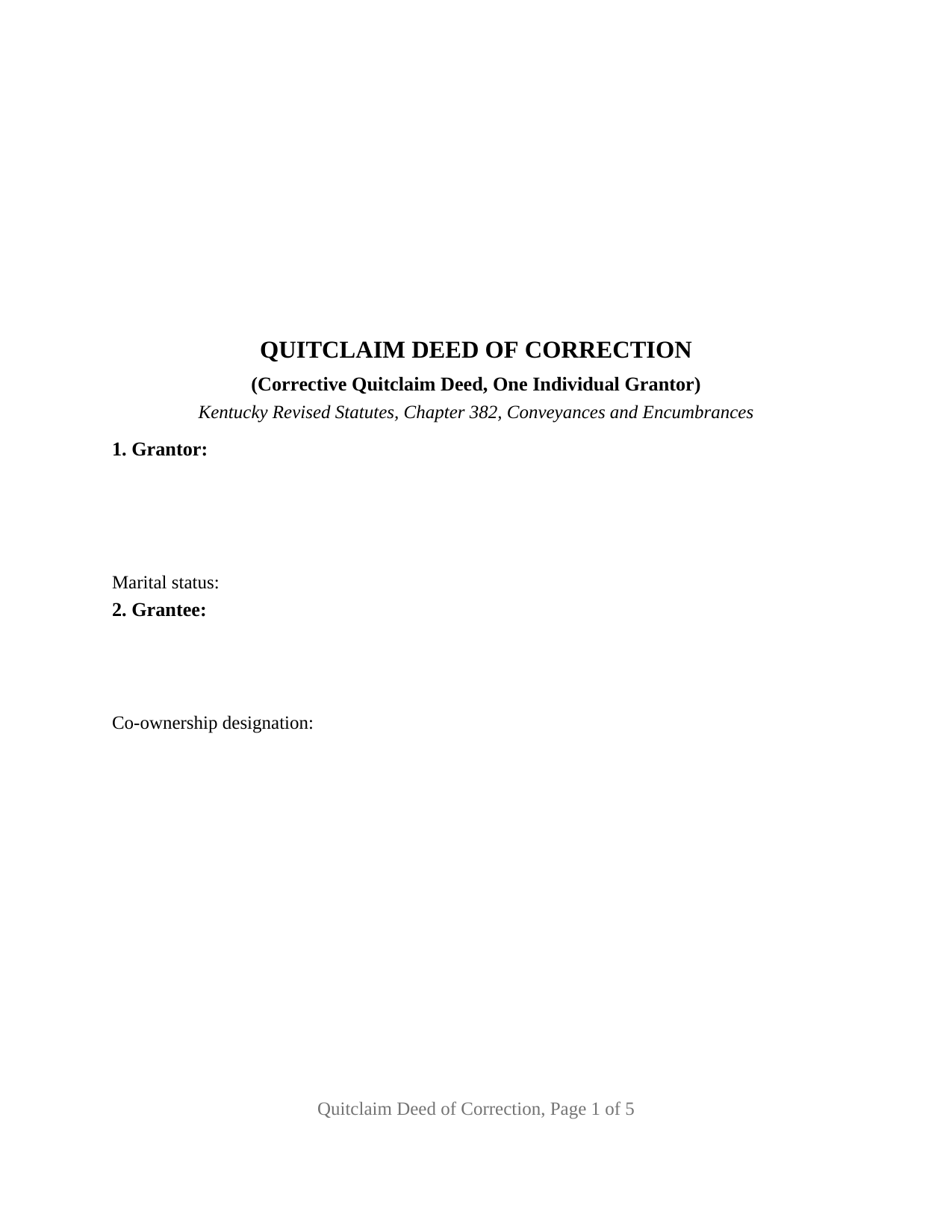
A Kentucky deed ordinarily collects sworn signatures from both sides of the transfer. This one does not. Where a deed corrects an error in an earlier deed running between the same grantor and the same grantee, KRS 382.135(2)(e) lifts the sworn consideration certificate out of the instrument, and the receiving side's signature goes with it. Sometimes searched as a corrective deed or a scrivener's error deed, this fillable Kentucky quitclaim deed of correction restates a recorded conveyance on corrected terms and carries one notarized signature.
The exception that empties three paragraphs
KRS 382.135(1) loads a Kentucky deed with content: the full names of both parties, their mailing addresses, a statement of the full consideration, the in care of address for the year's tax bill, and a sworn certificate signed by the grantor or agent and the grantee or agent. Subsection (2) names six kinds of deed the requirements of paragraphs (1)(c), (d), and (e) do not reach, and paragraph (2)(e) is this instrument: deeds which correct errors in previous deeds conveying the same property from the same grantor to the same grantee. The names and the mailing addresses of paragraphs (1)(a) and (1)(b) keep their place on the form. Section 8 states the exception where a clerk computing tax reads it.
A transfer tax the statute never reaches
An ordinary deed meets KRS 142.050 at the counter: fifty cents for each five hundred dollars of value, charged to the grantor and certified by the clerk, with KRS 382.260 holding the instrument out of the record until it is paid. A correcting deed sits in the exemption list under a paragraph of its own, KRS 142.050(7)(d), covering a transfer of title which confirms or corrects a deed previously recorded. County offices publishing deed of correction requirements add the practical boundary: tax is collected where the consideration amount has been changed, which is also where the sworn certificate returns.
Four things a Kentucky clerk looks for
Kentucky prescribes no statutory correction deed form, so the instrument takes its shape from those two statutes and from county intake requirements, consistent office to office: the parties are identical to those in the deed being corrected, no party is added, removed, or changed, the instrument says on its face that it is a deed of correction, it refers to the deed it corrects, and the reason for the correction is apparent. Sections 3, 4, and 9 carry those items. The source of title statement of KRS 382.110, the preparer endorsement of KRS 382.335, and acknowledgment under KRS 382.130 stay where they always were.
What this form recites, and what it is not arranged for
The deed recites exactly one grantor, an individual, with a marital status entry; the grantee or grantees named in the deed being corrected, with a co-ownership designation entry; one prior deed identified by its recording data; and one correction stated as a before and after pair. A single signature block follows, one acknowledgment certificate beneath it, and whoever drew the instrument signs the Section 11 endorsement. A plat slide reference pointing at the wrong slide, an acreage figure that does not match the survey, and a source of title clause citing the wrong deed book present the patterns this deed recites. It is not arranged for two people on the granting side, for an entity or a fiduciary conveying through a representative, for an agent signing under a power of attorney, for a joining spouse, or for an instrument that changes the consideration.
Where a correction stops and a court begins
Correction by a second deed rests on the agreement of the same two parties, which is why identity of the parties is the condition every Kentucky source states. The instrument carries no covenant of title, since Kentucky attaches covenants to statutory words and this deed prints neither with warranty under KRS 382.030 nor with special warranty under KRS 382.040, so liens, easements, and chain gaps ride through the correction untouched. Changing who takes, changing the estate taken, or settling a disagreement about the earlier deed's meaning is reformation, a remedy a court supplies, and no Kentucky appellate decision construing a deed of correction was located when this product was researched.
The download delivers this corrective quitclaim deed as a fillable PDF, a completed Franklin County example with every blank filled, and a plain language guide covering the correction entries, the single notarized signature, and recording at the county clerk's office. The materials are informational and are not legal advice.
Important: County-Specific Forms
Our quitclaim deed (corrective) forms are specifically formatted for each of the 120 counties in Kentucky.
After selecting your county, you'll receive forms that meet all local recording requirements, ensuring your documents will be accepted without delays or rejection fees.