Kentucky Quitclaim Deed (Trustee Grantor)
County Specific Legal Forms Validated as recently as September 28, 2026 by our Forms Development Team
About the Kentucky Quitclaim Deed (Trustee Grantor)
How to Use This Form
- Select your county from the list
- Download the county-specific form
- Fill in the required information
- Have the document notarized if required
- Record with your county recorder's office
What Others Like You Are Saying
"Exactly what I needed"
"The forms were exactly the ones required by that New Jersey county, and were very easy to fill out. …"
"Deeds was very easy to use. I thought it might take weeks to complete, but the whole process was com…"
"AMAZING! Easy to use, reasonable fee - and get MUCH MORE than just a deed form. I ordered a "de…"
"The personal attention and the ease of use is beyond any other service I have used. Thank you for ma…"
4.8/5 from 4,828 reviews. Read all
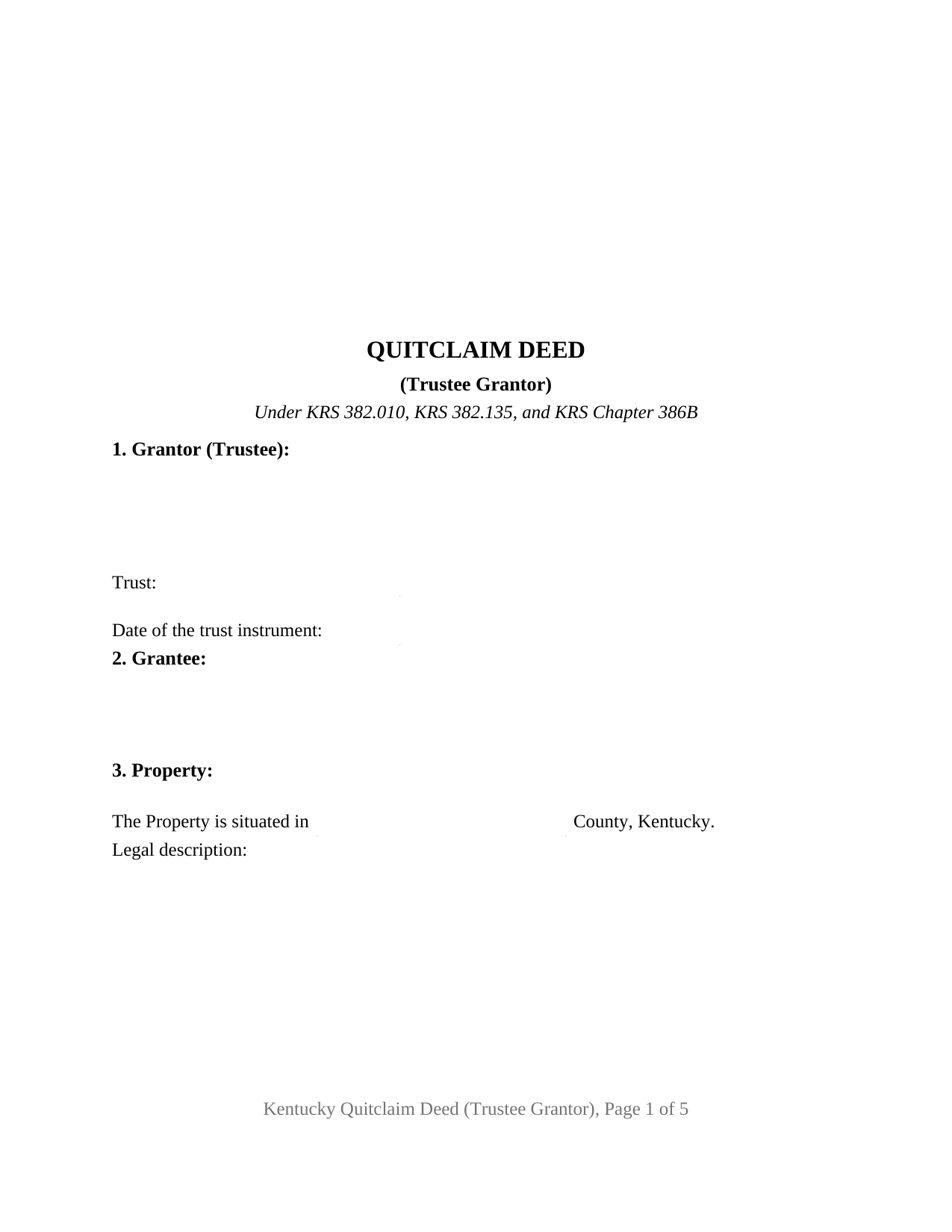
On this Kentucky quitclaim deed the grantor holds the property for someone else. One trustee signs, in that capacity and not individually, and releases whatever right, title, and interest the trust holds in the described real property. Sometimes searched as a trustee quitclaim deed or a quit claim deed out of a trust, it carries no covenant of title.
Where a trustee's signing authority comes from
A deed does not give a trustee the power to sign it. That power sits in the trust instrument and the Kentucky Uniform Trust Code: KRS 386B.8-150 lets a trustee exercise the powers described there without authorization by the court, and KRS 386B.8-160 adds specific powers, among them selling trust property at public or private sale and distributing it, on termination, to the persons entitled to it. The conveyance section names those two sections and the terms of the trust as the source of authority, and states that the trust terms are not written into the deed. Whether one trustee may act alone is itself a term of the trust, one of the items a certification of trust answers under KRS 386B.10-120, an instrument prepared and recorded on its own and not included here.
When the transfer tax follows the property out of the trust
The transfer tax under KRS 142.050 falls on the grantor at fifty cents for each five hundred dollars of value, collected and certified by the county clerk before recording, with KRS 382.260 holding the deed out of the record until it is paid. Trust conveyances answer to KRS 142.050(8), which reaches transfers in both directions, a transfer from a trustee to a beneficiary of the trust included. The test looks through the trust: where the grantor is the sole beneficiary, or where a direct transfer to the other individual beneficiaries would have been exempt under the general list in KRS 142.050(7), the tax does not apply. A trustee selling to a non-beneficiary buyer pays on the stated consideration. The consideration section holds both entries the statute divides transfers between, the full consideration paid and the estimated fair cash value.
One fiduciary signature, and what the form is not arranged for
The deed recites exactly one grantor, described as trustee of a named trust with the trust instrument's date, and names the grantee or grantees, with any co-ownership wording following their names. Two signature blocks follow. The trustee signs the deed together with the sworn certificate KRS 382.135 places inside it, and the grantee signs that certificate alone, which is what the statute asks of the receiving side, and the form states that the signature conveys nothing. Each signer has a notarial certificate of its own, taking the oath and the acknowledgment in one paragraph, so the appearances can happen weeks and counties apart. A successor trustee distributing a house to the beneficiary named in the trust, a trustee clearing a stray undivided interest out to the person who owns the rest, and a trustee closing a sale to a buyer who takes a release of interest present the patterns this deed recites. It is not arranged for two trustees signing together, for an owner conveying individually, for a bank or corporate trustee signing through an officer, or for a grantee taking as fiduciary, and it carries no spouse joinder block.
No covenants, and the entries a clerk checks
Kentucky attaches title covenants to two statutory phrases, with warranty or with general warranty under KRS 382.030 and with special warranty under KRS 382.040. This deed uses neither and says so, remising, releasing, and forever quitclaiming what the trust holds at delivery, while KRS 382.010 and KRS 381.060 carry that estate without words of inheritance. Liens, mortgages, easements, and chain gaps ride through untouched. The remaining blanks answer the clerk's content list. KRS 382.110 wants the immediate source of the grantor's title by office, book, page, and date, which for a fiduciary grantor is the deed that put the property into the trustee's hands, often a deed to a predecessor trustee. KRS 382.135 wants party names with mailing addresses and the in care of address for the year's tax bill, and KRS 382.335 wants the preparer endorsement signed by whoever drew the instrument.
The download delivers the trustee grantor quitclaim deed as a fillable PDF, a completed Campbell County example, and a plain language guide covering the trust entries, the authority statutes, the signatures, and recording with the county clerk. The materials are informational and are not legal advice.
Important: County-Specific Forms
Our quitclaim deed (trustee grantor) forms are specifically formatted for each of the 120 counties in Kentucky.
After selecting your county, you'll receive forms that meet all local recording requirements, ensuring your documents will be accepted without delays or rejection fees.