Maryland Transfer on Death Deed (Joint Owners with Right of Survivorship)
County or Independent City Specific Legal Forms Validated as recently as September 29, 2026 by our Forms Development Team
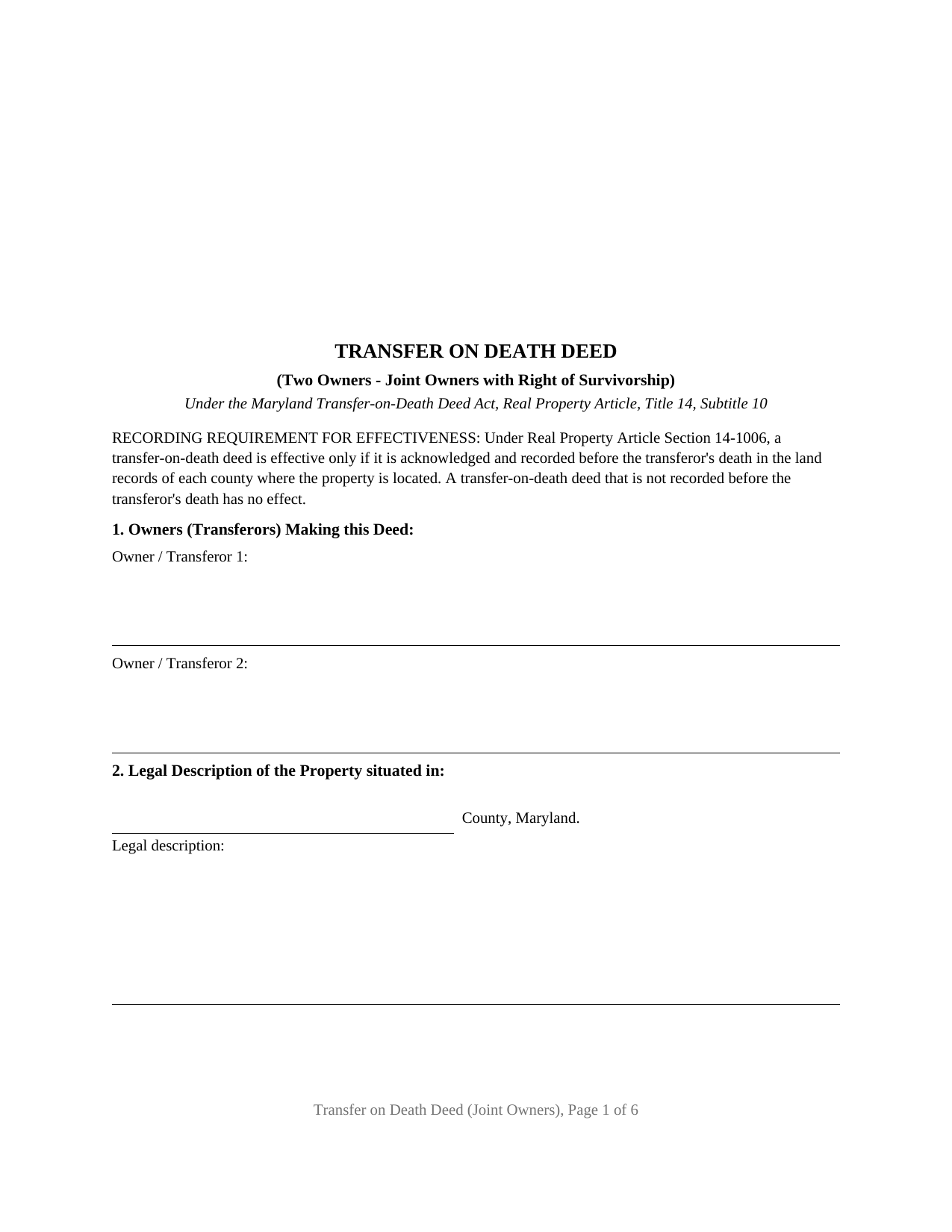
About the Maryland Transfer on Death Deed (Joint Owners with Right of Survivorship)
How to Use This Form
- Select your county or independent city from the list
- Download the county or independent city-specific form
- Fill in the required information
- Have the document notarized if required
- Record with your county or independent city recorder's office
What Others Like You Are Saying
"its a bit confusing for a novice computer user. I would prefer to print out the forms, fill them out…"
"as always, perfect!"
"The site was easy to use and find what I needed. The purchase and download were very easy."
"Forms were great. I wasn't able to find them anywhere. Even the county recorder didn't have them"
"very good. got my info in minuetes. thank you"
4.8/5 from 4,820 reviews. Read all
A Maryland transfer-on-death deed lets an owner name who receives real estate at death, outside probate, and Maryland only added the tool in 2026. For two people who already hold title together with a right of survivorship, the deed answers a narrower question than it does for a sole owner: not the first death, which the survivorship already settles, but what happens after both owners are gone. This form prepares that deed under the Maryland Transfer-on-Death Deed Act, Real Property Article, Title 14, Subtitle 10, for two joint owners with right of survivorship.
A New Maryland Law on a Delayed Clock
The Act was signed on May 26, 2026 as House Bill 738 and the cross-filed Senate Bill 651, and it takes effect October 1, 2026. It is modeled on the Uniform Real Property Transfer on Death Act, which Maryland courts are directed to follow in reading it. Before this Act, Maryland did not recognize transfer-on-death or beneficiary deeds for real property, so a deed has no effect under the Act until the October 1, 2026 effective date.
Why the Deed Operates Only at the Second Death
When two owners hold with right of survivorship, the first death is already accounted for: the property passes to the surviving owner automatically. The Act builds that order into the deed. If a joint owner is survived by another joint owner, the property belongs to the surviving owner by survivorship and the deed is not effective at that death. The deed becomes effective at the death of the last surviving joint owner, when the named beneficiaries take. The form states this timing in its operative language.
The form recites exactly two record owners, both of whom sign; a designation by a sole owner follows a different pattern, and a pair whose vesting deed carries no survivorship language presents a different title question than the one this deed's recital answers. Siblings who inherited together under express survivorship language, a parent and an adult child added to title as joint tenants, and unmarried partners whose deed recites survivorship are the pairs that present this pattern in the record.
What the Beneficiary Receives
The deed transfers the property without covenant or warranty of title, and the beneficiary takes subject to every mortgage, lien, easement, and other interest affecting title at the transferor's death. Where more than one beneficiary is named, the Act has them take in the form of ownership the deed states, defaulting to joint tenants with right of survivorship if the deed is silent. The form provides a section to set that choice and a section for alternate beneficiaries, who may be named in succession so a later alternate takes if an earlier one does not survive.
Signing, Recording, and Tax Treatment
The Maryland statutory form is signed by both owners before two adult witnesses and a notary, none of whom may be a beneficiary, a party, or a relative of an owner or beneficiary. Under Section 14-1006 the deed is effective only if it is acknowledged and recorded before the transferor's death in the land records of each county where the property sits, so a signed deed left unrecorded transfers nothing. Conforming tax amendments exempt a transfer-on-death deed of the transferor's primary or secondary residence from recordation tax and from State and county transfer tax.
The deed in this package is formatted for the land records: a letter-size first page reserving the statutory three inches at the top for the clerk's recording use, one-inch side margins, and the certificate of preparation that Real Property Section 3-104(f) makes a recording condition for a deed prepared by a party. The package includes the fillable deed, a completed Anne Arundel County example, and a plain-language guide. The materials are informational and are not legal advice.
Important: County or Independent City-Specific Forms
Our transfer on death deed (joint owners with right of survivorship) forms are specifically formatted for each of the 24 county or independent cities in Maryland.
After selecting your county or independent city, you'll receive forms that meet all local recording requirements, ensuring your documents will be accepted without delays or rejection fees.