Maryland Transfer-on-Death Deed (Individual)
County or Independent City Specific Legal Forms Validated as recently as September 18, 2026 by our Forms Development Team
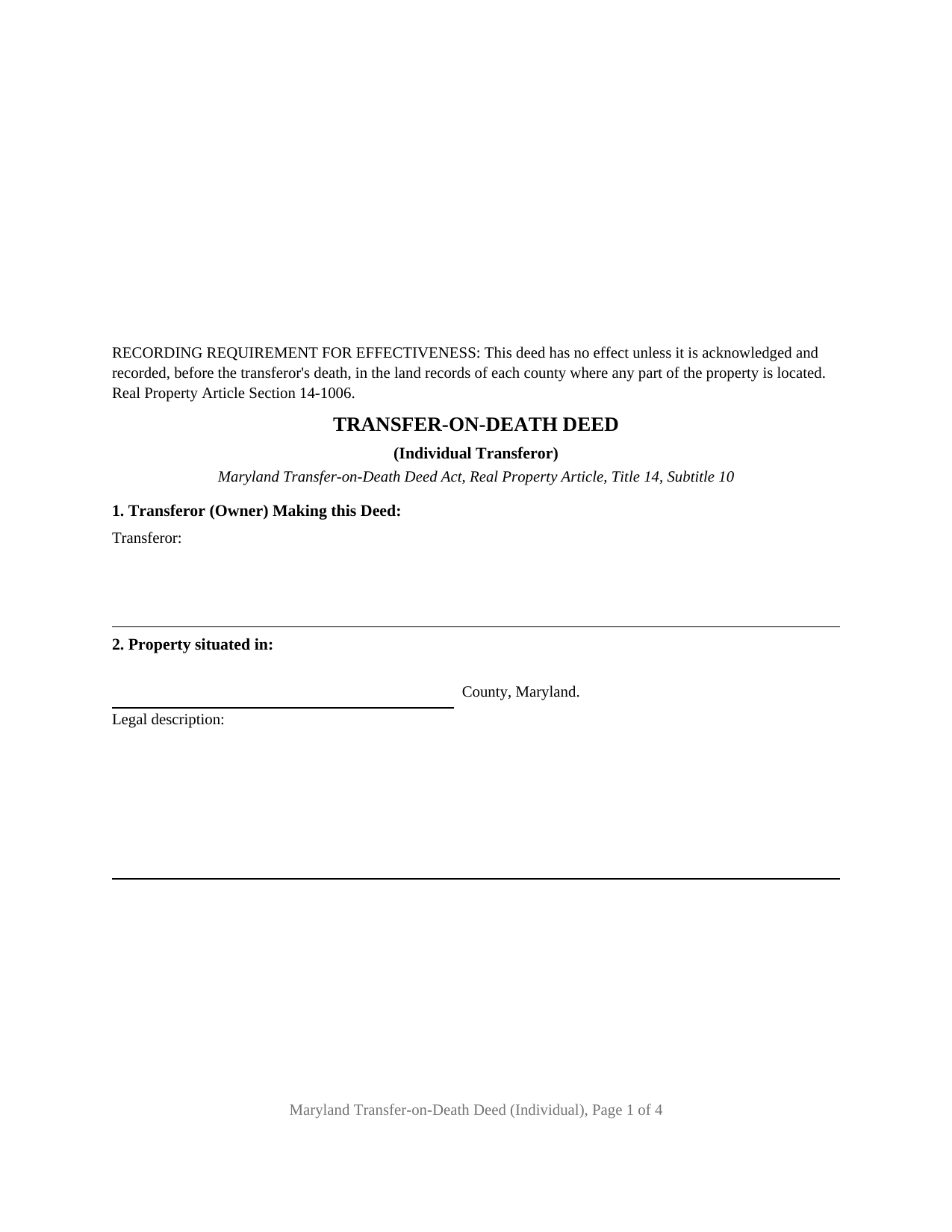
About the Maryland Transfer-on-Death Deed (Individual)
How to Use This Form
- Select your county or independent city from the list
- Download the county or independent city-specific form
- Fill in the required information
- Have the document notarized if required
- Record with your county or independent city recorder's office
What Others Like You Are Saying
"Awesome and perfect."
"You had the generic document that I was looking for Yay! The "example" page was helpful an…"
"very professional"
"Easy peasy"
"Awesome product. Quick and easy. Thanks"
4.8/5 from 4,818 reviews. Read all
Maryland did not allow transfer-on-death deeds for real property until the 2026 General Assembly passed the Maryland Transfer-on-Death Deed Act. Codified at Real Property Article, Title 14, Subtitle 10, the Act lets a single owner name who receives their real estate at death, outside probate, while keeping full control during life. The Act takes effect October 1, 2026, and a deed recorded before that date is not yet effective under it.
How a Maryland Transfer-on-Death Deed Works
The deed is nontestamentary. It transfers no interest while the owner is alive, so the property can still be sold, mortgaged, or leased, and the deed stays revocable even if it says otherwise. At the owner's death, the designated beneficiary receives whatever interest the owner then holds, subject to any mortgage, lien, or other interest affecting title at that moment, and without covenant or warranty of title. The capacity needed to make the deed is the capacity to make a will, and only an individual may be the transferor. A recorded deed is later taken out of effect by a revocation instrument acknowledged and recorded before the owner's death, by a later inconsistent transfer-on-death deed, or by a lifetime transfer of the property; a revocation is a separate instrument, prepared and recorded on its own and not included in this package.
Why Recording Before Death Matters
Under Real Property Section 14-1006, the deed has no effect unless it is acknowledged and recorded, before the owner's death, in the land records of every county where the property sits. A deed that is signed, witnessed, and notarized but never recorded transfers nothing, and a deed recorded in only one of several counties reaches only the property in that county. This recording-before-death rule is the detail that most often defeats a homemade beneficiary deed.
Witnessed and Notarized, With a Disqualification Rule
The statutory form is both witnessed by two witnesses and acknowledged before a notary public, and it complies with the ordinary Maryland deed formalities of Real Property Section 4-101. The Act adds a guardrail that catches many do-it-yourself deeds: the two witnesses and the notary may not be a party to the deed, a designated beneficiary, or a relative of a party or beneficiary, and a disqualified witness or notary makes the deed ineffective.
Who This Form Describes
This form recites a single individual transferor, the only kind the Act allows: one owner, married or unmarried, signing alone. Maryland is not a community property state and recognizes no inchoate dower or curtesy, so a spouse who is not a record owner is not a transferor and has no signature line; a surviving spouse's protection runs through the statutory elective share at death. The form provides for primary beneficiaries, optional alternates, and the form of ownership among multiple beneficiaries; where that line is left blank, multiple beneficiaries take as joint tenants with right of survivorship under Real Property Section 14-1003.
The package includes the blank deed as a fillable PDF, a plain language guide that walks through every numbered section and where each entry comes from, and a completed example filled in for a realistic Maryland fact pattern.
The package is formatted for Maryland recording: letter size pages within the Real Property Section 3-104 limits, the codified three inch reserved area at the top of the first page, the certificate of preparation a clerk requires before recording any deed, and space for the tax account identification number that ties the deed to the assessment records. The guide covers the land instrument intake sheet, the recordation and transfer tax exemption the Act provides for a primary or secondary residence, and step by step completion. The materials are informational and are not legal advice.
Important: County or Independent City-Specific Forms
Our transfer-on-death deed (individual) forms are specifically formatted for each of the 24 county or independent cities in Maryland.
After selecting your county or independent city, you'll receive forms that meet all local recording requirements, ensuring your documents will be accepted without delays or rejection fees.