Franklin County Quitclaim Deed (Trustee Grantee) Form
Last validated August 28, 2026 by our Forms Development TeamFormatted for recording in Franklin County, for property anywhere in the county: rural and unincorporated areas as well as Ashfield, Bernardston, Buckland, Charlemont, Colrain, Conway, Deerfield, Erving and 21 more.
- 3 documents included
- Immediate PDF download
- Formatting guarantee
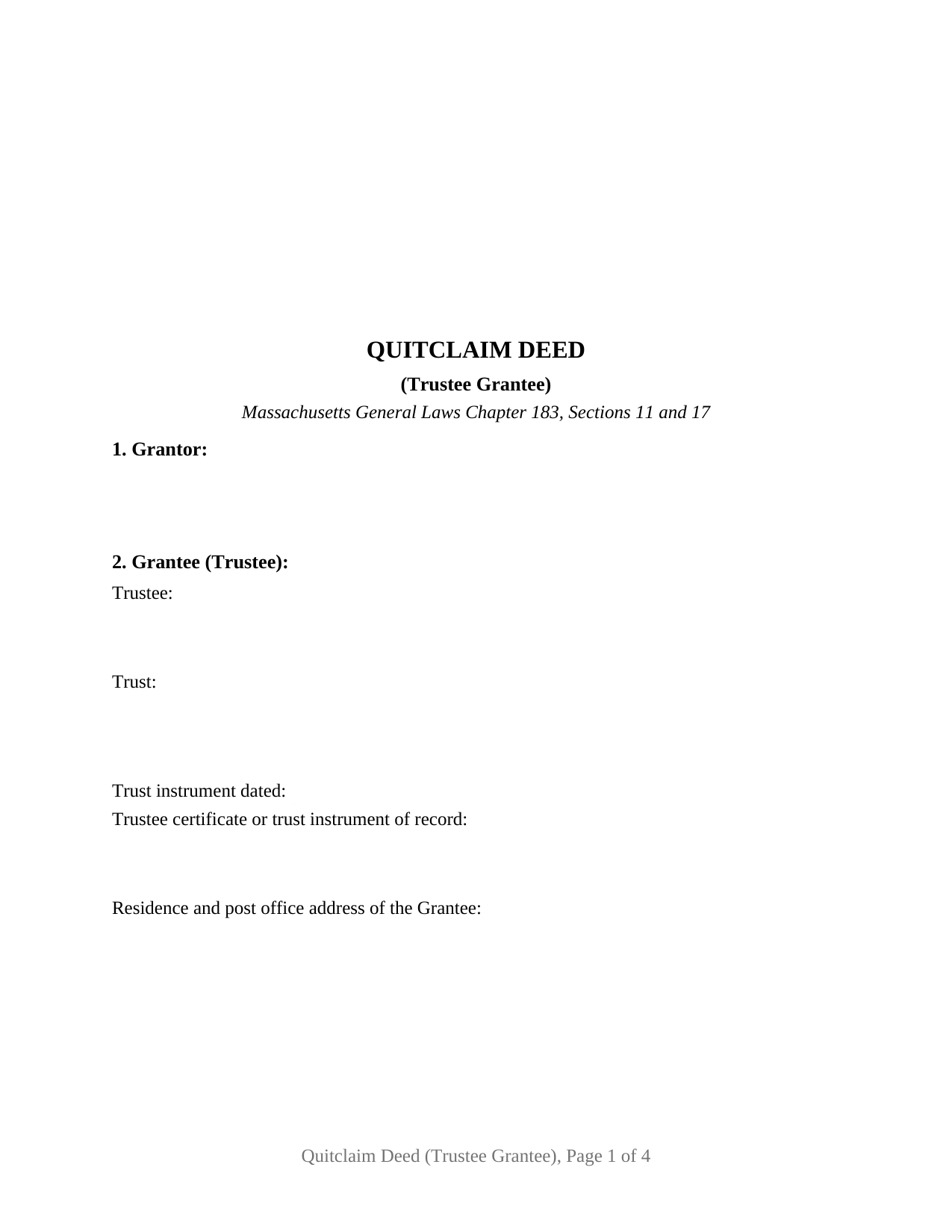
Franklin County Quitclaim Deed (Trustee Grantee) Form
Fill in the blank Quitclaim Deed (Trustee Grantee) form formatted to comply with all Massachusetts recording and content requirements.
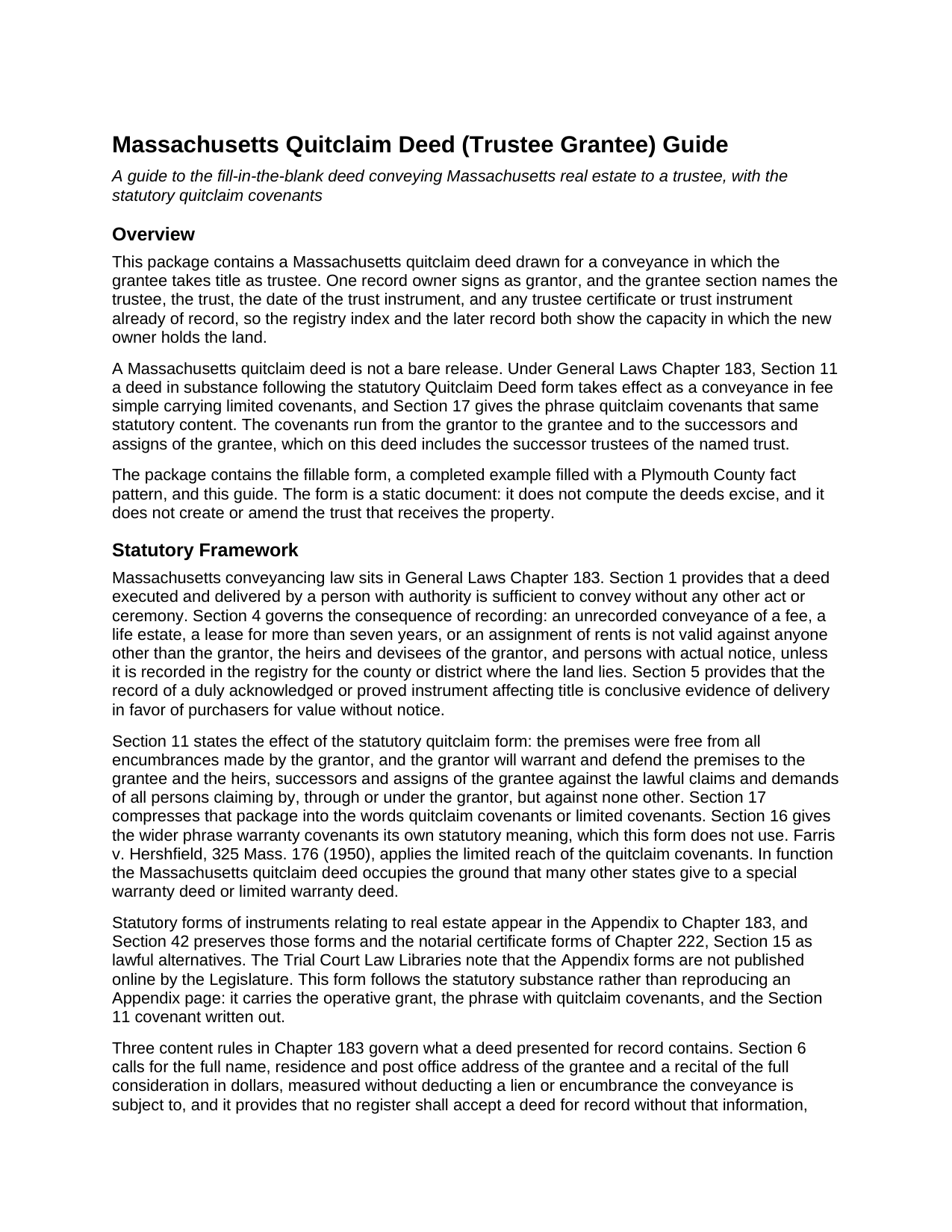
Franklin County Quitclaim Deed (Trustee Grantee) Guide
Line by line guide explaining every blank on the Quitclaim Deed (Trustee Grantee) form.
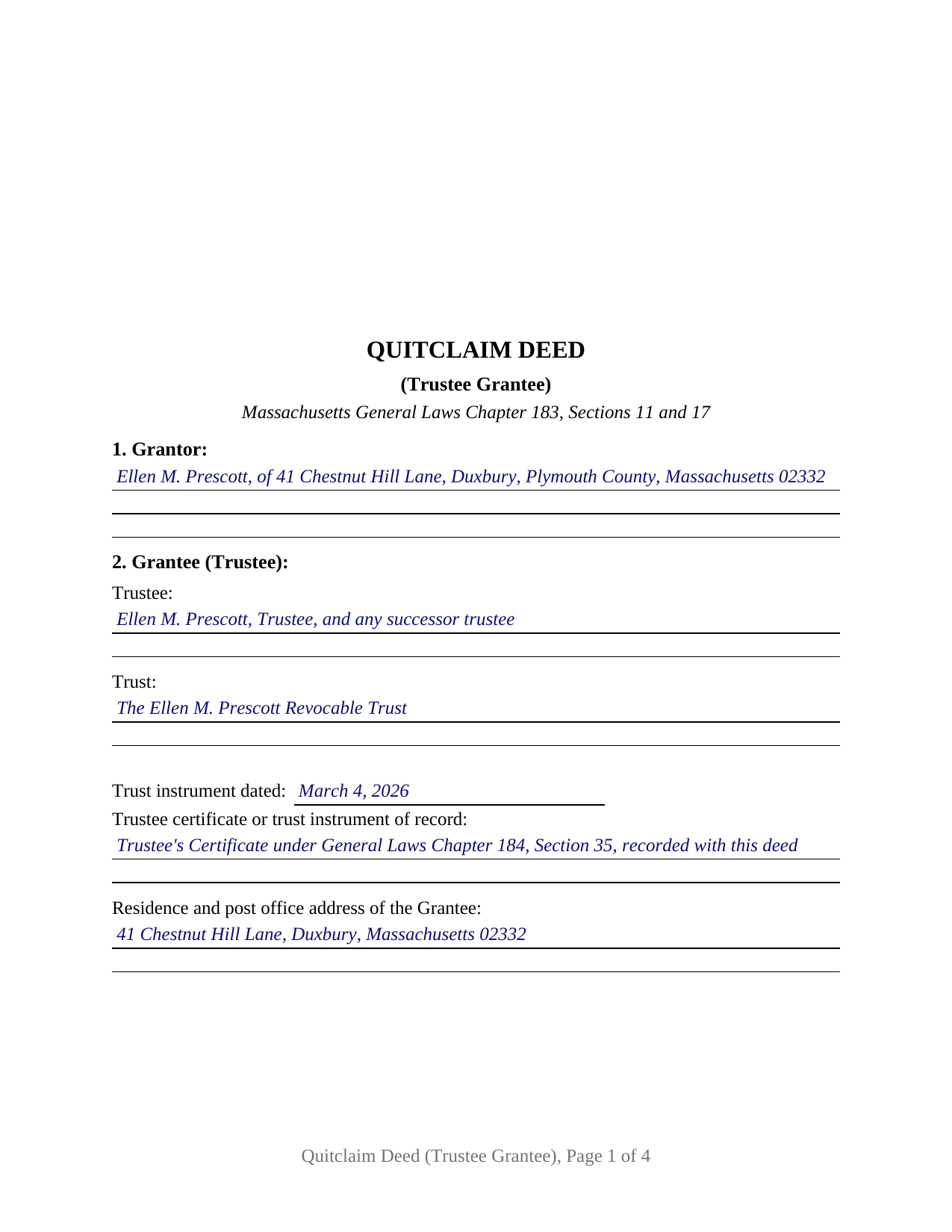
Franklin County Completed Example of the Quitclaim Deed (Trustee Grantee) Document
Example of a properly completed Massachusetts Quitclaim Deed (Trustee Grantee) document for reference.
All 3 documents above included • One-time purchase • No recurring fees
Immediate Download • Secure Checkout
Additional Massachusetts and Franklin County documents included at no extra charge:
Where to Record Your Documents
Franklin Registry of Deeds
Greenfield, Massachusetts 01302
Hours: 8:30 to 4:15 Monday through Friday
Phone: (413) 772-0239
Recording Tips for Franklin County:
- Bring your driver's license or state-issued photo ID
- Ensure all signatures are in blue or black ink
- Recording fees may differ from what's posted online - verify current rates
- Request a receipt showing your recording numbers
- Ask about accepted payment methods when you call ahead
Cities and Jurisdictions in Franklin County
Properties in any of these areas use Franklin County forms:
- Ashfield
- Bernardston
- Buckland
- Charlemont
- Colrain
- Conway
- Deerfield
- Erving
- Gill
- Greenfield
- Heath
- Lake Pleasant
- Leverett
- Millers Falls
- Monroe Bridge
- Montague
- New Salem
- Northfield
- Orange
- Rowe
- Shelburne Falls
- Shutesbury
- South Deerfield
- Sunderland
- Turners Falls
- Warwick
- Wendell
- Wendell Depot
- Whately
Hours, fees, requirements, and more for Franklin County
How do I get my forms?
Forms are available for immediate download after payment. The Franklin County forms will be in your account ready to download to your computer. An account is created for you during checkout if you don't have one. Forms are NOT emailed.
Are these forms guaranteed to be recordable in Franklin County?
Yes. Our form blanks are guaranteed to meet or exceed the applicable formatting requirements used for recording in Franklin County, including margin requirements, font requirements, and other layout standards. This guarantee applies to formatting, not to the legal sufficiency of information entered by the user or the suitability of a form for a particular transaction.
Can I reuse these forms?
Yes. You can reuse the forms for your personal use. For example, if you have multiple properties in Franklin County you only need to order once.
What do I need to use these forms?
The forms are PDFs that you fill out on your computer. The free Adobe Acrobat Reader is recommended, and most PDF apps also work. You do NOT enter your property information online - you download the blank forms and complete them privately on your own computer.
Are there any recurring fees?
No. This is a one-time purchase. Nothing to cancel, no memberships, no recurring fees.
How much does it cost to record in Franklin County?
Recording fees in Franklin County vary. Contact the recorder's office at (413) 772-0239 for current fees.
Questions answered? Let's get started!
The party that makes this deed distinctive never signs it. Where a Massachusetts quitclaim deed runs to a trustee, the grantee is not an owner taking for himself or herself but a fiduciary taking for a trust, and the record has to show it: which trustee, which trust, the date of the trust instrument, and where the authority to act can be read. This fillable form is drawn for that conveyance, one record owner as grantor and a trustee as grantee, passing title with the limited covenants that General Laws Chapter 183 calls quitclaim covenants.
The capacity written into the grantee section
Section 2 is where this variant does its work. It collects the trustee and any successor trustee, the trust's name, the date of the trust instrument, and any trustee certificate of record, closing with the grantee's residence and post office address, which Chapter 183, Section 6 makes a condition of acceptance at the registry counter. The deed points at the trustee's authority instead of reprinting the trust. Chapter 184, Section 35 allows a certificate executed by the record trustees to be recorded, setting out the trust, the trustees and the extent of trustee authority, and a purchaser acting in good faith may rely on it. Chapter 203E, Section 1013 lets a trustee furnish a certification of trust in place of the instrument, giving its date, who may sign, and whether it has been revoked or amended, while leaving the dispositive terms out.
Covenants that follow the successor trustees
Massachusetts uses the word quitclaim for a deed that carries real promises. Chapter 183, Section 11 gives a deed drawn in substance on the statutory quitclaim form the effect of a conveyance in fee simple, with the grantor covenanting that the premises are free of encumbrances the grantor made and defending against claims arising by, through or under the grantor, and against none other; Section 17 folds that package into two words. Here the grant runs to the grantee as trustee and to the successors in trust of that trustee, so the covenant reaches whoever holds the office later. Mortgages and easements of record go in the encumbrances section, which the operative section excepts from what the grantor answers for.
A homestead that outlives the transfer
Moving a home to a trustee raises a question no other grantee raises, and Chapter 188 answers it in a clause. Section 10(a)(1) provides that a deed to a trustee of a trust for the benefit of a grantor does not terminate that grantor's existing homestead, which continues as to that grantor's interest as a trust beneficiary; Section 1 counts the holder of a present, vested and non-contingent beneficial interest in a trust as an owner. Section 9 of the form states what the deed does and does not release, since subsection (b) asks for an express release from everyone entitled to the benefit of a homestead on a deed between a trustee and a beneficiary. A new declaration is a separate recorded paper: Section 5 keeps declarations out of title-vesting instruments and has the trustee sign where a home is held in trust.
One grantor, one certificate, one trust
The form recites a single record owner in Section 1, one signature line, and one acknowledgment certificate in the substance of the Chapter 222, Section 15 form; the grantee signs nothing, because a Massachusetts deed operates on the grantor's signature and delivery. A sole owner conveying a home to herself as trustee of her own revocable trust, an owner placing rental property with the trustee of a nominee trust, and a seller whose buyer takes title through the trustee of a family trust all present the pattern this deed recites. The form is not set up for two grantors, for an entity or a representative signer on the grantor side, or for a grantee taking in an individual capacity. Searches for a Massachusetts deed into trust, or a quit claim deed to a trust, describe this configuration.
Recording happens at the registry for the county or registry district covering the land, at the statewide deed fee, with Chapter 64D excise stamps due only where consideration passes one hundred dollars, which a nominal transfer to a trustee does not. The completed example runs a Plymouth County pattern in Duxbury. The download delivers the fillable deed, that example, and a guide covering each numbered section, the certificate, the homestead statement, and recording. The materials describe Massachusetts law in general terms and are not legal advice.
Important: Your property must be located in Franklin County to use these forms. Documents should be recorded at the county recording office listed above.
This Quitclaim Deed (Trustee Grantee) meets all recording requirements specific to Franklin County.
Our Promise
The documents you receive here are guaranteed to meet or exceed the applicable Franklin County recording format requirements. If there is a rejection caused by our formatting, we will correct the issue or refund your payment. This guarantee applies to document formatting only and does not extend to information entered by the user, the selection of the form, or the legal effect of the completed document.
Save Time and Money
Get your Franklin County Quitclaim Deed (Trustee Grantee) form done right the first time with Deeds.com Uniform Conveyancing Blanks. At Deeds.com, we understand that your time and money are valuable resources, and we don't want you to face a penalty fee or rejection imposed by a county recorder for submitting nonstandard documents. We constantly review and update our forms to meet rapidly changing state and county recording requirements for roughly 3,500 counties and local jurisdictions.
4.8 out of 5 - ( 4,823 Reviews )
Patricia P. 5 out of 5 stars
Easy to use and super convenient.
Thank you for your feedback. We really appreciate it. Have a great day!
Rebecca V. 5 out of 5 stars
The staff is Great to work with, Thank You
Thank you!
Judith F. 5 out of 5 stars
Easy to understand and use!
Thank you!
Sandra N. 5 out of 5 stars
Very quick and painless process!
We appreciate your business and value your feedback. Thank you. Have a wonderful day!
Renata L. 3 out of 5 stars
Was a bit difficult to navigate. I feel a fee to access the site and a fee to print is a bit much. I am in the real estate business and find the deeds very useful
Thank you for your feedback. We really appreciate it. Have a great day!
milton m. 5 out of 5 stars
good product easy to use, as advertised
Thank you for your feedback. We really appreciate it. Have a great day!
Armstrong K. 5 out of 5 stars
Very smooth and speedy process. Thank you.
Thank you!
Richard B. 5 out of 5 stars
Excellent! I was able to complete the documents especially using the instructions as a guide. Thanks
We appreciate your business and value your feedback. Thank you. Have a wonderful day!
Jamie P. 5 out of 5 stars
The forms are easy to download. Easy to fill out. The information on the site and on the web provided by Deeds.com have been immensely helpful.
Thank you!
Theresa J. 5 out of 5 stars
The beginning of the process was very simple. In the middle now waiting for the invoice to move forward.
Thank you for your feedback. We really appreciate it. Have a great day!
Filomena G. 5 out of 5 stars
very helpful
Thank you!
Sander G. 4 out of 5 stars
Good but knocked off a star because the download file names are mostly numbers instead of recognizable names of the file contents (e.g., Promissory_Note_blank.pdf). Renaming would be a great help!
Thank you for your feedback. We really appreciate it. Have a great day!
Nancy E. 3 out of 5 stars
Took me awhile to figure out and get the information printed so I can use it later. Thank you.
Your insights are invaluable to us and help us strive for better service. Thank you for taking the time to share your thoughts.
Laurel D. 5 out of 5 stars
This is a great service. I can't believe how fast my document was recorded!
Thank you for your feedback. We really appreciate it. Have a great day!
Ronald C. 5 out of 5 stars
My goal was to find the Covenant, Conditions, and Restrictions for my HOA. From what I can read, these documents should be attached to our Deed (single family, patio home in New Hanover County). I am not sure if I have a copy of my Deed. I would need to check my Safe Deposit Box. Unfortunately, I was not successful at finding these documents from your Website. If you can help me find them, I would appreciate that.
It is most common to obtain a copy of CC&Rs directly from the HOA. Alternatively, they are also usually a matter of public record recorded with the local recorder and you can obtain a copy there.