Michigan Quitclaim Deed
County Specific Legal Forms Validated as recently as October 9, 2026 by our Forms Development Team
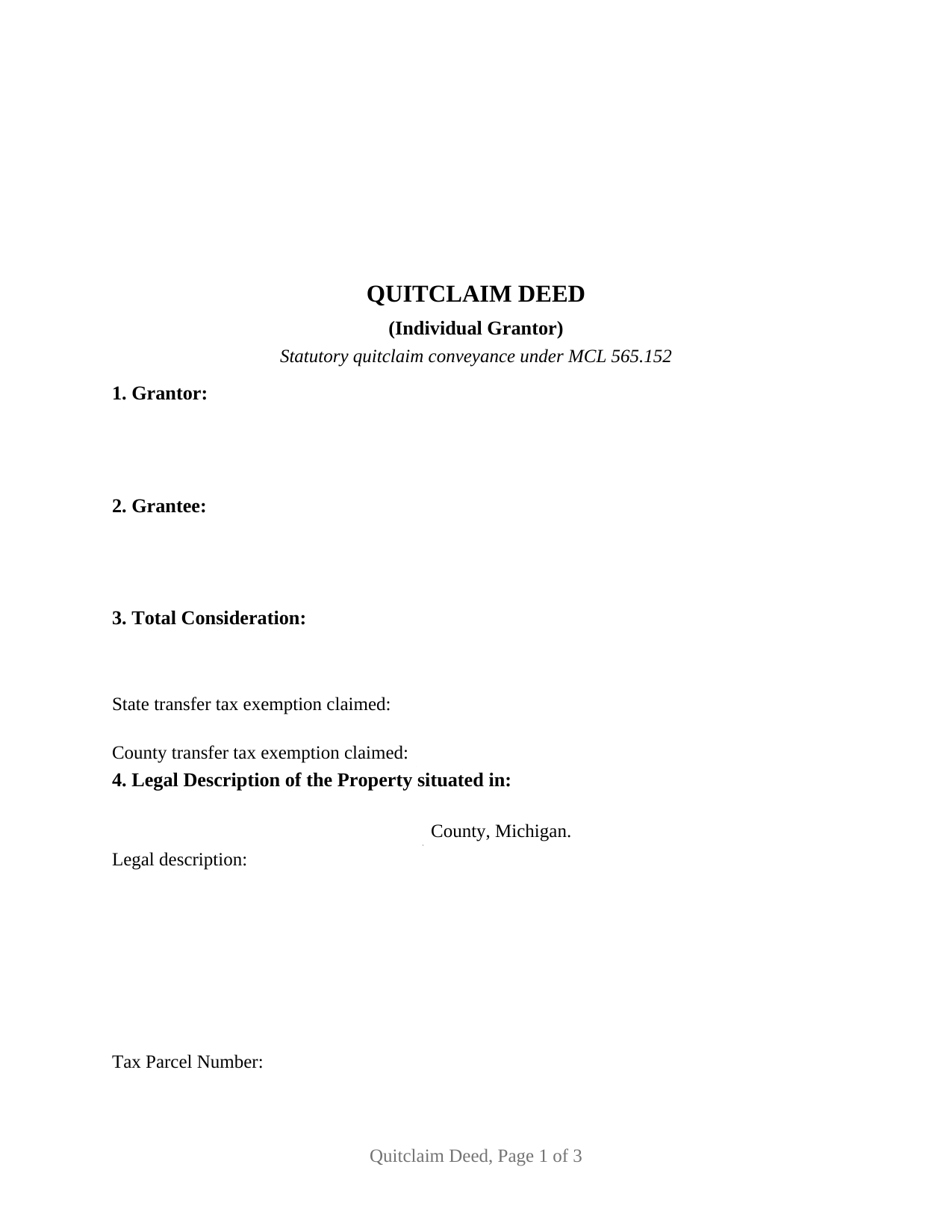
About the Michigan Quitclaim Deed
How to Use This Form
- Select your county from the list
- Download the county-specific form
- Fill in the required information
- Have the document notarized if required
- Record with your county recorder's office
What Others Like You Are Saying
"It was a wonderful experience. Thank you for your help."
"Easy to complete. I would suggest, since it is 2 pages, make a bigger space for land descriptions &a…"
"I loved the easy to understand and use system, very user friendly."
"All went well."
"Thanks for the quick response. That really helps when you're under a time deadline."
4.8/5 from 4,828 reviews. Read all
Michigan settled the quit claim question twice, and both settlements are still law. The Revised Statutes of 1846 fixed its reach: MCL 565.3 provides that a deed of quit claim and release, of the form in common use, passes all the estate which the grantor could lawfully convey by a deed of bargain and sale. Thirty-five years on, 1881 PA 187 fixed the wording, and MCL 565.152 has carried it since. This Michigan quitclaim deed is built on both.
Two sections, one conveyance
MCL 565.152 supplies the operative language: a conveyance worded in substance that the grantor quit claims described premises for a stated sum, duly signed and acknowledged, is a good and sufficient conveyance in quit claim. Nothing in that sentence promises anything. Seisin, freedom from encumbrances, and the duty to defend belong to the separate warranty form at MCL 565.151, and their absence follows the deed to the counter, since MCL 211.135 routes a covenant of warranty to the county treasurer first and there is none here to certify. MCL 565.3 supplies the ceiling: what moves is the estate the grantor could lawfully convey, which may be a whole fee, an undivided share, or nothing.
One or two names on each side
This is the base configuration of the Michigan line, and its architecture is deliberately open. The Grantor block and the Grantee block are multi-line blanks that each take one or two natural persons, with no vesting or capacity wording preprinted, so four count patterns run through a single form: one to one, one to two, two to one, and two to two. Execution follows suit, with two signature blocks headed GRANTOR and SECOND GRANTOR (if applicable) and a certificate for each, so two signers may appear before different notaries on different dates; where a single grantor conveys, the second block and its certificate stay blank. What the form is not set up as: an instrument executed in an entity name, one signed in a representative capacity, or a conveyance out of three or more record owners.
The words that follow the grantee names
Because vesting is nowhere preprinted, the designation entered after the grantee names selects the estate, and the Michigan menu holds a trap. MCL 554.44 makes tenancy in common the default for two or more grantees and permits a joint tenancy only where one is expressly declared. Albro v Allen, 434 Mich 271 (1990), separates ordinary joint tenancy, which a cotenant may sever alone, from joint tenancy with full rights of survivorship, which Michigan treats as a joint life estate carrying indestructible contingent remainders. Grantees married to each other draw the entirety presumption of MCL 554.45 and MCL 557.71, and DeYoung v Mesler holds that merely adding joint tenancy words does not displace it.
Value on the face, tax in two acts
Michigan reads total value off the face of a deed, so the form states it and adds a blank for the valuation affidavit MCL 207.504(2) and MCL 207.525(2) accept instead. Because the two exemption lists differ, one citation blank answers to MCL 207.526 and a second to MCL 207.505. The example runs a taxable 52,000 dollar conveyance of five unplatted acres in Genesee County, works the combined rate through to 390 dollars of state tax and 57 dollars and 20 cents of county tax, and completes the two statements MCL 560.109 places in a deed for unplatted land.
What the counter reads
MCL 565.201 fixes the terms on which a Michigan register of deeds receives an instrument, and a deed missing one is turned away rather than surcharged: a single recordable event on the first line of print, two and one half inches left clear atop page one, an address for each grantee, printed names matching the certificates, and the drafter's business address. The fee is flat, 30 dollars for a document of any length under MCL 600.2567. Recording buys priority rather than validity, since MCL 565.29 voids an unrecorded conveyance against a later good faith purchaser who records first.
Delivered here: the blank fillable deed, a completed example worked through entry by entry for the Genesee County conveyance above, and a plain language guide to every section, the vesting language, the notarization, recording, and the assessor filing Michigan Treasury Form 2766 calls for after a transfer. Often searched as a quit claim deed, this Michigan form and its materials describe Michigan law in general terms and are not legal advice.
Important: County-Specific Forms
Our quitclaim deed forms are specifically formatted for each of the 83 counties in Michigan.
After selecting your county, you'll receive forms that meet all local recording requirements, ensuring your documents will be accepted without delays or rejection fees.