Michigan Warranty Deed (Two Grantors)
County Specific Legal Forms Validated as recently as October 9, 2026 by our Forms Development Team
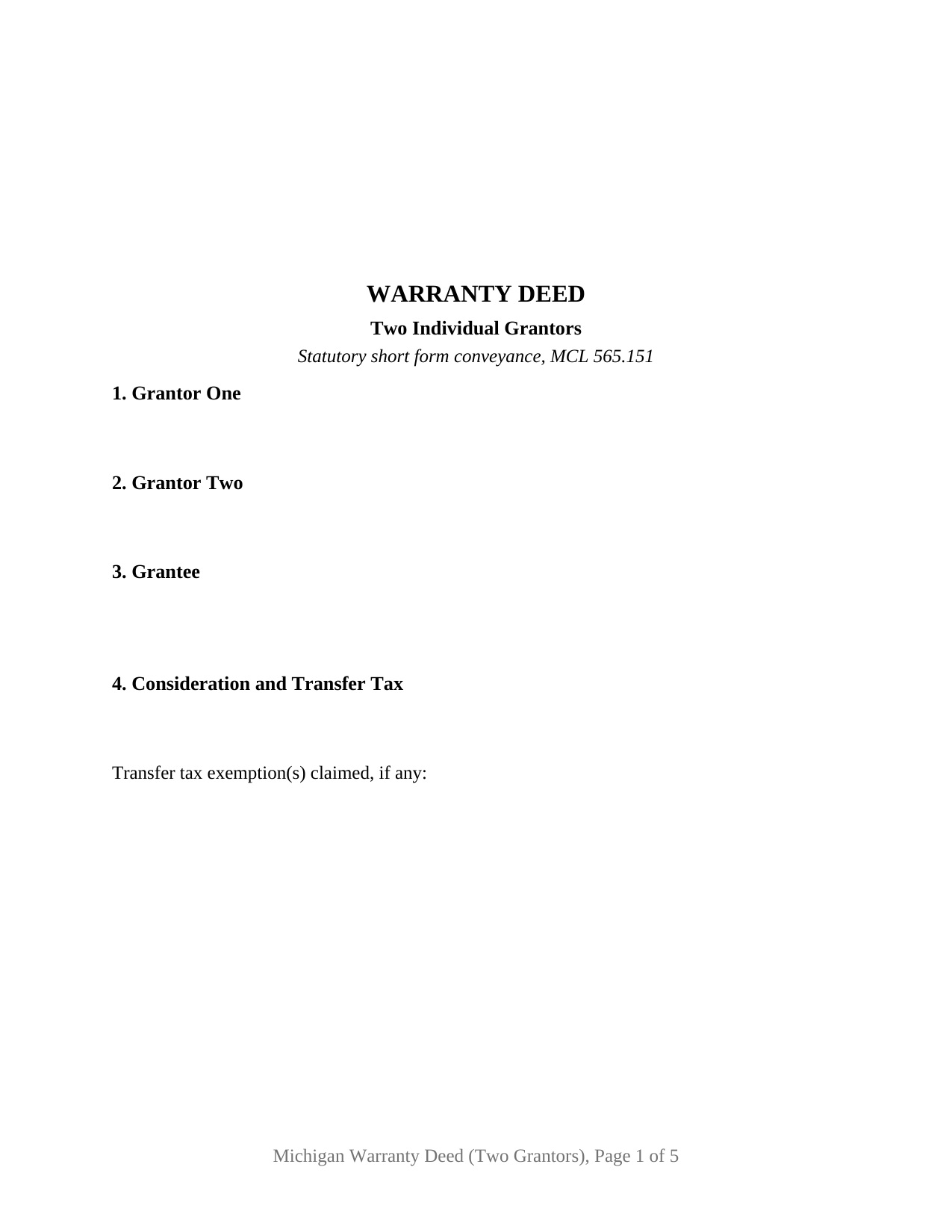
About the Michigan Warranty Deed (Two Grantors)
How to Use This Form
- Select your county from the list
- Download the county-specific form
- Fill in the required information
- Have the document notarized if required
- Record with your county recorder's office
What Others Like You Are Saying
"Easy to use,thanks"
"I was very pleased with Deeds.Com. It was easy to use."
"To set the service was incredibly easy and the results came back very fast. Very reasonable price."
"Great service, quick and easy!"
"Amazing forms, thanks so much for making these available."
4.8/5 from 4,825 reviews. Read all
When Michigan land stands in two names, the deed that sells it carries two of everything: two grantors recited at the top, two signature lines with printed names beneath them, and two acknowledgment certificates at the end. This fillable warranty deed prepares exactly that conveyance: two individual owners joining in one instrument to convey and warrant Michigan real property under MCL 565.151.
Why co-owned title takes two grantors
Each Michigan co-owner holds an interest the other cannot give away. Tenants in common each hold an undivided share, joint tenants hold concurrent interests with survivorship, and a married couple presumptively holds as tenants by the entirety, an estate the Michigan Supreme Court treats as inseverable: neither spouse acting alone may convey or encumber entirety property. A single deed signed by both owners passes the whole title at once, and the statutory covenants of MCL 565.151, seizin, right to convey, quiet possession, freedom from undisclosed encumbrances, and the promise to defend the title, run to the grantee from both grantors together.
Two signatures, two certificates
The form pairs each grantor's signature line with a printed name beneath it, the detail MCL 565.201 makes a condition of recording, and closes with an acknowledgment certificate for each grantor. Michigan law does not require separate certificates for co-signers; the two-certificate layout is a feature of the form, keeping each acknowledgment independent, so one grantor can appear before a notary in the property's county on signing day while the other acknowledges days later in another county or another state. Each certificate carries the notary content Michigan's notarial act statute specifies, including the county of commission, the acting county, and the commission expiration date, and the name on each certificate matches the name printed beneath the corresponding signature, the exact consistency the register's intake review checks.
Patterns that arrive in pairs
Spouses selling the home or farm they hold by the entirety present the most common two-grantor record. Two siblings conveying inherited acreage they hold as tenants in common, and unmarried co-owners passing a jointly held parcel to one buyer, present the same configuration: two individual names in the record, two signatures on the deed. The form recites exactly two individual grantors signing in their own right; a sole owner, three or more co-owners, an entity, or a fiduciary presents a different signer configuration than this form is set up as. The receiving side stays open: one or more grantees may take title, and the guide describes each vesting Michigan recognizes for them, from a plain undivided share through the entirety estate a married couple takes by default.
What travels with a two-owner warranty deed
Because the instrument warrants title, the county treasurer certifies the parcel's tax status under MCL 211.135 before the register of deeds will record it. The transfer tax acts put the combined state and county tax, $4.30 for each $500 of value at the standard rate, on the grantors, with the total value stated on the deed's face or carried on a valuation affidavit, and Michigan's flat $30 recording fee covers the deed at any page count. The form also builds in the Land Division Act statements for unplatted land, including the right to farm paragraph in its exact statutory words and the division rights sentence that keeps or grants splits under MCL 560.108. The included example walks a realistic transfer: two co-owners conveying 80 unplatted acres in Ingham County to a married couple who take as tenants by the entirety, with every blank completed and the transfer tax computed.
The purchase delivers the two-grantor warranty deed as a fillable PDF, the completed Ingham County example, and a plain language guide covering each section, the signing and notary formalities, and the recording steps. The materials are informational and are not legal advice.
Important: County-Specific Forms
Our warranty deed (two grantors) forms are specifically formatted for each of the 83 counties in Michigan.
After selecting your county, you'll receive forms that meet all local recording requirements, ensuring your documents will be accepted without delays or rejection fees.