Michigan Warranty Deed
County Specific Legal Forms Validated as recently as October 9, 2026 by our Forms Development Team
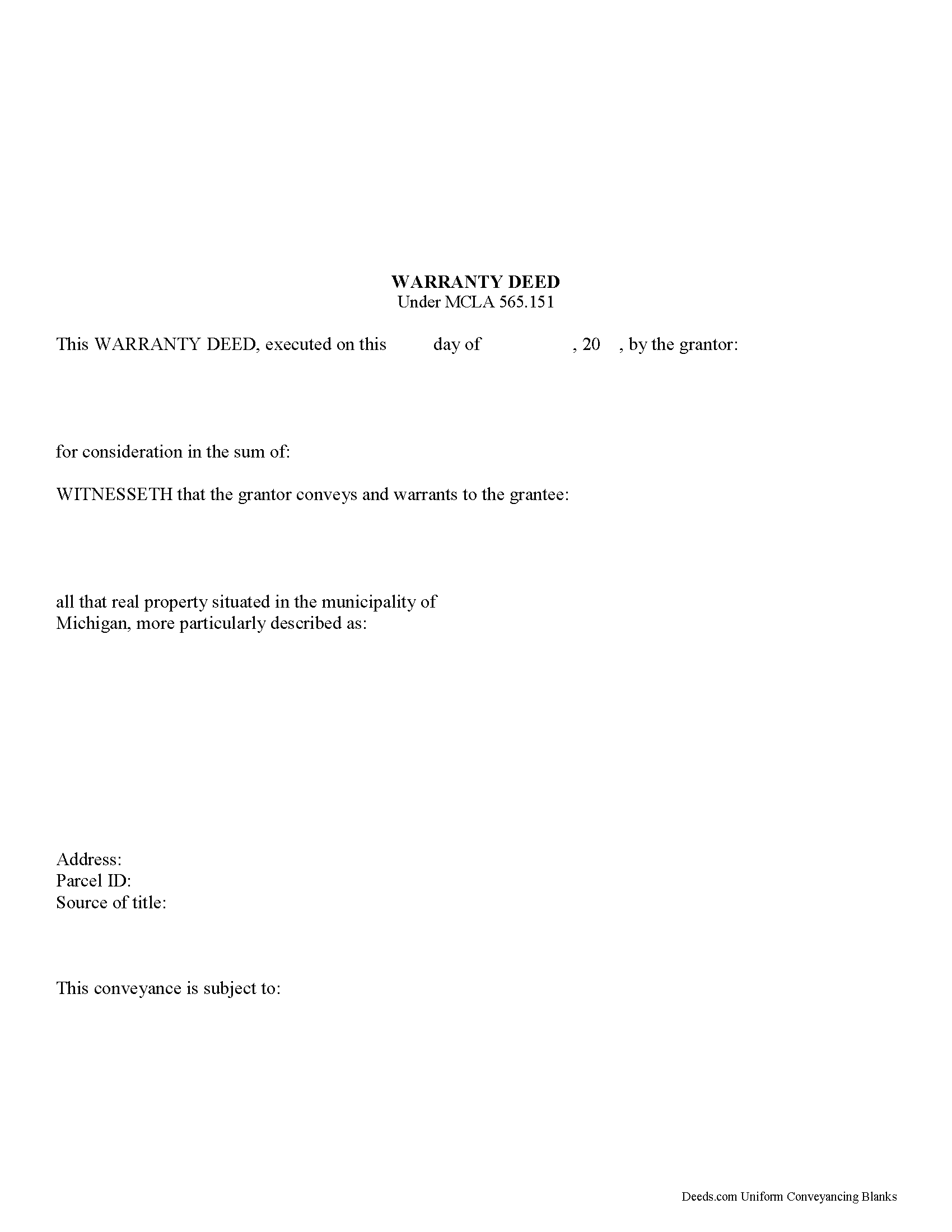
About the Michigan Warranty Deed
How to Use This Form
- Select your county from the list
- Download the county-specific form
- Fill in the required information
- Have the document notarized if required
- Record with your county recorder's office
What Others Like You Are Saying
"QUICK SERVICE"
"This site was a breeze using."
"Response time was fantastic. I had no idea it would be so quick. I would definitely use again. They …"
"VERY easy to register, to request relevant deeds that apply to your own county/state, and to downloa…"
"The forms were as I expected them to be. The guide was very helpful. Overall very good."
4.8/5 from 4,828 reviews. Read all
Michigan's warranty deed statute does its work in two words, and leaves the rest of the instrument to the parties. This fillable Michigan warranty deed is the base form of that conveyance: one or two individual owners conveying to one or two new owners, carrying the covenants of MCL 565.151 and preprinting no assumption about how anyone holds title.
What conveys and warrants commits a grantor to
Under MCL 565.151, wording a conveyance in substance as the grantor conveying and warranting the land for a stated consideration transfers a fee simple estate and attaches a set of covenants reaching backward through the whole chain of title: that the grantor is lawfully seized, holds the right to convey, guarantees quiet possession, warrants the premises free of encumbrances the deed does not except, and will defend against lawful claims. Michigan buyers and lenders searching for a general warranty deed or a statutory warranty deed are searching for this instrument. Section 9 of the form is where that promise gets its boundaries, since a recorded easement, a plat restriction, or a lien written into that section sits outside the covenant against encumbrances while everything left out of it stays inside.
The estate lives in the grantee line
Michigan supplies the answer only when the deed stays silent, and the answer is rarely the one parties expect. A conveyance to two people who add no co-ownership words leaves them tenants in common under MCL 554.44, with each share passing through its owner's estate. Spouses are the statutory exception: MCL 554.45 and MCL 557.71 presume a tenancy by the entirety, and DeYoung v Mesler holds that sprinkling joint tenancy words on the deed does not by itself displace it. Between unmarried grantees, Albro v Allen separates a plain joint tenancy, which one cotenant can sever alone, from a joint tenancy with full rights of survivorship, which Michigan treats as a joint life estate with indestructible survivorship remainders. Those distinctions turn on words typed into a blank line, so the form preprints none of them and the guide sets out each estate, the language that creates it, and what happens at a co-owner's death.
One instrument, one or two people on each side
The form gives the grantor and grantee sides open, multi-line blocks that take one or two individuals in their own right, along with whatever status recital and mailing address belong in the record. Execution follows the same shape: two signature blocks, each with the printed name line MCL 565.201 makes a condition of recording, and a separate acknowledgment certificate for each signer, carrying the notary's commission county, acting county, and expiration date under MCL 55.287. On a single-owner conveyance the second signature block and its certificate stay blank. A sole owner selling a home, and two owners on a deed conveying together, both present themselves in Michigan land records, and this instrument recites either without a change of form. Title held by an entity, by a trustee, by a signer acting under a power of attorney, or by three or more owners on one side calls for a different signer configuration than this form is set up as.
The Michigan counter has three habits
First, a warranty deed detours through the county treasurer: MCL 211.135 conditions recording of any conveyance containing a covenant of warranty on tax certification, a step a deed without warranty language skips. Second, registers of deeds refuse nonconforming instruments instead of charging extra, so the printed layout follows MCL 565.201 exactly, from the recordable event on the first line of print through the 2.5 inch top reserve, the grantee address, and the drafter statement. Third, the money is settled at the window: a flat $30 recording fee under MCL 600.2567 whatever the page count, plus transfer tax on the seller at 55 cents per $500 to the county and $3.75 per $500 to the state, computed from the total value stated in the deed itself. The form also carries the Land Division Act statements that ride on deeds of unplatted land under MCL 560.109.
The package delivers the fillable deed, a completed example running a platted Ottawa County sale through every blank, with the transfer tax on that sale figured in the guide, and a guide covering the statutory background, each section, the notary formalities, and the recording steps. The materials are informational and are not legal advice.
Important: County-Specific Forms
Our warranty deed forms are specifically formatted for each of the 83 counties in Michigan.
After selecting your county, you'll receive forms that meet all local recording requirements, ensuring your documents will be accepted without delays or rejection fees.