Missouri Beneficiary Affidavit of Death
County or Independent City Specific Legal Forms Validated as recently as November 10, 2026 by our Forms Development Team
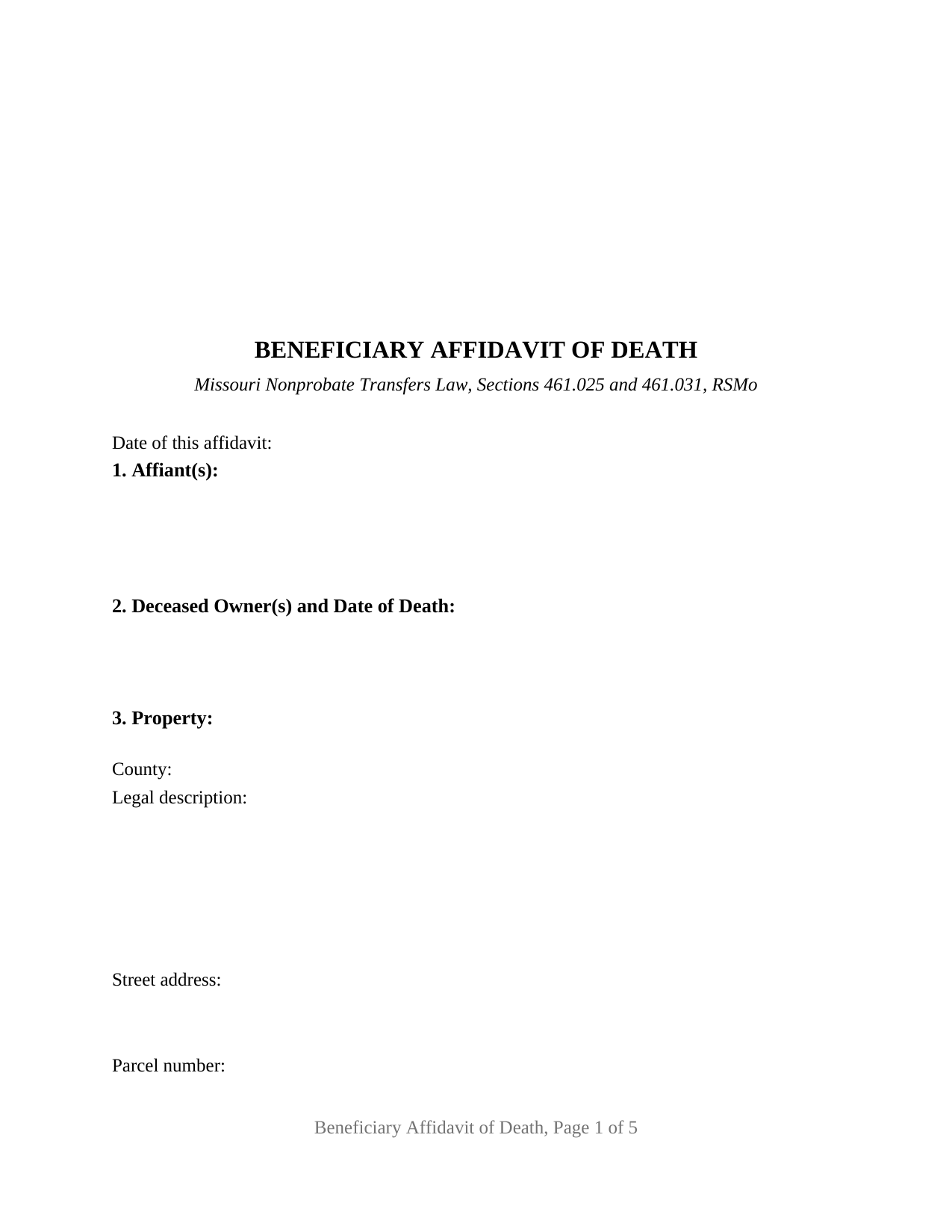
About the Missouri Beneficiary Affidavit of Death
How to Use This Form
- Select your county or independent city from the list
- Download the county or independent city-specific form
- Fill in the required information
- Have the document notarized if required
- Record with your county or independent city recorder's office
What Others Like You Are Saying
"Worked very well"
"Thank-you for your excellent services"
"No problem with Recorders Office using your document. It is now completed and recorded."
"The forms download was quick and easy. The example deed was excellent. However, the payment method s…"
"I wish you could send copy in mail"
4.8/5 from 4,847 reviews. Read all
When the owner of Missouri real estate dies with a beneficiary deed on record, the property passes to the named grantee beneficiary by operation of law at the moment of death. Nothing is filed to make that happen. What the land records lack, until someone adds it, is proof that the death occurred and a statement of who took. This Missouri Beneficiary Affidavit of Death is the sworn, recordable statement that supplies both, prepared for one or two grantee beneficiaries signing in their own right.
The deed did the work; the affidavit shows it
Missouri's Nonprobate Transfers Law, Chapter 461 of the Revised Statutes of Missouri, is unusually direct about timing. Section 461.025.1 makes a beneficiary deed effective at the owner's death if it was executed and filed of record before the death, and Section 461.031.3 states that on the death of the owner the property passes by operation of law to the beneficiary. The transfer is complete without a court, a deed from an executor, or any further signature. The chapter also provides no post-death filing for land, and prescribes no affidavit form.
That silence is the reason this affidavit exists. A title examiner reading the chain of title sees a beneficiary deed and an owner who, as far as the record shows, is still alive. The affidavit closes the gap: it names the deceased owner, states the date of death, attaches a certified copy of the death certificate, identifies the recorded beneficiary deed by its recording reference, and lists the grantee beneficiaries who survived the owner. Recorded in the same office where the deed was recorded, it imparts notice of those facts to everyone who later deals with the property, the effect Section 442.390 gives any instrument from the time it is filed with the recorder.
Sworn, not acknowledged
Because the document is an affidavit, the affiant signs it before a notary who administers an oath or affirmation and completes a jurat certificate, the notarial act Section 486.600(9) RSMo defines. The form carries the jurat certificate Section 486.755 prescribes for a Missouri notary, with the statute's own identification alternatives, and the affiant signs in the notary's presence. That is a different act from the acknowledgment a deed carries, and the two certificates are not interchangeable. The form prints a separate jurat certificate for each of its two affiants, so co-beneficiaries living in different cities can each sign where they are.
What the affidavit swears to
The sworn statements in Section 6 are fixed text that tracks the facts the statute makes decisive. The affiant states that each deceased owner died on the date given and that a certified death certificate is attached; that the owner, alone or as a joint owner, held the property and executed the beneficiary deed, which was of record before the death; that where joint owners executed the deed no joint owner survives and the last to die is named; that each affiant is a grantee beneficiary designated in the deed; that each beneficiary listed as surviving outlived the owner by more than one hundred twenty hours, the survival period Section 461.042 requires; and that no instrument revoking or changing the designation appears of record. A closing statement records that the affidavit is made for recording as evidence of the owner's death and of the passage of the deeded interest under Section 461.031 RSMo.
Joint owners and the last death
Where spouses holding as tenants by the entirety, or co-owners holding as joint tenants with right of survivorship, signed one beneficiary deed, Section 461.005(3) treats the death of the owner as the death of the last surviving owner, and Section 461.031.2 keeps the property with the surviving joint owner until then. The form's deceased-owner block holds two names and two dates of death for exactly that case, with a death certificate attached for each. The completed example included with the package shows it: two children recording the deaths of both parents under a single deed recorded years earlier.
One or two affiants, no preprinted assumptions
This is the base configuration of the Missouri Beneficiary Affidavit of Death. The form recites one or two natural-person grantee beneficiaries as affiants, with an AFFIANT signature block, a SECOND AFFIANT block used only when two sign, and a jurat for each. Its party blocks are open space: nothing about marital status, vesting, or capacity is preprinted, and the guide explains what each block carries. The form is not set up for a trustee or an entity signing as the grantee beneficiary, for an attorney in fact signing for a beneficiary, or for three or more affiants on one instrument; those patterns call for a different recital than the one this form fixes in its sworn statements.
Built to Missouri recording standards
The affidavit is laid out to Section 59.310 RSMo: letter-size pages, twelve-point type over the eight-point minimum, a three-inch band at the top of the first page reserved for the recorder, and one-inch margins elsewhere over the statute's three-quarter-inch minimum. The title, the date of the affidavit, the affiants with a mailing address, the deceased owners, and the county and legal description all sit on recorded page one, where Section 59.310.2 places them. Fees follow the recorder's published schedule, which combines the statutory page fees with the statewide user fee Section 59.319 sets, six dollars from August 28, 2026.
The package includes the fillable form, a completed example filled in for a realistic Greene County fact pattern, and the guide that walks through every numbered section, the jurat, and the recording process. This description and the guide describe the form and the governing statutes in general terms; they are not legal advice.
Important: County or Independent City-Specific Forms
Our beneficiary affidavit of death forms are specifically formatted for each of the 115 county or independent cities in Missouri.
After selecting your county or independent city, you'll receive forms that meet all local recording requirements, ensuring your documents will be accepted without delays or rejection fees.