Missouri Revocation of Beneficiary Deed
County or Independent City Specific Legal Forms Validated as recently as November 10, 2026 by our Forms Development Team
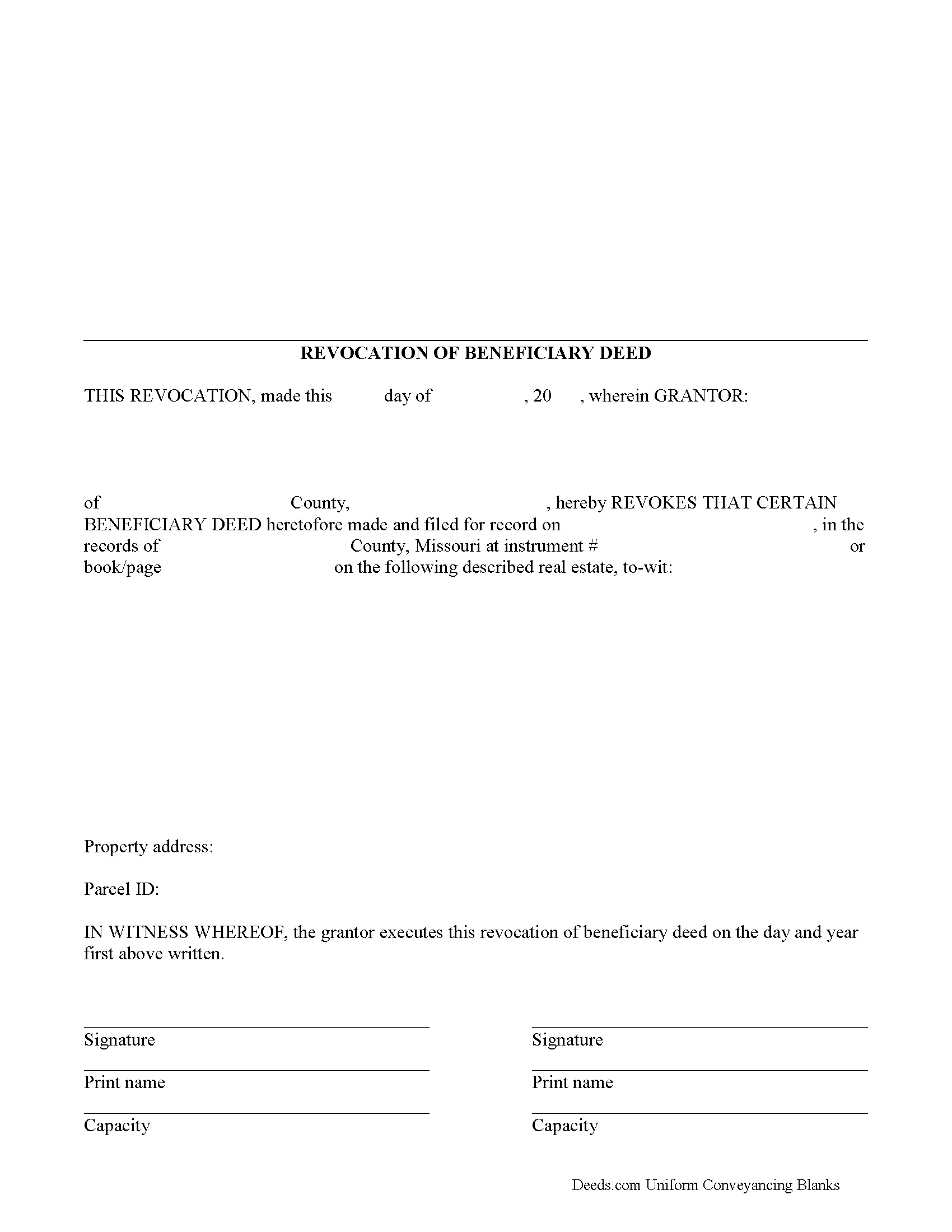
About the Missouri Revocation of Beneficiary Deed
How to Use This Form
- Select your county or independent city from the list
- Download the county or independent city-specific form
- Fill in the required information
- Have the document notarized if required
- Record with your county or independent city recorder's office
What Others Like You Are Saying
"Great resource! Nice to have these forms and information available. No problems at the recorder, in …"
"I was very pleased with the quick turn around on a response to my inquiry. Further guidance was dire…"
"They are fantastic. I am a little technically challenged, but very helpful and respectful. Highly re…"
"The process was easy and cost was reasonable. My only suggestion is to allow user the ability to sho…"
"Quick and easy! I had previously prepared a Lady Bird deed, submitted it through Deeds.com and it wa…"
4.8/5 from 4,860 reviews. Read all
This Missouri package prepares a recorded revocation of a previously recorded beneficiary deed under Section 461.033, RSMo, part of the Nonprobate Transfers Law of Missouri. The instrument is signed by the owner or owners, one or two natural persons, who made the beneficiary deed being revoked. It is delivered as one statewide form rather than county-specific versions.
What the download contains
- Revocation of Beneficiary Deed Form: a fillable PDF. The first page is an instructions page marked not for recording, followed by the five-page instrument. Entries can be typed into the fields or printed by hand.
- Revocation of Beneficiary Deed Guide: a line-by-line guide that explains the statutory framework, each section of the form, the signing and notarization rules, the recording process, and what the form does not do.
- Completed Example: the same form filled in for a fictional married couple revoking a recorded Greene County beneficiary deed, with both signature blocks and both acknowledgment certificates completed. The guide refers to the example's entries by name, so each blank can be compared against a finished version.
What the form does
The form identifies the owners by name and marital status with a mailing address; the beneficiary deed being revoked by its date, recording date, document number or book and page, the recorder of deeds office where it was recorded, and the grantee beneficiaries named in it; and the property by county and legal description. Its operative section, which contains no blanks, revokes the identified beneficiary deed and its beneficiary designation in its entirety as to the described property. That section also recites that the revocation conveys no interest in the real property and makes no new beneficiary designation.
The revocation reaches only the beneficiary deed it identifies and the property it describes. A new beneficiary deed naming a different beneficiary is a separate instrument that is not included in this package. The revocation does not clear liens, release a deed of trust, or affect any other recorded interest.
Owners who sign
The form carries two owner signature blocks and two acknowledgment certificates, so one or two owners can sign. Under Section 461.033.1, RSMo, a revocation involving property of joint owners, meaning joint tenants with right of survivorship or a husband and wife holding as tenants by the entirety, may only be made with the agreement of all owners then living, and the form's operative language recites that where the deed was made by joint owners each signs. The second signature block and its certificate are designed to remain unused when a single owner revokes.
The guide describes four owner patterns the form reaches: a sole owner, two joint owners who both sign, a surviving joint owner who revokes alone, and two tenants in common. The form is not set up for a revocation signed by an entity, a trustee, a personal representative, or an attorney in fact or other agent acting for an owner, and three or more owners on one revocation are outside the form. The guide also notes that a person who acquired the property after the beneficiary deed was recorded is not the owner who made the designation.
Effective date and recording
The form's capitalized closing paragraph recites the statutory rule that the effective date of a revocation is determined in the same manner as the effective date of a beneficiary designation (Section 461.033.6), and that a beneficiary deed transfers the property only if it is executed and filed of record with the recorder of deeds where the property is situated before the owner's death (Section 461.025). The guide explains the consequence for this instrument: a signed and acknowledged revocation that is not of record at the owner's death leaves the recorded beneficiary deed in place.
The instrument is letter size and is laid out with the three-inch first-page top margin and first-page items described in Missouri's recording standards, with the legal description box on page two and that page reference stated on page one. The guide's recording section covers the recording office, statutory fees, formatting standards, and county intake differences.
Notarization
Each owner has a separate acknowledgment certificate printing the Missouri statutory short form, with a line for the officer to designate whether the signer appeared by physical presence or by communication technology. The separate certificate for each owner is the form's design rather than a Missouri requirement; it allows two owners to acknowledge on different dates, before different officers, or in different states. The guide describes acknowledgments taken outside Missouri and remote online notarization.
This description and the included guide provide general information about the supplied form and the Missouri statutes it cites. They are not legal advice.
Important: County or Independent City-Specific Forms
Our revocation of beneficiary deed forms are specifically formatted for each of the 115 county or independent cities in Missouri.
After selecting your county or independent city, you'll receive forms that meet all local recording requirements, ensuring your documents will be accepted without delays or rejection fees.