Nevada Quitclaim Deed (Corrective)
County or Independent City Specific Legal Forms Validated as recently as October 16, 2026 by our Forms Development Team
About the Nevada Quitclaim Deed (Corrective)
How to Use This Form
- Select your county or independent city from the list
- Download the county or independent city-specific form
- Fill in the required information
- Have the document notarized if required
- Record with your county or independent city recorder's office
What Others Like You Are Saying
"I found exactly the perfect forms that I needed with Deeds, and much more. I definitely will be usin…"
"This is an excellent service during a pandemic! Recording documents can be challenging with changing…"
"Quick, easy way to get the forms I needed"
"I was unable to finish what I started due to computer crash. I'll get back soon. I paid off my mortg…"
"I am a WA State Attorney and just made my first purchase. The experience was flawless, and I appreci…"
4.8/5 from 4,836 reviews. Read all
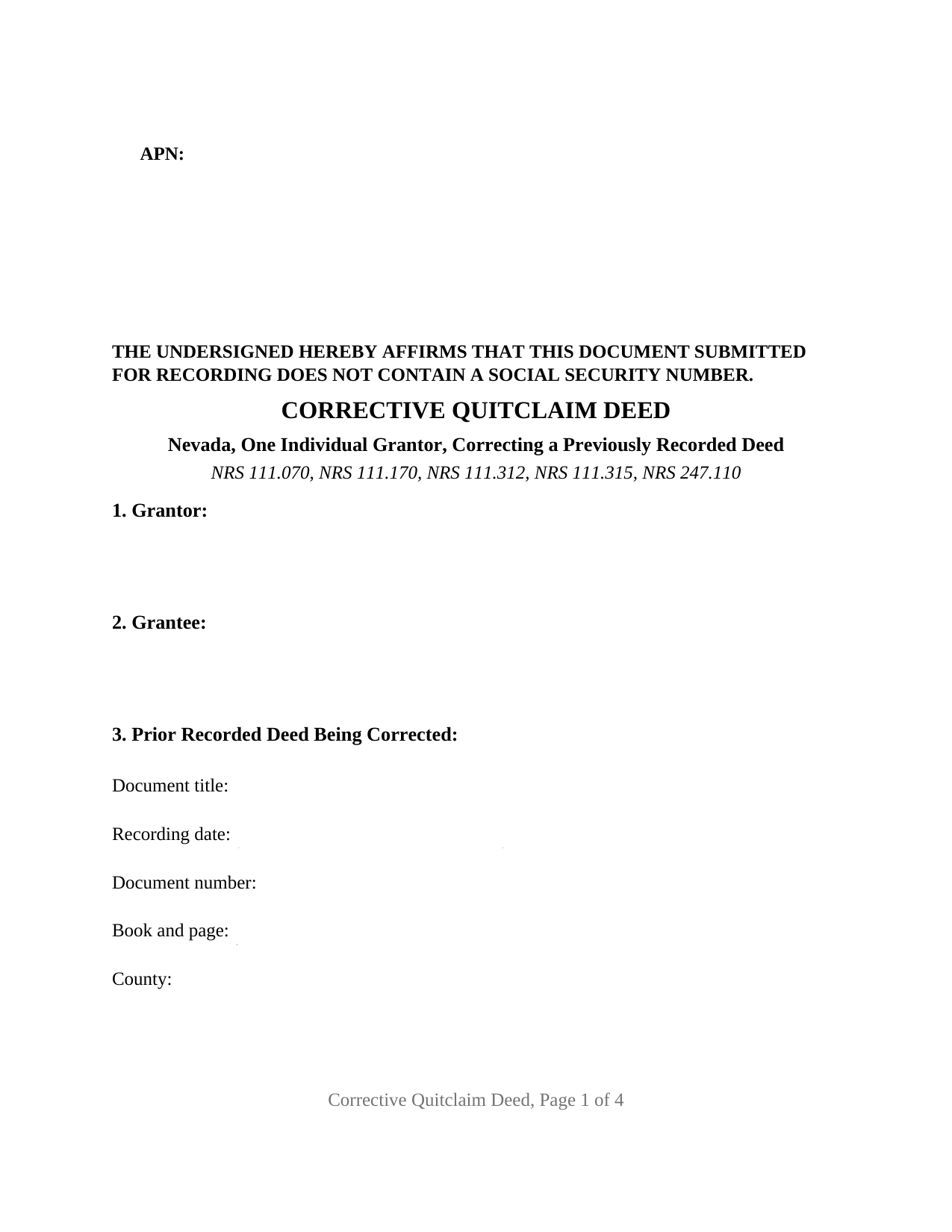
The Nevada Quitclaim Deed (Corrective) starts where another deed already sits in the county record. Section 3 pins that earlier deed down by document title, recording date, document number, book and page, and county; Section 4 sets the entry as the recorded deed states it directly beside the entry as this deed states it. One individual grantor signs, and the conveyance that follows carries the corrected terms into the record. A correction deed, a scrivener's error deed, a quit claim drawn to fix a misspelled name: the informal phrases all point at this configuration.
Nothing gets erased
A recorded Nevada instrument is permanent. No provision of the Nevada Revised Statutes lets a party pull the image back off the record, strike a word, or swap in a clean copy, and research located no Nevada statute creating a corrective deed or supplying a re-recording procedure. The correction travels the only route the state leaves open: a second conveyance, signed and acknowledged and recorded like any other. NRS 111.105 describes that instrument; NRS 111.070 measures what it moves, passing the whole estate the grantor holds unless a lesser estate appears in the deed's own terms.
The two entries that do the work
Everything distinctive about this deed sits in Sections 3 and 4. The recording data locates the earlier instrument precisely enough that an examiner can pull it, and the paired before and after entries show which term moved, so the two documents read together in the grantor and grantee index. That recording data earns its keep twice more: NRS 111.312(6) accepts a pointer to a previously recorded document carrying the same metes and bounds description, and Nye County's declaration of value instructions ask an exemption claim to name the document number being corrected.
One grantor, one signature, one certificate
The architecture stays single throughout: one grantor entry with name, marital status, and mailing address; one grantee entry carrying the address NRS 111.312(1) makes a condition of recordation; one signature line under the printed name rule of NRS 247.190; one certificate in the individual short form at NRS 240.166. Corrections wearing this shape in the Nevada record include a grantee name misspelled by a letter, a lot or block number transposed in a platted description, an omitted assessor's parcel number, and vesting words left out of the grantee clause. The form is not built to enlarge the transaction: adding a party who never signed, dropping one who did, or reaching a different parcel is a new transfer from the current record owner, and community real property moves only where both spouses join and acknowledge under NRS 123.230(3).
A release, with no covenant behind it
The operative sentence remises, releases, and forever quitclaims. Three words stay out of it on purpose, grant, bargain and sell, which NRS 111.170 loads with limited implied covenants, and the deed states that omission on its face. The grantee takes the corrected terms and the grantor's actual position in the title, liens and easements included, with no promise attached to either.
Exemption 3, and the document it points back to
Every Nevada deed reaches the counter with a State of Nevada Declaration of Value beside it, the Tax Commission form NRS 375.060 prescribes, obtained separately and not included here. Under NRS 375.030 the recorder computes the transfer tax and collects it before the deed is accepted, at $1.95 per $500 of value in most counties and $2.55 in Clark. Where a correction moves no interest and adds no consideration, the entry it ordinarily reaches is NRS 375.090(3), exempting a transfer of title that recognizes the true status of ownership, with NAC 375.180 having the declaration carry the exemption type and a written explanation.
What the recorder reads first
Four items gate recordation under NRS 111.312. Page one carries the assessor's parcel number in its upper left corner, under the uppercase Social Security number affirmation; numbered sections hold the grantee's mailing address, the tax statement entry, and the metes and bounds statement. The sheet follows the format standards of NRS 247.110, and NRS 247.200 sends the signed instrument to the recorder of the county where the land sits.
The download holds the fillable blank deed, a completed example worked through a Lander County name correction, and a guide covering each numbered section, the ways a Nevada grantee may hold title, and recording. Everything here is informational and is not legal advice; how these statutes fall on one parcel or one earlier deed is a question for a Nevada attorney.
Important: County or Independent City-Specific Forms
Our quitclaim deed (corrective) forms are specifically formatted for each of the 17 county or independent cities in Nevada.
After selecting your county or independent city, you'll receive forms that meet all local recording requirements, ensuring your documents will be accepted without delays or rejection fees.