Nevada Quitclaim Deed (Trustee Grantor)
County or Independent City Specific Legal Forms Validated as recently as October 15, 2026 by our Forms Development Team
About the Nevada Quitclaim Deed (Trustee Grantor)
How to Use This Form
- Select your county or independent city from the list
- Download the county or independent city-specific form
- Fill in the required information
- Have the document notarized if required
- Record with your county or independent city recorder's office
What Others Like You Are Saying
"One thing I would suggest that could be changed is the last page because we have a trust and I had t…"
"I think Deeds is a great site for learning. On recording a document, I had trouble. It was me, becau…"
"My Quick claim formsi downloaded had not come through so I contacted customer service and they provi…"
"The service was simple and easy enough but the UI isn't the easiest on the eyes and the process is a…"
"In 15 minutes I had my out of state documents. I am very pleased with the ease of acquiring them. I …"
4.8/5 from 4,833 reviews. Read all
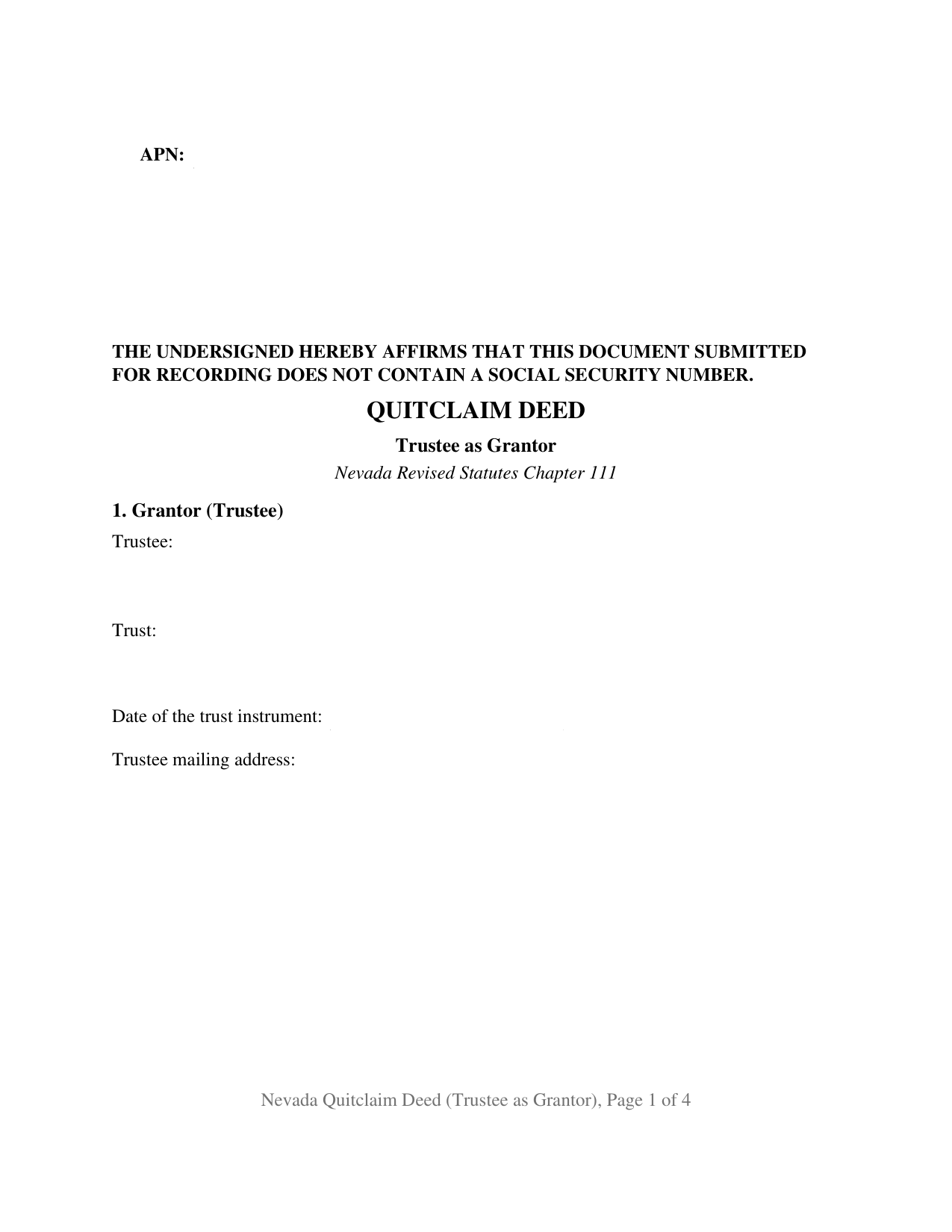
The grantor on this deed holds title in a fiduciary capacity, and the instrument is built around that fact from its first entry to its closing certificate. The Nevada Quitclaim Deed (Trustee Grantor) names the trustee, the trust, and the date of the trust instrument in Section 1, then releases whatever interest that trust holds in the parcel described further down the page. A quit claim deed out of a living trust, a quick claim by a successor trustee: those searches land on this configuration of the Nevada quitclaim deed.
Where a trustee's power to convey comes from
NRS 164.067 answers the question a title examiner reaches first. Where title to property is taken in the name of a trustee, the trustee has power to sell, convey or encumber it unless the deed by which that title was taken specifically limits the power. Section 5 collects the recording reference for that earlier deed, so the instrument carrying the statutory power and the only one that could cut it back are both located in the chain. Behind the statute sit the trust's own terms: NRS 163.023 recognizes powers held under the trust instrument, by law, or by court order, and NRS 163.100 makes those powers attach to the office rather than to a person, the section standing behind a successor trustee's signature.
One trustee, signing in a representative capacity
The architecture is single all the way through: one grantor entry naming trustee, trust, and trust date, one signature line under the printed name rule of NRS 247.190, and one certificate whose name line takes the signer followed by the capacity, in the pattern NRS 240.1665 sets for a representative signature. Section 10 states that the signer acts as trustee and not in an individual capacity, and that the deed creates no personal obligation of that person. Shapes in the Nevada record presenting this configuration include a successor trustee distributing a parcel to the beneficiary entitled to it, a trustee releasing a trust's fractional interest so that whole title stands in a co-owner's name, and a trustee deeding a parcel back to the settlor after an amendment. Two cotrustees present a different shape: NRS 163.110(3) has a power vested in two trustees exercised only by unanimous action unless the trust instrument or a court order provides otherwise, which calls for a second signature line and a second certificate.
A release measured by what the trust actually holds
The operative sentence remises, releases, and forever quitclaims, and the face of the deed records the absence of the words grant, bargain and sell, so no covenant arises under NRS 111.170. NRS 111.070 fixes the size of the transfer: whatever estate the trust holds at delivery moves, and nothing beyond it. The grantee takes the trust's real position, liens and easements included, and the trust's history travels with the interest, which is why the guide reaches Smolen v. Smolen on severance of a joint tenancy by transfer to a revocable trust.
First page items, and the tax at the counter
Four items are conditions of recording under NRS 111.312, and each sits somewhere on the form: a parcel number in the upper left of page one, a mailing address for the grantee, the entry for tax statements, and, for metes and bounds, a preparer statement or a locator for a prior recorded document carrying the same description. The uppercase social security number affirmation opens the page, and the sheet is drawn to NRS 247.110. A State of Nevada Declaration of Value goes in beside the deed, a Nevada Tax Commission form obtained separately from this package, and the transfer tax is figured before acceptance: the rate runs $1.95 per $500 of value, rising to $2.05 in Washoe and Churchill Counties and $2.55 in Clark. Where nothing is paid, exemption 7 is the entry a trust conveyance ordinarily reaches, conditioned on a certificate of trust arriving with the deed, and NRS 375.030 carries what follows a claim later disallowed.
What the download holds
Inside: the fillable blank deed, a completed example worked through an Elko County distribution from a family trust to its beneficiary, and a guide covering each numbered section, the ownership forms a Nevada grantee may take, the certificate, and the recording steps. The package describes Nevada law in general terms, for information. It is not legal advice. Questions about a particular trust, parcel, or chain of title belong with a Nevada attorney.
Important: County or Independent City-Specific Forms
Our quitclaim deed (trustee grantor) forms are specifically formatted for each of the 17 county or independent cities in Nevada.
After selecting your county or independent city, you'll receive forms that meet all local recording requirements, ensuring your documents will be accepted without delays or rejection fees.