New Jersey Correction Deed
County Specific Legal Forms Validated as recently as October 22, 2026 by our Forms Development Team
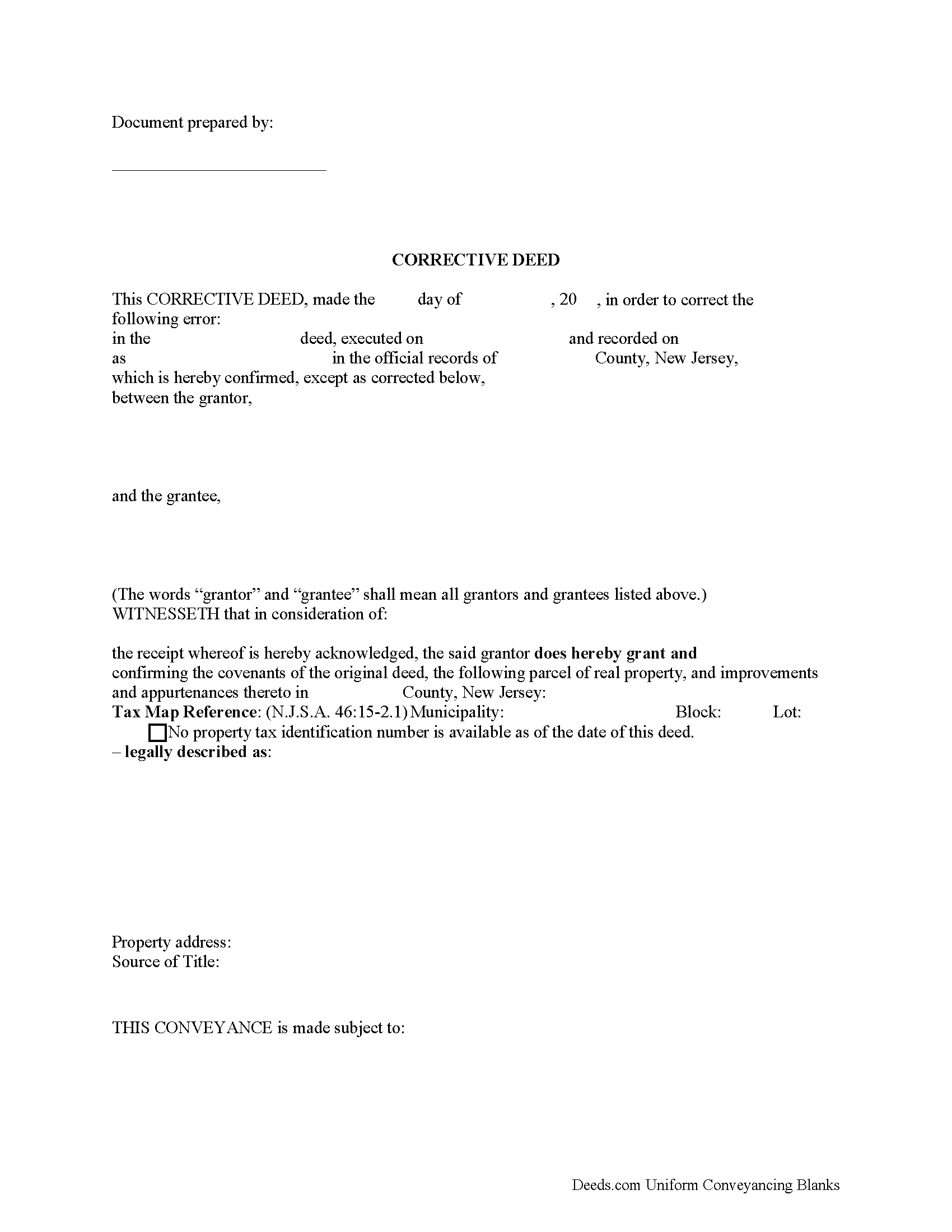
About the New Jersey Correction Deed
How to Use This Form
- Select your county from the list
- Download the county-specific form
- Fill in the required information
- Have the document notarized if required
- Record with your county recorder's office
What Others Like You Are Saying
"Clear and easy instructions. Prompt processing and confirmation. I am still in the middle of submitt…"
"Love it"
"Glad I found you. After much searching, you had the right form that I needed. Quick and easy. Cathy"
"I couldn't be more pleased or more impressed with the e-recording services I received from deeds.com…"
"Thank you so much for making the site so easy to use."
4.8/5 from 4,832 reviews. Read all
Use the corrective deed to correct an error in a previously recorded warranty, special warranty, or quitclaim deed in New Jersey.
Once a deed has been recorded, it cannot be changed and remains part of the public record. It is possible, however, to amend that record by adding a newly executed deed. The method used depends upon the reasons for changing. For corrections or omissions in the existing deed, file a corrective deed, or re-record the original deed after making the changes on it. In order to include/omit a name from the existing deed, however, a new standard conveyance, such as a warranty or quitclaim deed from the current owner (instead of the original grantor), may be more appropriate.
The errors usually adjusted by a corrective deed are minor omissions or typographical mistakes, sometimes called scrivener's errors. Among those are misspelled names, omitted or wrong middle initial, a minor error in the property description, or an omitted execution date. The corrective deed, also called deed of correction or deed of confirmation, must state that its sole purpose is to correct a specific error, which is usually identified by type. For example: an error in the grantor's name, or an error in the grantor's marital status. The latter might also require an additional signature by the grantor's spouse in the acknowledgement section of the deed.
In some counties, it is common practice to re-record the prior deed and to make the correction, error identification and reference to the earlier recording on the face of it. The entire deed, including new signature and acknowledgement page(s), must be re-recorded for new fees. As with the prior deed, the corrective deed (or re-recorded deed) must be accompanied by two copies of the affidavit of consideration (RTF-1 form), identifying and explaining the exemption under #4. In addition, submit the GIT/REP-4a form, which is a tax waiver form for corrected deeds without consideration. Download both forms from the website of New Jersey's Department of the Treasury.
(New Jersey CD Package includes form, guidelines, and completed example)
Important: County-Specific Forms
Our correction deed forms are specifically formatted for each of the 21 counties in New Jersey.
After selecting your county, you'll receive forms that meet all local recording requirements, ensuring your documents will be accepted without delays or rejection fees.