Livingston County Transfer on Death Deed (Two Joint Tenants with Right of Survivorship, Last Survivor) Form
Last validated November 20, 2026 by our Forms Development TeamFormatted for recording in Livingston County, for property anywhere in the county: rural and unincorporated areas as well as Avon, Caledonia, Conesus, Dalton, Dansville, Geneseo, Groveland, Hemlock and 15 more.
- 3 documents included
- Immediate PDF download
- Formatting guarantee
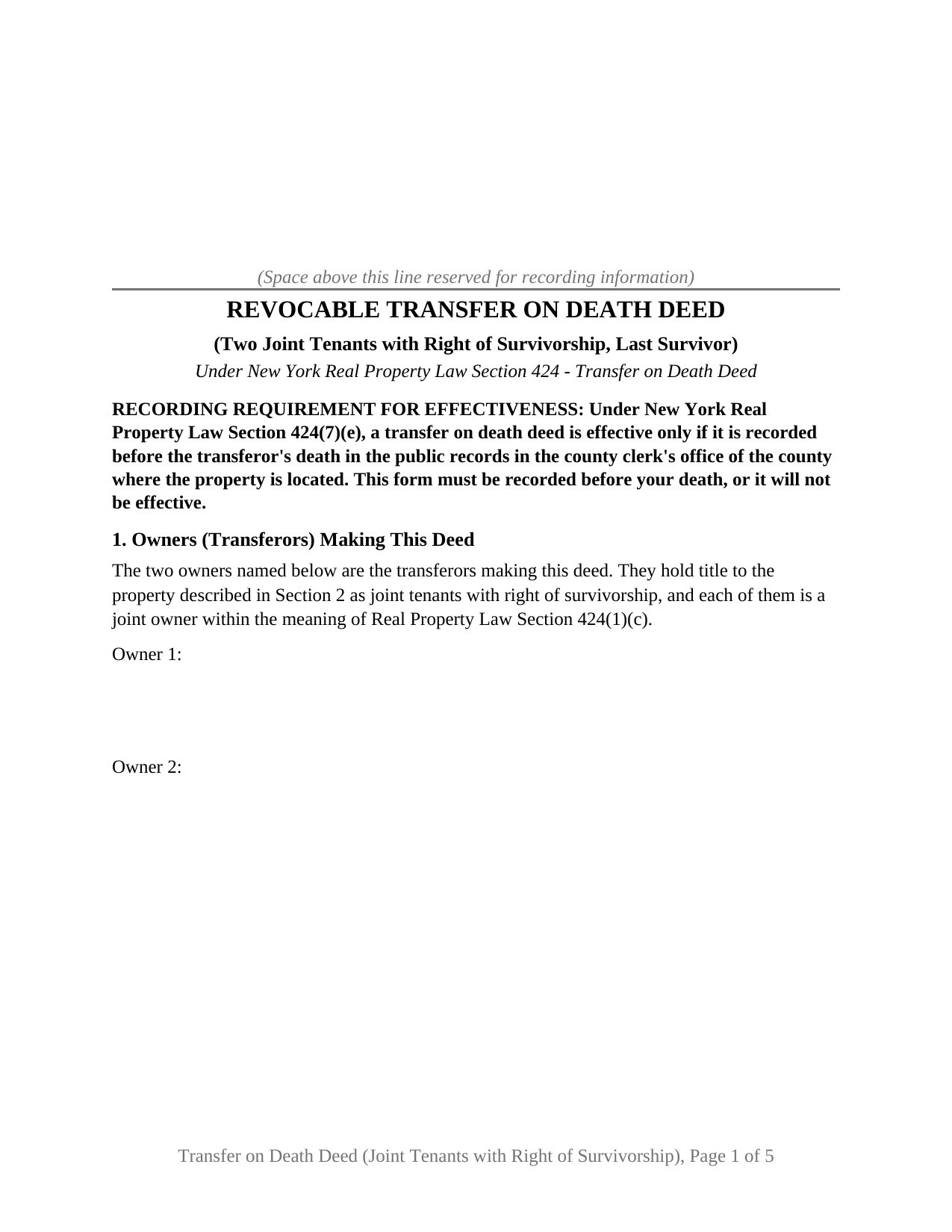
Livingston County Transfer on Death Deed (Two Joint Tenants with Right of Survivorship, Last Survivor) Form
Fill in the blank Transfer on Death Deed (Two Joint Tenants with Right of Survivorship, Last Survivor) form formatted to comply with all New York recording and content requirements.
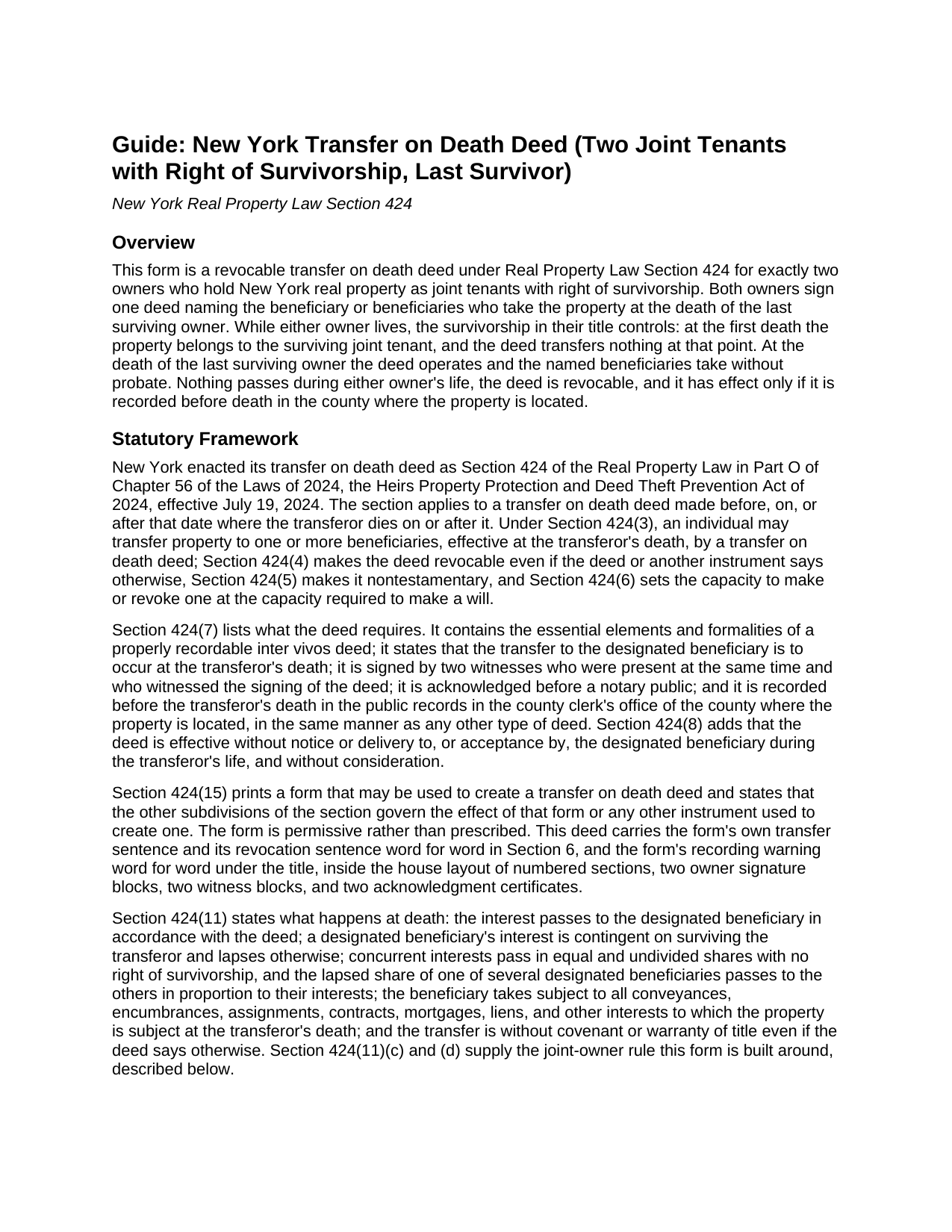
Livingston County Transfer on Death Deed (Two Joint Tenants with Right of Survivorship, Last Survivor) Guide
Line by line guide explaining every blank on the Transfer on Death Deed (Two Joint Tenants with Right of Survivorship, Last Survivor) form.
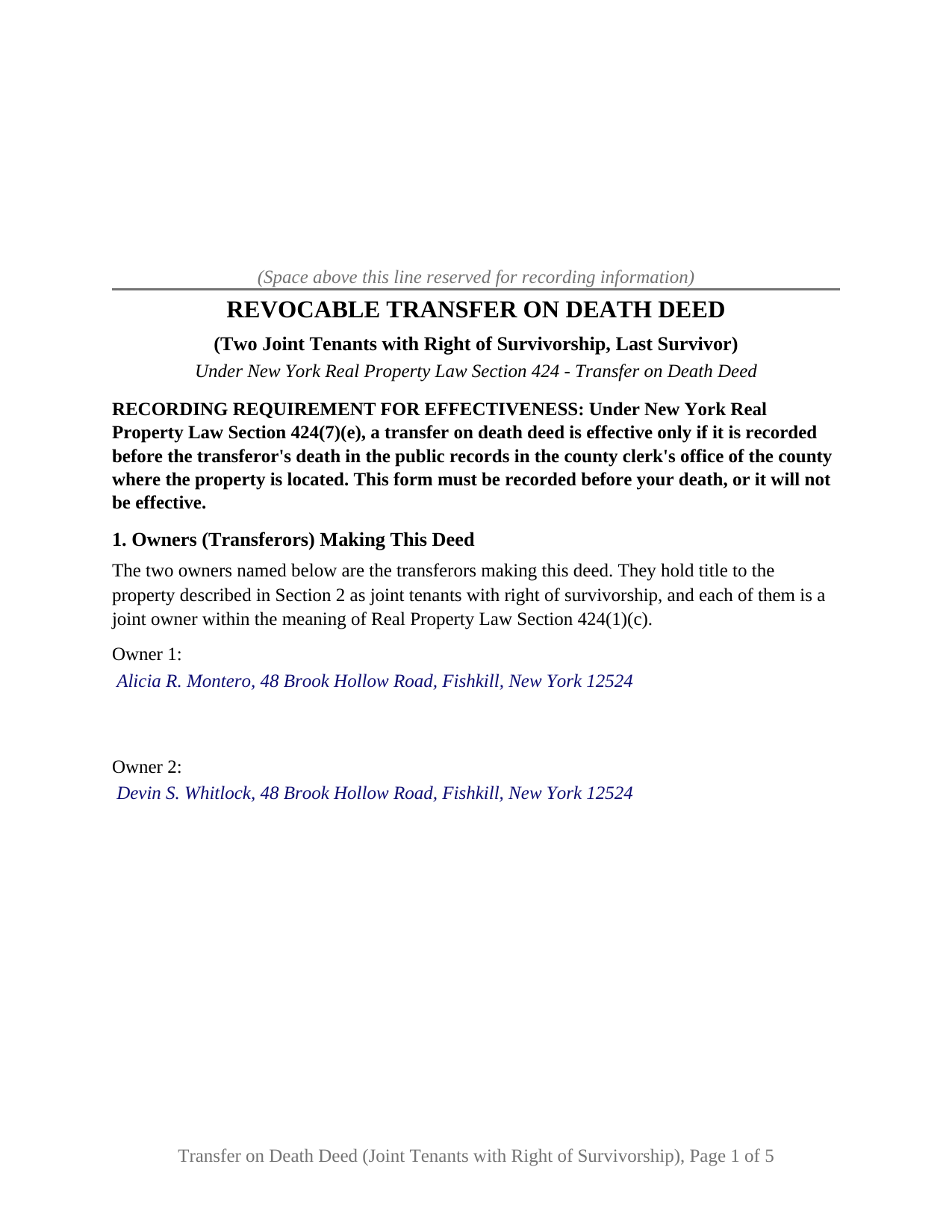
Livingston County Completed Example of the Transfer on Death Deed (Two Joint Tenants with Right of Survivorship, Last Survivor) Document
Example of a properly completed New York Transfer on Death Deed (Two Joint Tenants with Right of Survivorship, Last Survivor) document for reference.
All 3 documents above included • One-time purchase • No recurring fees
Immediate Download • Secure Checkout
Additional New York and Livingston County documents included at no extra charge:
Where to Record Your Documents
Livingston County Clerk
Geneseo, New York 14454
Hours: 8:30 to 4:30 M-F
Phone: (585) 243-7010 & 335-1712
Recording Tips for Livingston County:
- Bring your driver's license or state-issued photo ID
- Ensure all signatures are in blue or black ink
- Verify all names are spelled correctly before recording
- White-out or correction fluid may cause rejection
- Ask about their eRecording option for future transactions
Cities and Jurisdictions in Livingston County
Properties in any of these areas use Livingston County forms:
- Avon
- Caledonia
- Conesus
- Dalton
- Dansville
- Geneseo
- Groveland
- Hemlock
- Hunt
- Lakeville
- Leicester
- Lima
- Livonia
- Livonia Center
- Mount Morris
- Nunda
- Piffard
- Retsof
- Scottsburg
- Sonyea
- South Lima
- Springwater
- York
Hours, fees, requirements, and more for Livingston County
How do I get my forms?
Forms are available for immediate download after payment. The Livingston County forms will be in your account ready to download to your computer. An account is created for you during checkout if you don't have one. Forms are NOT emailed.
Are these forms guaranteed to be recordable in Livingston County?
Yes. Our form blanks are guaranteed to meet or exceed the applicable formatting requirements used for recording in Livingston County, including margin requirements, font requirements, and other layout standards. This guarantee applies to formatting, not to the legal sufficiency of information entered by the user or the suitability of a form for a particular transaction.
Can I reuse these forms?
Yes. You can reuse the forms for your personal use. For example, if you have multiple properties in Livingston County you only need to order once.
What do I need to use these forms?
The forms are PDFs that you fill out on your computer. The free Adobe Acrobat Reader is recommended, and most PDF apps also work. You do NOT enter your property information online - you download the blank forms and complete them privately on your own computer.
Are there any recurring fees?
No. This is a one-time purchase. Nothing to cancel, no memberships, no recurring fees.
How much does it cost to record in Livingston County?
Recording fees in Livingston County vary. Contact the recorder's office at (585) 243-7010 & 335-1712 for current fees.
Questions answered? Let's get started!
Two New York co-owners whose deed made them joint tenants with right of survivorship can record one transfer on death deed naming who takes the property after the second of them dies. This deed is prepared under Real Property Law Section 424 for that title and no other: two owners holding as joint tenants with right of survivorship, both signing, with the transfer postponed to the death of the last surviving owner.
A joint tenancy that the vesting deed created in so many words
New York does not presume a joint tenancy. Under Estates, Powers and Trusts Law Section 6-2.2(a), a disposition of property to two or more persons creates a tenancy in common unless the instrument expressly declares a joint tenancy, so two unmarried co-owners hold with survivorship only because the deed that conveyed to them said so, usually in the words as joint tenants with right of survivorship. The rule runs the other way for spouses: under Section 6-2.2(b) a conveyance to a married couple creates a tenancy by the entirety unless the deed expressly declares a joint tenancy or a tenancy in common, so a husband and wife appear under this form only when their vesting deed chose the joint tenancy over the default. Section 6-2.2(d) adds the one case where the joint tenancy arises without an express declaration: two people who are not legally married but whom the deed describes as spouses take as joint tenants.
That is why the deed carries a source of title section. Section 1 recites that the two owners hold as joint tenants with right of survivorship and that each is a joint owner within the meaning of Section 424(1)(c), a definition that names the joint tenant and excludes the tenant in common; Section 3 identifies the recorded deed by which they took title, with the words that declared the tenancy. The recital expresses what the owners represent about their title, and the vesting deed is what the record shows. The pairs that hold this way in New York are siblings who bought or inherited together, a parent and an adult child, unmarried partners, business associates holding investment property, and couples who deliberately chose a joint tenancy.
What a joint tenant can still do after recording
A New York joint tenancy is not locked in by this deed. Real Property Law Section 240-c lets one joint tenant sever the tenancy without the other's consent, by a deed to a third person, by a deed naming the severing tenant as grantee, or by a written instrument evidencing an intent to sever, and the severance defeats the other tenant's survivorship only if it is recorded before the severing tenant dies. Section 424(10)(a) reinforces the point from inside the transfer on death statute: during a transferor's life the deed does not affect the right of the transferor or any other owner to transfer or encumber the property. A severance changes the title that Section 1 recites, because the former joint tenants then hold as tenants in common, an estate outside the Section 424(1)(c) definition, and what the recorded deed then does as to each interest is governed by Section 424(11)(a) and the instruments of record. The guide describes that interaction; the deed itself does nothing to prevent a sale, a mortgage, or a severance by either owner.
Postponed to the last survivor, by statute and on the page
Section 424(11)(c) provides that a transferor who is a joint owner and is survived by another joint owner leaves the property to the survivor with right of survivorship, and Section 424(11)(d) provides that the deed is effective where the transferor is the last surviving joint owner. Section 6 of the deed opens with the sentence the Section 424(15) form prints, At my death, I transfer my interest in the described property to the beneficiaries as designated above, and then fixes the two-owner reading as deed text: each owner makes that statement as to that owner's interest, the property belongs to the surviving owner at the first death and the deed does not operate then, and the deed is effective at the death of the last surviving owner. The same section states that a designated beneficiary takes only by surviving the last surviving owner, so the beneficiaries are measured against the death at which the deed actually works.
The beneficiary sections are open to the designations Section 424 permits. The primary section takes one beneficiary or several, by name and mailing address, with the equal-share and proportional-lapse rules of Section 424(11)(a)(3) and (4) governing a group; the optional alternate section takes a beneficiary who steps in only if no primary beneficiary survives the last surviving owner. Revocation while both owners live takes both of them, because under Section 424(9)(b) a deed of joint owners is revoked only by all of the living joint owners; after the first death the survivor revokes alone, by a recorded instrument acknowledged after this deed. That instrument of revocation is prepared and recorded separately and is not included in this package.
Two owners, two witnesses side by side, two certificates
Both owners sign in separate blocks on the same page. Under Section 424(7)(c) the deed is signed by two witnesses who were present at the same time and who witnessed the signing, and the form places the two witness blocks side by side beneath a sentence stating that the witnesses, both present at the same time, witnessed the signing of the deed by each owner. Each owner then acknowledges the deed under a certificate in the form Real Property Law Section 309-a(1) prescribes, printed with the New York venue, the three date blanks of the statutory sentence, and the lines Executive Law Section 137 has a notary complete. Two certificates are the form's layout rather than a legal requirement; one New York certificate may cover two signers who appear together, and the second certificate exists so the owners may acknowledge at different times or in different places. Recording under Section 424(7)(e), before either owner's death, with the clerk of the county where the land lies, is what makes the deed effective, and the Department of Taxation and Finance has stated that a transfer on death deed is recorded without the RP-5217 and TP-584 forms a sale carries.
The configuration this form recites
The form recites exactly two owners holding the described property as joint tenants with right of survivorship, both of them transferors, and a transfer that occurs at the death of the last surviving owner. It carries two owner signature blocks, two witness blocks, two acknowledgment certificates, a primary beneficiary section sized for more than one name, and an optional alternate beneficiary section. It fixes no marital status, because a joint tenancy exists between married and unmarried co-owners alike. Two siblings who inherited a lake house together, unmarried partners who took title with survivorship, and a parent and child who bought a two-family home as joint tenants present the pattern this deed recites. The form is not set up as a deed by a sole owner, by tenants in common, by spouses holding as tenants by the entirety, by three or more joint tenants, or by a trustee, an entity, or an attorney-in-fact.
The package includes the fillable transfer on death deed, a completed example worked through a Dutchess County fact pattern with two unmarried joint tenants and two beneficiaries, and the guide that covers each numbered section, the joint-owner rule, severance, the witness and notary blocks, and recording. The description and the guide describe the form and the governing New York statutes in general terms and are not legal advice.
Important: Your property must be located in Livingston County to use these forms. Documents should be recorded at the county recording office listed above.
This Transfer on Death Deed (Two Joint Tenants with Right of Survivorship, Last Survivor) meets all recording requirements specific to Livingston County.
Our Promise
The documents you receive here are guaranteed to meet or exceed the applicable Livingston County recording format requirements. If there is a rejection caused by our formatting, we will correct the issue or refund your payment. This guarantee applies to document formatting only and does not extend to information entered by the user, the selection of the form, or the legal effect of the completed document.
Save Time and Money
Get your Livingston County Transfer on Death Deed (Two Joint Tenants with Right of Survivorship, Last Survivor) form done right the first time with Deeds.com Uniform Conveyancing Blanks. At Deeds.com, we understand that your time and money are valuable resources, and we don't want you to face a penalty fee or rejection imposed by a county recorder for submitting nonstandard documents. We constantly review and update our forms to meet rapidly changing state and county recording requirements for roughly 3,500 counties and local jurisdictions.
4.8 out of 5 - ( 4,864 Reviews )
CHARLES V. 5 out of 5 stars
Legit. Reasonable prices.
Thank you for your feedback. We really appreciate it. Have a great day!
Marilyn O. 5 out of 5 stars
Good resource. Got what I needed easily
Thank you for your feedback. We really appreciate it. Have a great day!
Helen D. 5 out of 5 stars
I was just trying to look up a record.
Thank you for your feedback. We really appreciate it. Have a great day!
Bill S. 5 out of 5 stars
Very convenient and reasonably priced service. Excellent. A++
Thank you for your feedback. We really appreciate it. Have a great day!
Scott M. 5 out of 5 stars
Complete Package don't spend good money for a title co. to do this
Thank you for your feedback. We really appreciate it. Have a great day!
PEGGY D. 5 out of 5 stars
Very easy to find what I needed. Really liked the instructions included with the forms and also the suggestion of other forms that I might need.
We appreciate your business and value your feedback. Thank you. Have a wonderful day!
Albert j. 5 out of 5 stars
Very easy site to use for a simple minded happy howmowner. Very reasonable fee Quick turn around Good communication
Thank you!
Sylvia Y. 5 out of 5 stars
Fantastic forms! So nice to have them formatted correctly for our county, the recorder here can be very picky with the margins. No issues at all.
Thank you for your feedback. We really appreciate it. Have a great day!
Michael W. 5 out of 5 stars
Staff was very diligent in pointing out multiple errors I had made on filing the District of Columbia's confusing form for tax exemption in a marital property exchange.
We’re always here to help. Thank you for your feedback.
John B. 5 out of 5 stars
Simply amazing. I had absolutely no idea how to properly file a deed, until someone told me about deeds.com. It's just such a well designed service, with fantastic customer support, and speed. Bravo to everyone at deeds.
We appreciate your business and value your feedback. Thank you. Have a wonderful day!
Karen T. 5 out of 5 stars
Thank you for the feedback. I reviewed this with my client/friend and she is following up with the appropriate people, including the Police and a lawyer. Thank you for your help.
Thank you!
Charles C. 5 out of 5 stars
This was my first experience with e-recording. Deeds.com was AWESOME! Within one hour, I signed up with Deeds.com, recorded a deed in a neighboring county and had access to a copy of the recorded deed. I also appreciate the fact that there are no monthly or annual fees. Thanks Deeds.com!
Thank you for your feedback. We really appreciate it. Have a great day!
Elizabeth B. 5 out of 5 stars
Your site provided all I needed. Thank you!
It was a pleasure serving you. Thank you for the positive feedback!
Elizabeth L. 5 out of 5 stars
Used this site and the forms a few times now and always a good experience. It's so nice to be able to download these forms to my computer and work on them there. So many others want you to do everything online, pain in my opinion. Thank you Deeds!
Thank you for your feedback. We really appreciate it. Have a great day!
Patrick U. 5 out of 5 stars
Great product. They processed and transmitted the deed promptly. A small question I had was answered quickly and professionally. I would use again if the need arises and will recommend to friends.
Your feedback is greatly appreciated. Thank you for taking the time to share your experience!