New York Transfer on Death Deed (Two Joint Tenants with Right of Survivorship, Last Survivor)
County Specific Legal Forms Validated as recently as November 20, 2026 by our Forms Development Team
About the New York Transfer on Death Deed (Two Joint Tenants with Right of Survivorship, Last Survivor)
How to Use This Form
- Select your county from the list
- Download the county-specific form
- Fill in the required information
- Have the document notarized if required
- Record with your county recorder's office
What Others Like You Are Saying
"The forms were easy and convenient to use"
"I'm not certain yet that this is all I need to do what I need to do. Marion Co. Clerk's office has n…"
"I filled out the deed, had it notarized, and recorded. No problems. I put this off for so long. Once…"
"Thanks so much for the TOD Beneficiary Deed with the explanation, supplementary forms and great exam…"
"Phenomenal website !"
4.8/5 from 4,864 reviews. Read all
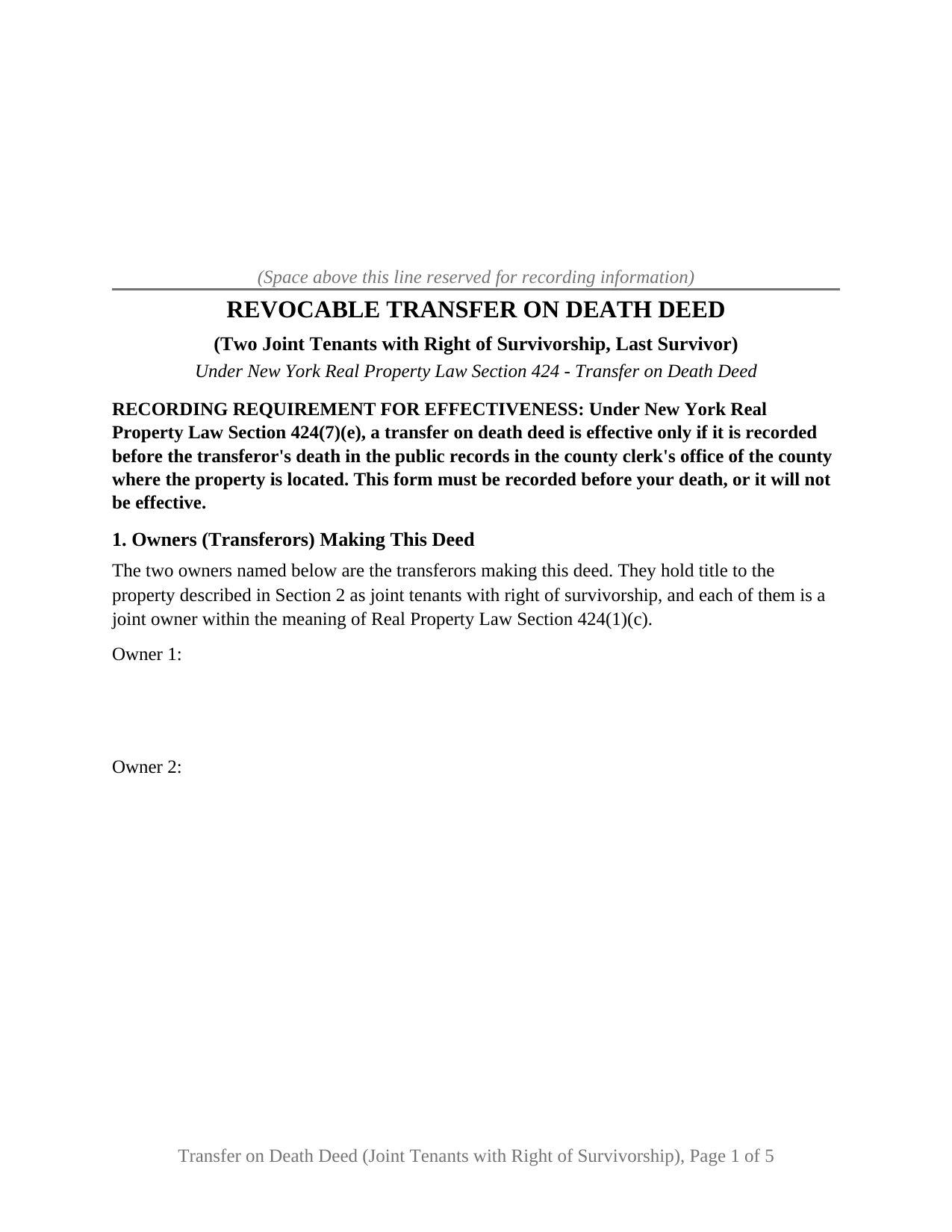
Two New York co-owners whose deed made them joint tenants with right of survivorship can record one transfer on death deed naming who takes the property after the second of them dies. This deed is prepared under Real Property Law Section 424 for that title and no other: two owners holding as joint tenants with right of survivorship, both signing, with the transfer postponed to the death of the last surviving owner.
A joint tenancy that the vesting deed created in so many words
New York does not presume a joint tenancy. Under Estates, Powers and Trusts Law Section 6-2.2(a), a disposition of property to two or more persons creates a tenancy in common unless the instrument expressly declares a joint tenancy, so two unmarried co-owners hold with survivorship only because the deed that conveyed to them said so, usually in the words as joint tenants with right of survivorship. The rule runs the other way for spouses: under Section 6-2.2(b) a conveyance to a married couple creates a tenancy by the entirety unless the deed expressly declares a joint tenancy or a tenancy in common, so a husband and wife appear under this form only when their vesting deed chose the joint tenancy over the default. Section 6-2.2(d) adds the one case where the joint tenancy arises without an express declaration: two people who are not legally married but whom the deed describes as spouses take as joint tenants.
That is why the deed carries a source of title section. Section 1 recites that the two owners hold as joint tenants with right of survivorship and that each is a joint owner within the meaning of Section 424(1)(c), a definition that names the joint tenant and excludes the tenant in common; Section 3 identifies the recorded deed by which they took title, with the words that declared the tenancy. The recital expresses what the owners represent about their title, and the vesting deed is what the record shows. The pairs that hold this way in New York are siblings who bought or inherited together, a parent and an adult child, unmarried partners, business associates holding investment property, and couples who deliberately chose a joint tenancy.
What a joint tenant can still do after recording
A New York joint tenancy is not locked in by this deed. Real Property Law Section 240-c lets one joint tenant sever the tenancy without the other's consent, by a deed to a third person, by a deed naming the severing tenant as grantee, or by a written instrument evidencing an intent to sever, and the severance defeats the other tenant's survivorship only if it is recorded before the severing tenant dies. Section 424(10)(a) reinforces the point from inside the transfer on death statute: during a transferor's life the deed does not affect the right of the transferor or any other owner to transfer or encumber the property. A severance changes the title that Section 1 recites, because the former joint tenants then hold as tenants in common, an estate outside the Section 424(1)(c) definition, and what the recorded deed then does as to each interest is governed by Section 424(11)(a) and the instruments of record. The guide describes that interaction; the deed itself does nothing to prevent a sale, a mortgage, or a severance by either owner.
Postponed to the last survivor, by statute and on the page
Section 424(11)(c) provides that a transferor who is a joint owner and is survived by another joint owner leaves the property to the survivor with right of survivorship, and Section 424(11)(d) provides that the deed is effective where the transferor is the last surviving joint owner. Section 6 of the deed opens with the sentence the Section 424(15) form prints, At my death, I transfer my interest in the described property to the beneficiaries as designated above, and then fixes the two-owner reading as deed text: each owner makes that statement as to that owner's interest, the property belongs to the surviving owner at the first death and the deed does not operate then, and the deed is effective at the death of the last surviving owner. The same section states that a designated beneficiary takes only by surviving the last surviving owner, so the beneficiaries are measured against the death at which the deed actually works.
The beneficiary sections are open to the designations Section 424 permits. The primary section takes one beneficiary or several, by name and mailing address, with the equal-share and proportional-lapse rules of Section 424(11)(a)(3) and (4) governing a group; the optional alternate section takes a beneficiary who steps in only if no primary beneficiary survives the last surviving owner. Revocation while both owners live takes both of them, because under Section 424(9)(b) a deed of joint owners is revoked only by all of the living joint owners; after the first death the survivor revokes alone, by a recorded instrument acknowledged after this deed. That instrument of revocation is prepared and recorded separately and is not included in this package.
Two owners, two witnesses side by side, two certificates
Both owners sign in separate blocks on the same page. Under Section 424(7)(c) the deed is signed by two witnesses who were present at the same time and who witnessed the signing, and the form places the two witness blocks side by side beneath a sentence stating that the witnesses, both present at the same time, witnessed the signing of the deed by each owner. Each owner then acknowledges the deed under a certificate in the form Real Property Law Section 309-a(1) prescribes, printed with the New York venue, the three date blanks of the statutory sentence, and the lines Executive Law Section 137 has a notary complete. Two certificates are the form's layout rather than a legal requirement; one New York certificate may cover two signers who appear together, and the second certificate exists so the owners may acknowledge at different times or in different places. Recording under Section 424(7)(e), before either owner's death, with the clerk of the county where the land lies, is what makes the deed effective, and the Department of Taxation and Finance has stated that a transfer on death deed is recorded without the RP-5217 and TP-584 forms a sale carries.
The configuration this form recites
The form recites exactly two owners holding the described property as joint tenants with right of survivorship, both of them transferors, and a transfer that occurs at the death of the last surviving owner. It carries two owner signature blocks, two witness blocks, two acknowledgment certificates, a primary beneficiary section sized for more than one name, and an optional alternate beneficiary section. It fixes no marital status, because a joint tenancy exists between married and unmarried co-owners alike. Two siblings who inherited a lake house together, unmarried partners who took title with survivorship, and a parent and child who bought a two-family home as joint tenants present the pattern this deed recites. The form is not set up as a deed by a sole owner, by tenants in common, by spouses holding as tenants by the entirety, by three or more joint tenants, or by a trustee, an entity, or an attorney-in-fact.
The package includes the fillable transfer on death deed, a completed example worked through a Dutchess County fact pattern with two unmarried joint tenants and two beneficiaries, and the guide that covers each numbered section, the joint-owner rule, severance, the witness and notary blocks, and recording. The description and the guide describe the form and the governing New York statutes in general terms and are not legal advice.
Important: County-Specific Forms
Our transfer on death deed (two joint tenants with right of survivorship, last survivor) forms are specifically formatted for each of the 62 counties in New York.
After selecting your county, you'll receive forms that meet all local recording requirements, ensuring your documents will be accepted without delays or rejection fees.