New York Warranty Deed (Two Grantors)
County Specific Legal Forms Validated as recently as October 14, 2026 by our Forms Development Team
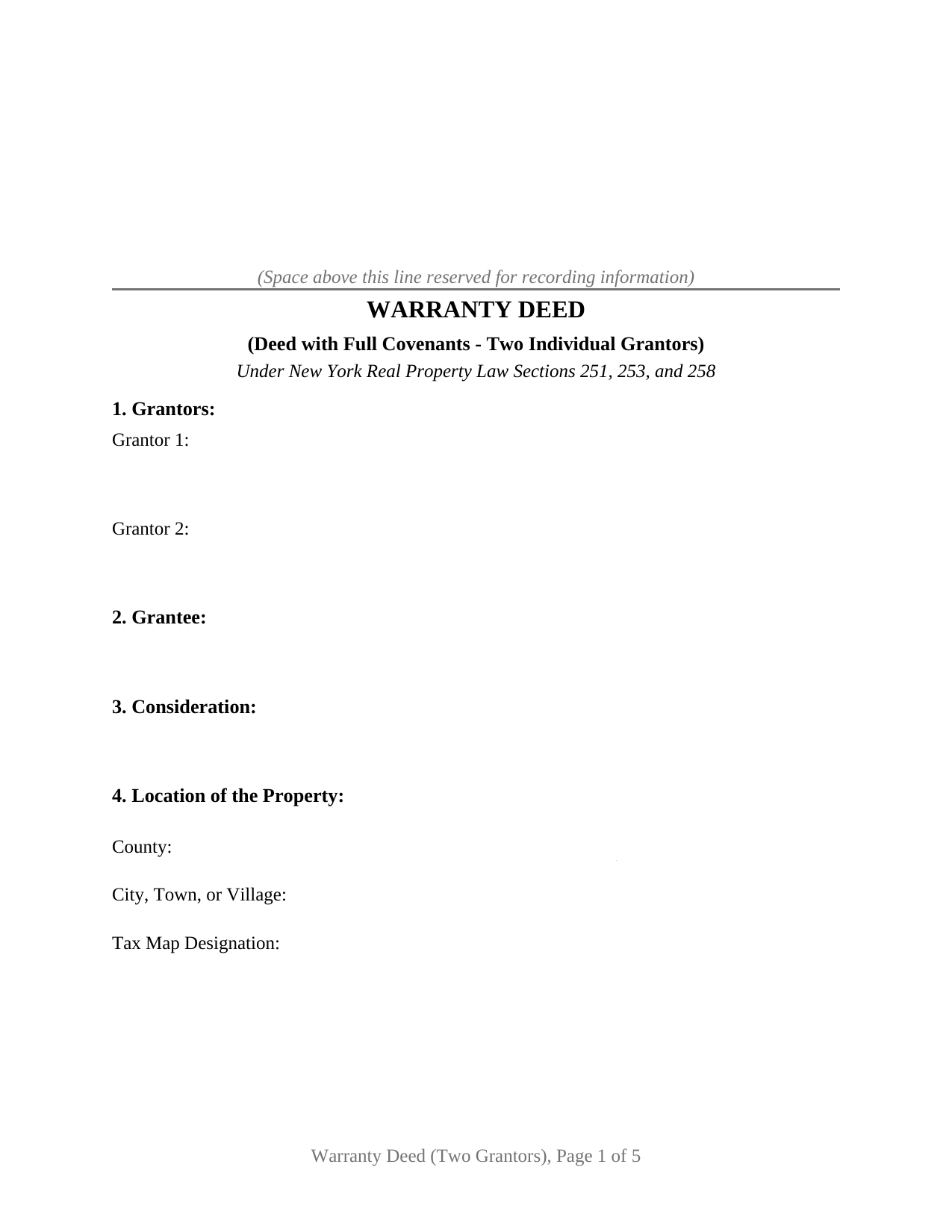
About the New York Warranty Deed (Two Grantors)
How to Use This Form
- Select your county from the list
- Download the county-specific form
- Fill in the required information
- Have the document notarized if required
- Record with your county recorder's office
What Others Like You Are Saying
"The website made it easy to find and print out the documents I needed. The whole process was straigh…"
"Great service. It had all the forms I needed."
"I wish I had found this site earlier!!! Not only was it helpful and just what I needed but I got my …"
"Deed.com has been an amazing resource for my solo practice. Very timely communication and quick resu…"
"I am satisfied with the service. Live in another state and could not go directly to the county offic…"
4.8/5 from 4,827 reviews. Read all
Two owners of record convey New York real property together on this warranty deed, prepared for exactly two individual grantors. Each grantor has a named block in the deed, a signature line of that grantor's own, and an acknowledgment certificate conforming to Real Property Law Section 309-a, so one recorded instrument documents both halves of the title passing at once.
Two grantors, two signatures, two certificates
The deed recites two individual grantors, each conveying that grantor's entire interest in the property, both joining in a single conveyance and a single set of covenants. Two tenants in common selling a shared parcel, two joint tenants ending a co-ownership, siblings passing an inherited property to a buyer, and a married couple conveying a home held as tenants by the entirety all present the two-grantor pattern this deed recites. The form is not set up as a sole-owner conveyance, and entity grantors, fiduciaries, and agents under a power of attorney follow different execution patterns than the two-individual configuration it carries.
The paired acknowledgment certificates are practical architecture. Each grantor's certificate records the appearance that grantor actually makes, so the two owners may acknowledge on different dates, in different counties, or before different notaries, as the completed example illustrates with two signing dates. New York law does not require a separate certificate for each signer; the Section 309-a uniform certificate is worded so that one certificate may cover signers who appear together before the same officer at the same time.
Full covenants from both owners
Real Property Law Section 251 keeps covenants out of a New York deed unless the deed spells them out, and this form spells out the complete statutory set from the Section 258 full covenant form: seizin in fee simple with good right to convey, quiet enjoyment, freedom from incumbrances beyond the exceptions the deed itself lists, further assurance, and a warranty of title that runs to defects arising anywhere in the chain. Because both grantors join in the covenants, the grantee holds those promises against each of the two owners who conveyed. The deed also prints the trust fund covenant of Lien Law Section 13, standard text on New York conveyances, under which the consideration is received in trust to pay the cost of any recent improvement before anything else.
Spouses and the tenancy by the entirety
A married couple selling a home held as tenants by the entirety is where the two-grantor architecture does its clearest work. New York's default vesting for spouses is the tenancy by the entirety, and the Court of Appeals has long held that one spouse acting alone conveys only that spouse's interest and cannot cut off the other spouse's survivorship; a deed signed by both spouses is what passes the entire fee. This form puts both owners of record on the instrument, each in the traditional New York style of name followed by residence that Real Property Law Section 333 contemplates for every party to a conveyance.
One deed, several forms at the counter
The finished deed records in the county where the land lies, with the county clerk or, for the Bronx, Brooklyn, Manhattan, and Queens, through the City Register's ACRIS system. Two state forms ride with it: the TP-584 transfer tax return, due on every conveyance whether taxable or not, and the RP-5217 transfer report printed on legal size paper. The guide covers the state transfer tax and its exemptions, the additional tax on high value residential conveyances, the race that Real Property Law Section 291 sets up between an unrecorded deed and a later purchaser who records first, and the county level quirks a filer meets, from Nassau's first-page tax lot data to Suffolk's own cover page.
The download delivers the two-grantor warranty deed as a fillable PDF, along with a completed example presenting an Onondaga County sale by two co-owners from the grantor blocks through both notary certificates, and a plain language guide covering each numbered section, the grantee vesting menu, and the full recording package; the materials are informational and are not legal advice.
Important: County-Specific Forms
Our warranty deed (two grantors) forms are specifically formatted for each of the 62 counties in New York.
After selecting your county, you'll receive forms that meet all local recording requirements, ensuring your documents will be accepted without delays or rejection fees.