New York Warranty Deed
County Specific Legal Forms Validated as recently as October 2, 2026 by our Forms Development Team
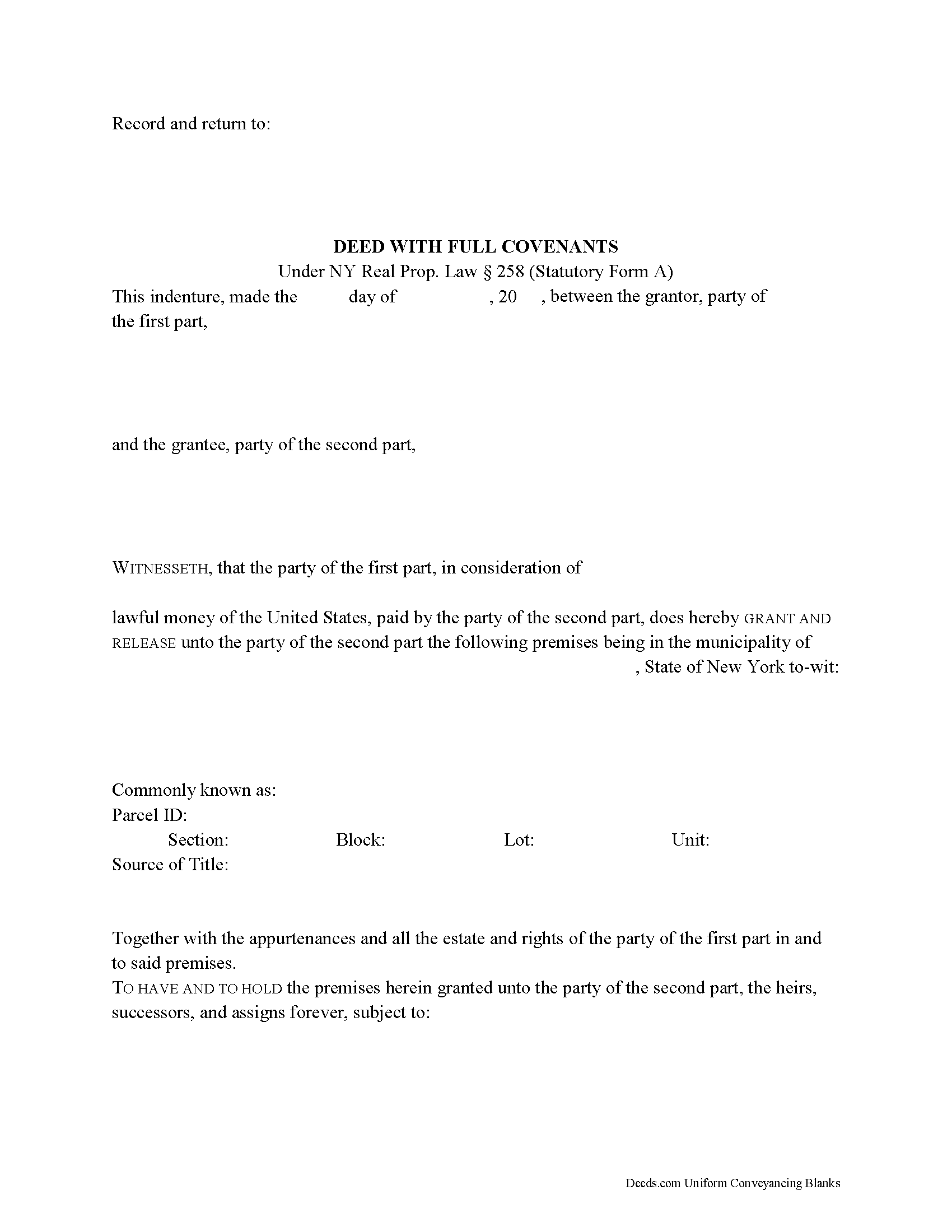
About the New York Warranty Deed
How to Use This Form
- Select your county from the list
- Download the county-specific form
- Fill in the required information
- Have the document notarized if required
- Record with your county recorder's office
What Others Like You Are Saying
"Excellent. Timely. Efficient. Smooth. Thank you!"
"Thanks, the documents were easy to follow and complete."
"The service was easy and fast. Definitely much better than the regular process directly at the Count…"
"good"
"5 STAR, THIS WAS A GREAT EXPERIENCE, FAST VERY RESOURCEFUL TOOL TO PROVIDE FOR MY CLIENTS. Thank you"
4.8/5 from 4,829 reviews. Read all
New York's statutes do not print an instrument called a warranty deed. What they print is Schedule A of Real Property Law Section 258, headed Deed with Full Covenants, and that schedule is the source of everything a New York warranty deed promises. This fillable form prepares that instrument for a conveyance between natural persons, with free-form party blocks that take one or two grantors on the conveying side and one or two grantees on the receiving side.
Covenants are printed, never implied
Real Property Law Section 251 states that a covenant is not implied in a conveyance of real property, whether or not the conveyance contains special covenants. A New York deed promises exactly what appears on its face, and the whole distance between a full covenant and warranty deed and a bargain and sale deed is the paragraph that follows the habendum clause. This form prints the Section 258 covenant list entire: seizin in fee simple with good right to convey, quiet enjoyment, freedom from incumbrances except the matters the deed itself carves out, further assurance, and a perpetual warranty of title. Real Property Law Section 253 then fixes what each phrase means, construing seizin as a promise that the grantor is lawfully seized of a good, absolute and indefeasible estate of inheritance in fee simple.
One or two grantors, one or two grantees
The party blocks carry no preprinted status, capacity, or vesting wording. The grantor block takes the names of one or two individual owners along with whatever words describe how they hold title, and the grantee block takes one or two names along with any co-ownership designation the parties choose, which the guide sets against the New York menu, from tenancy in common to the tenancy by the entirety that Estates, Powers and Trusts Law Section 6-2.2 makes the default between spouses. Two grantor signature blocks follow, each with an acknowledgment certificate in the uniform wording Real Property Law Section 309-a requires a within-state certificate to conform to substantially; where a single grantor conveys, the second block and its certificate stay blank. Paired certificates are what the form carries rather than what New York demands, and they let two grantors appear on separate dates or before separate notaries. The deed is set up for individuals signing in their own names. Entity grantors, trustees and executors, and agents under a recorded power of attorney sign in a representative capacity this configuration does not preprint, and three or more owners on either side exceed the blocks' two-name capacity.
The trust fund covenant that travels with the deed
Lien Law Section 13 adds a covenant that has nothing to do with title. Under subdivision 5, a conveyance recorded after an improvement has begun, and before the Section 10 mechanics lien period has run, loses its validity against liens filed in a corresponding window unless the grantor covenants to receive the consideration as a trust fund and apply it first to that improvement's cost. The form prints the covenant below the title covenants, where New York conveyancing has long put it. The same subdivision relieves the grantee of any duty to see that the money is in fact applied.
Recording, and the returns that go with it
A signed and acknowledged deed goes to the clerk of the county holding the land, or through the City Register's ACRIS system in the Bronx, Brooklyn, Manhattan, and Queens. Real Property Law Section 291 makes recording a question of priority rather than validity: the deed binds grantor and grantee on delivery, while an unrecorded deed loses to a later good faith purchaser from the same seller who reaches the index first. Real Property Law Section 333 accounts for the residence and locality blanks, since a recording officer may not accept a conveyance lacking the parties' addresses or the city, town, and village where the land sits. Tax Law Section 1410 accounts for the rest of the pile: no recording until the transfer tax return is filed and the tax paid, at two dollars per five hundred of consideration, with the RP-5217 transfer report alongside.
The download delivers the New York warranty deed as a fillable PDF, a completed example carrying a Dutchess County conveyance through every blank and both notary certificates, and a plain language guide covering the statutory framework, each numbered section, the ways grantees may hold title, and the recording package. These materials are informational and are not legal advice.
Important: County-Specific Forms
Our warranty deed forms are specifically formatted for each of the 62 counties in New York.
After selecting your county, you'll receive forms that meet all local recording requirements, ensuring your documents will be accepted without delays or rejection fees.