North Carolina Affidavit of Heirship (Certificate of Estate)
County Specific Legal Forms Validated as recently as September 15, 2026 by our Forms Development Team
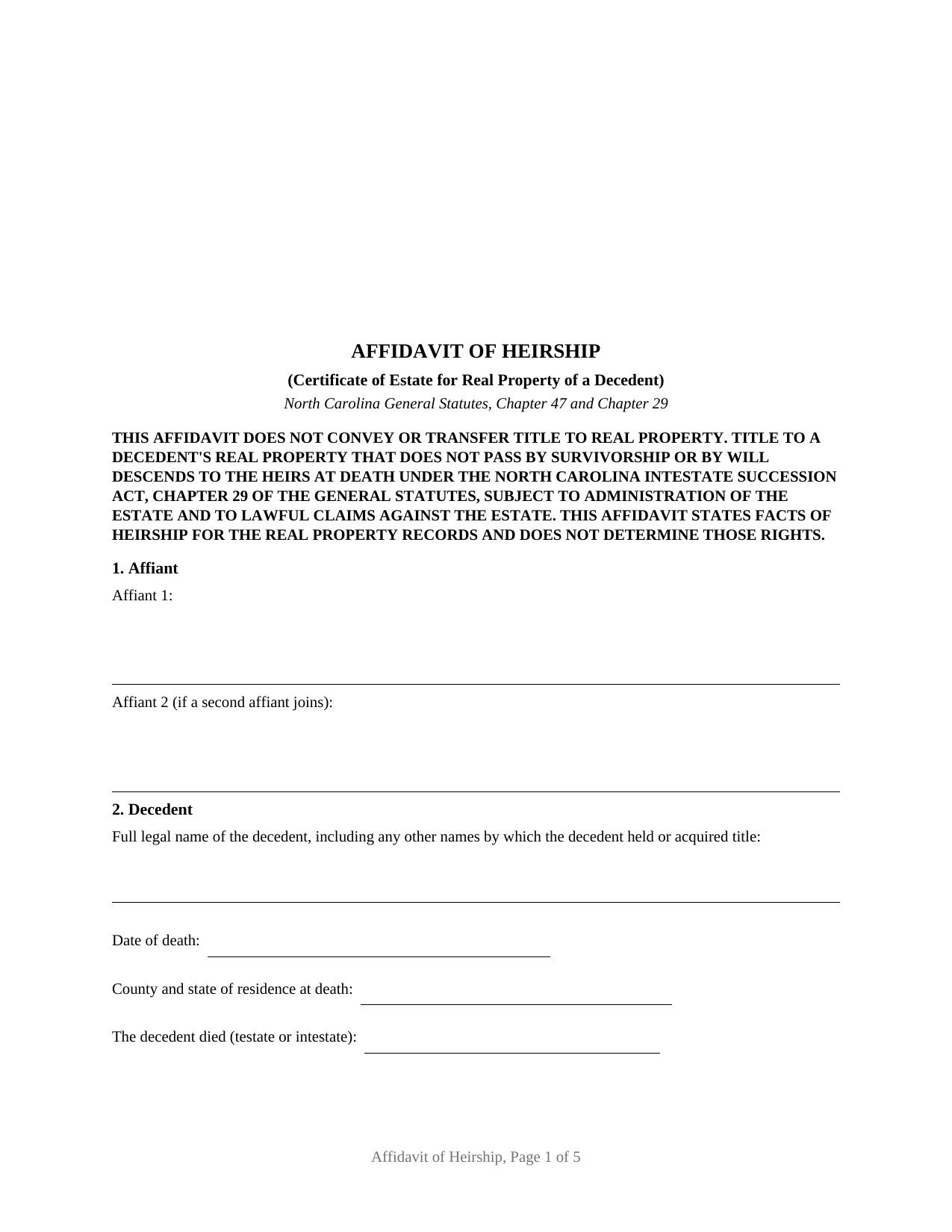
About the North Carolina Affidavit of Heirship (Certificate of Estate)
How to Use This Form
- Select your county from the list
- Download the county-specific form
- Fill in the required information
- Have the document notarized if required
- Record with your county recorder's office
What Others Like You Are Saying
"It worked great- I had a little trouble at first with the site, figuring out where to do what, but t…"
"Since the recorder's office is closed, due to Covid, this worked well to submit my Quit Claim Deed. …"
"The forms download was quick and easy. The example deed was excellent. However, the payment method s…"
"I had an issue due to the fact that I had many beneficiaries. I was and still am not sure how to han…"
"Getting the forms and paying the fee was very simple and easy to follow. Now we"ll see how it g…"
4.8/5 from 4,820 reviews. Read all
When a North Carolina owner dies and real estate passes to the family, the deed in the courthouse still shows the deceased owner's name. An affidavit of heirship, sometimes called a certificate of estate, puts the facts of who inherited into the public record so a later title examiner can follow ownership from the decedent to the heirs. This form prepares that sworn statement for North Carolina real property.
Evidence of Descent, Not a Conveyance
The affidavit does not move title. Under the North Carolina Intestate Succession Act, Chapter 29 of the General Statutes, title to a decedent's real property that does not pass by right of survivorship or by a probated will descends to the heirs at the moment of death, subject to administration of the estate and to lawful claims against it. The affidavit records the facts of that descent; it does not transfer the land and does not replace administration where administration is needed. One or two affiants who knew the decedent's family swear to the decedent's death, marital history, children, and the heirs who take, with the undivided fractional interest of each.
The Statutes Behind the Form
North Carolina supplies no statutory heirship-affidavit form. N.C. Gen. Stat. Section 47-1 lists affidavits concerning land titles or family history among the instruments that may be sworn before a North Carolina notary or other authorized official and recorded. Two citations that circulate in older guidance no longer fit: Section 47-37, which once made a recorded affidavit prima facie evidence, was repealed effective October 1, 2005, and Section 47-11 is a subpoena statute rather than an heirship provision. This form rests on the statutes in force, with the heirs and their shares drawn from Chapter 29 and the recording mechanics from Chapter 47.
How the Shares Are Figured
Section 29-14 sets the surviving spouse's undivided interest in the real property: one-half where the decedent left one child or that child's descendants, one-third where the decedent left two or more children or their descendants, one-half where there are no descendants but a parent survives, and all of the real property where neither survives. The remaining undivided interest passes to the children, descendants, or more distant kin under Sections 29-15 and 29-16. The form's heirs section asks for each heir's name, address, relationship, and fraction, and the completed example works through a spouse and two children, who take one-third each.
Swearing and Recording
Because the statement is made under oath, each affiant signs before a notary, who completes a jurat rather than the acknowledgment used on a deed. North Carolina does not require subscribing witnesses for an affidavit of this kind, but title practice often looks for two affiants who knew the decedent and have no interest in the estate, so the form provides for one or two. The completed affidavit is recorded with the register of deeds in each county where the land lies, commonly with a certified copy of the death certificate, and because it is not a conveyance for consideration the documentary excise tax does not apply.
What Comes in the Package
The package includes the blank affidavit as a fillable PDF, a completed example built on a realistic Wake County fact pattern, and a plain-language guide that walks through every section, explains where each entry comes from, and sets out the statutory framework, the recording standards, and the limits of what a recorded affidavit accomplishes. The materials are informational and are not legal advice.
Important: County-Specific Forms
Our affidavit of heirship (certificate of estate) forms are specifically formatted for each of the 100 counties in North Carolina.
After selecting your county, you'll receive forms that meet all local recording requirements, ensuring your documents will be accepted without delays or rejection fees.