North Carolina Executors Deed
County Specific Legal Forms Validated as recently as September 16, 2026 by our Forms Development Team
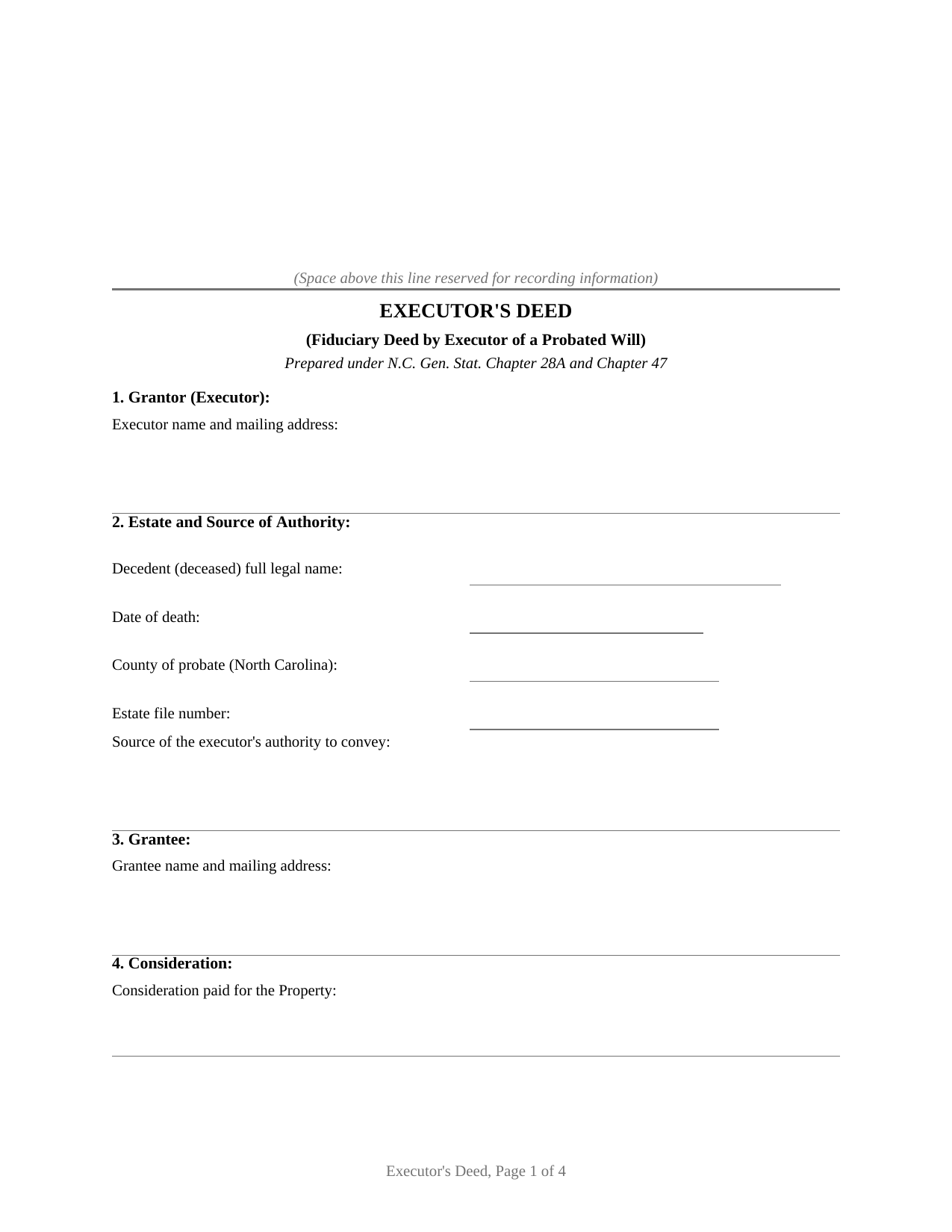
About the North Carolina Executors Deed
How to Use This Form
- Select your county from the list
- Download the county-specific form
- Fill in the required information
- Have the document notarized if required
- Record with your county recorder's office
What Others Like You Are Saying
"I would like the ability to edit the document."
"I found what I needed easily."
"Easy download, and super easy to fill out. Had them recorded Friday with zero issues. Recommended."
"Thank you! I received my forms promptly and they are easy to follow along for filling out. The examp…"
"very good forms. they covered everything i needed."
4.8/5 from 4,819 reviews. Read all
An executor's deed is the instrument a North Carolina executor uses to move real property out of a testate estate and into a buyer's hands. It is a fiduciary deed: the person who signs it does so as executor of the estate, not as an individual owner, and the deed conveys only the interest the estate may lawfully convey. That fiduciary character shapes everything about the document, from the authority it recites to the warranties it withholds.
Authority is the heart of the deed
Unlike a deed from a living owner, an executor's deed has to show where the power to sell came from. North Carolina recognizes two sources. The first is a power of sale written into the will. Under N.C. Gen. Stat. Section 28A-15-1(c), a sale made pursuant to authority given by the will does not require a special proceeding. The second source is an order of the Clerk of Superior Court. When a will supplies no power of sale and the estate needs to sell land to pay debts and claims, Article 17 of Chapter 28A lays out a special proceeding, with the heirs and devisees as necessary parties and the sale conducted under the judicial sale rules of Chapter 1, Article 29A. The deed names whichever source applies.
A fiduciary signs without a general warranty
A personal representative who hands a buyer a general warranty deed risks personal liability for the state of the title. The customary fiduciary deed avoids that result by making no general warranty: the executor conveys what the estate can convey and promises only that the executor has not encumbered the property. N.C. Gen. Stat. Section 28A-17-9 reflects the same principle from a related angle, providing that warranties a personal representative gives to complete a decedent's contract bind the estate and not the representative personally. This form carries that posture in its conveyance language and in a capitalized warning that the grantee takes subject to all matters affecting title.
Capacity in the granting clause
North Carolina makes the granting clause the place to fix the executor's capacity. N.C. Gen. Stat. Section 47-108.17 provides that when the granting clause sets forth the grantor's official capacity, the conveyance is not undone by a failure to repeat that capacity after the signature or in the acknowledgment, as long as the instrument is otherwise properly executed. The deed states the executor capacity in the conveyance section and again at the signature, and the acknowledgment by-line records the executor's name and representative capacity.
Recording in the county registry
The completed deed is recorded with the register of deeds in the county where the property sits, the office whose order of registration under N.C. Gen. Stat. Section 47-18 fixes priority against later purchasers and lien creditors. A sale of estate land for value is a conveyance for consideration, so the documentary excise tax under Sections 105-228.30 and 105-228.32 is calculated on the price and collected before recording. The deed also names its drafter on the first page and states each party's mailing address.
This package includes the fillable deed, a completed example built on a realistic Wake County fact pattern, and a section by section guide to the statutes behind each blank. The materials are informational and are not legal advice.
Important: County-Specific Forms
Our executors deed forms are specifically formatted for each of the 100 counties in North Carolina.
After selecting your county, you'll receive forms that meet all local recording requirements, ensuring your documents will be accepted without delays or rejection fees.