North Carolina General Warranty Deed (Two Grantors)
County Specific Legal Forms Validated as recently as August 13, 2026 by our Forms Development Team
About the North Carolina General Warranty Deed (Two Grantors)
How to Use This Form
- Select your county from the list
- Download the county-specific form
- Fill in the required information
- Have the document notarized if required
- Record with your county recorder's office
What Others Like You Are Saying
"We were able to find deceased parents' deed."
"Very helpful and efficient!"
"Awesome product. Quick and easy. Thanks"
"Got me all the info I was looking for Thanks you deeds.com"
"Easy to understand and download!"
4.8/5 from 4,828 reviews. Read all
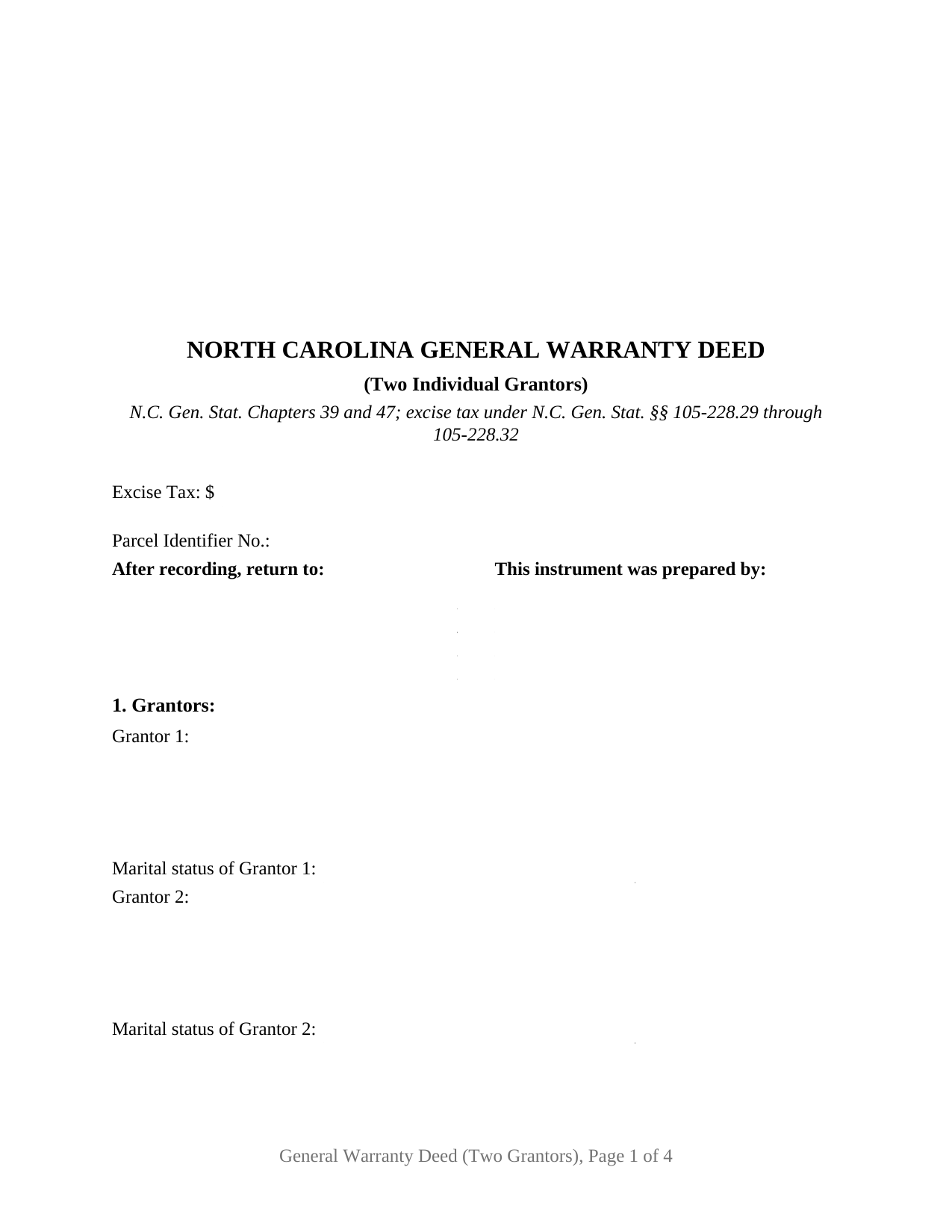
Two record owners conveying North Carolina real property together present a distinct instrument: a general warranty deed with two grantor entries, a marital status line for each, two signature lines, and a notary acknowledgment certificate for each signer. This form recites exactly two individual grantors passing fee simple title with full warranty covenants, and it is prepared for the register of deeds of the county where the land lies.
Both undivided interests in one conveyance
North Carolina makes tenancy in common the default whenever a deed leaves land in co-ownership, under Chapter 41, Article 7 of the General Statutes, and it lets each tenant in common deal with that cotenant's own share alone: under N.C. Gen. Stat. 41-90, a deed signed by one cotenant passes only that cotenant's undivided interest, even where the instrument purports to convey the whole tract. A grantee taking the entire property therefore looks for every record owner on the signature page, and this deed collects both. Co-heirs who inherited undivided interests in the family land, two investors closing out a joint purchase, and former spouses whose absolute divorce converted an entireties title to a tenancy in common under N.C. Gen. Stat. 41-63 are the ownership patterns the two-grantor record presents.
Married grantors and the written joinder rule
When the two grantors are spouses holding as tenants by the entirety, the second signature is not just good title practice; it is the statute. A conveyance to two people who are married to each other vests tenancy by the entirety by default under N.C. Gen. Stat. 41-56, and N.C. Gen. Stat. 41-58 bars either spouse from conveying, leasing, mortgaging, or encumbering entireties property without the written joinder of the other. A deed built around two grantor signatures carries that joinder on its face. The marital status entries in the grantor section state each grantor's status in the record, and the guide walks through the related rule for a grantor whose spouse is not in title, the elective life estate waiver of N.C. Gen. Stat. 39-7, with its purchase-money, interspousal, and separation-agreement exceptions.
Two signatures, two certificates
The signature section carries a labeled signature line, printed name, and date entry for each grantor, followed by an acknowledgment certificate for each, so the two grantors are free to sign on different days, before different notaries, in different counties or states; the completed example shows one grantor acknowledging in Mecklenburg County and the other in Wake County a day later. The per-signer certificates are the form's architecture rather than a statutory command, and both grantors join in the same express covenants: seizin in fee simple, the right to convey, marketable title free of encumbrances other than those the deed lists in its exceptions section, and the covenant to warrant and defend against the lawful claims of all persons. The exceptions entry bounds those covenants for both signers at once.
Excise tax and the order of registration
The deed's first page carries the excise tax entry, computed at one dollar per five hundred dollars of the consideration and collected by the register of deeds when the deed is presented, with gifts and other listed transfers exempt under N.C. Gen. Stat. 105-228.29. Registration order then does the protective work: N.C. Gen. Stat. 47-18 makes the conveyance good against lien creditors and purchasers for value only from registration in the county where the land lies, and under N.C. Gen. Stat. 47-14(d) registration operates as to each grantor whose execution has been duly acknowledged, one more reason complete certificates for both signers matter on a two-grantor instrument.
The download delivers this two-grantor warranty deed as a blank fillable PDF, a completed example filled in for a realistic Mecklenburg County sale by two co-owners, and a guide covering each section, the co-owner and spousal signing rules, the excise tax, and county recording. The materials are informational and are not legal advice; a North Carolina attorney can apply these statutes to a particular title or closing.
Important: County-Specific Forms
Our general warranty deed (two grantors) forms are specifically formatted for each of the 100 counties in North Carolina.
After selecting your county, you'll receive forms that meet all local recording requirements, ensuring your documents will be accepted without delays or rejection fees.