North Carolina Warranty Deed
County Specific Legal Forms Validated as recently as October 13, 2026 by our Forms Development Team
About the North Carolina Warranty Deed
How to Use This Form
- Select your county from the list
- Download the county-specific form
- Fill in the required information
- Have the document notarized if required
- Record with your county recorder's office
What Others Like You Are Saying
"Easy to download. Hopefully easy to fill in. Just wish there was wording for a Beneficiary Deed for …"
"You guys have it DOWN!! You made it easy to navigate your site and services. You explained things ef…"
"Perfect"
"It took me a while to locate my documents. Check out was a breeze."
"Thank you for the information you sent."
4.8/5 from 4,825 reviews. Read all
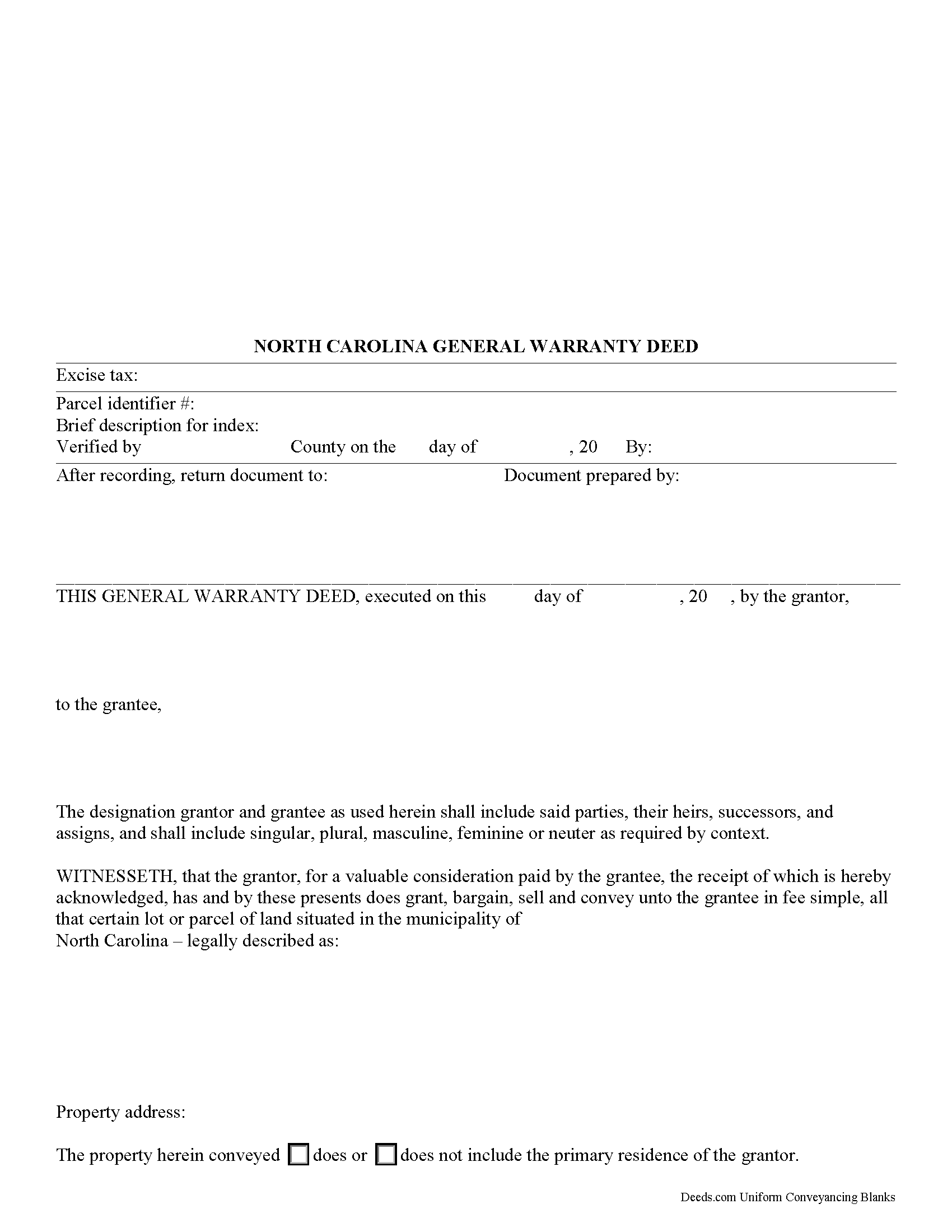
North Carolina rewrote its co-ownership statutes in 2024, and the consequence lands in a single line of every deed: the words following the grantee names decide whether the estate carries survivorship or passes through a deceased owner's estate. This warranty deed leaves that line open rather than preprinting a form of ownership, and it carries the express covenant text North Carolina requires, because the General Statutes supply no short form and no statute implying covenants from granting words.
What the grantee line decides
Chapter 41, Article 7, enacted by Session Law 2024-47, makes tenancy in common the result whenever a conveyance leaves North Carolina land in co-ownership and nothing more is said. Survivorship has to be asked for: Article 6 lists the phrases that create a joint tenancy with right of survivorship, among them joint tenants with right of survivorship, and it measures survival by the 120 hour rule of N.C. Gen. Stat. 41-74. Marriage runs the other way, since N.C. Gen. Stat. 41-56 vests a tenancy by the entirety in two grantees then married to each other unless a contrary intention appears. One trap sits inside the machinery: N.C. Gen. Stat. 41-75 places executors, trustees, partnerships, business entities, and life estates outside Article 6, so the survivorship phrases work between natural persons taking in their own right. The guide sets out each recognized form, the words that produce it, and the default when the line says nothing.
Covenants that have to be written out
With no statutory deed form to fall back on, the deed's strength is the covenant language printed in it. It conveys in fee simple and states the four classic covenants: seizin in fee simple, the right to convey, marketable title free and clear of encumbrances other than those the deed lists, and a promise to warrant and defend the title against the lawful claims of all persons whomsoever. A separate exceptions section bounds every one of them, and current year ad valorem taxes, recorded restrictions, and easements of record are the usual entries. N.C. Gen. Stat. 39-1 presumes a fee simple unless the instrument plainly shows a smaller estate.
One or two names on either side
The form is built for natural persons signing in their own right, in any of four counts: one grantor to one grantee, one grantor to two grantees, two grantors to one grantee, and two grantors to two grantees. Party blocks are free-form, carrying no preprinted status, capacity, or vesting language, so the marital status entry beside each grantor name and any survivorship words beside the grantee names come from the person completing the deed. Two signature blocks, headed GRANTOR and SECOND GRANTOR, each carry an acknowledgment certificate, so signers may appear before different notaries on different days, and the second block and its certificate stay blank when one grantor conveys. A parent conveying to two adult children who take with survivorship, and a pair of owners conveying to one buyer, are ownership patterns these counts take in. What the form is not set up as is equally plain: an entity grantor executing under its organic law, a trustee conveying under N.C. Gen. Stat. 39-6.7, an attorney-in-fact whose power of attorney N.C. Gen. Stat. 47-28 requires to be registered first, or three or more owners on either side.
Recorded, not rejected
North Carolina answers a format fault with a price rather than a refusal. N.C. Gen. Stat. 161-14(b) sets the standards, and a document that misses them still goes on record, with the twenty five dollar nonstandard document fee of N.C. Gen. Stat. 161-10(a)(18a) added to the twenty six dollar base charge for the first fifteen pages. The real gatekeepers sit elsewhere: a register may not accept a deed unless its first page names the drafter, N.C. Gen. Stat. 47-17.1, or unless a completed officer certificate appears, N.C. Gen. Stat. 47-14. Excise tax of one dollar for each five hundred dollars of consideration is collected before recording. This form builds in the three inch recording band, the drafter entry, the excise tax and parcel identifier lines, and the mailing addresses and primary residence statement of N.C. Gen. Stat. 105-317.2.
The download delivers the blank fillable deed, a completed example filled in for a Wake County sale, and a guide covering each numbered section, the vesting words, the signing rules, the excise tax, and county recording. The materials are informational and are not legal advice; a North Carolina attorney can apply these statutes to a particular title or closing.
Important: County-Specific Forms
Our warranty deed forms are specifically formatted for each of the 100 counties in North Carolina.
After selecting your county, you'll receive forms that meet all local recording requirements, ensuring your documents will be accepted without delays or rejection fees.